How Much Free Camping Does Each State Actually Have?
We built a State Outdoor Index a few weeks back — a broad look at affordability, public land, and outdoor opportunity across all 50 states. This is the natural follow-up, and honestly, it might be the better story.
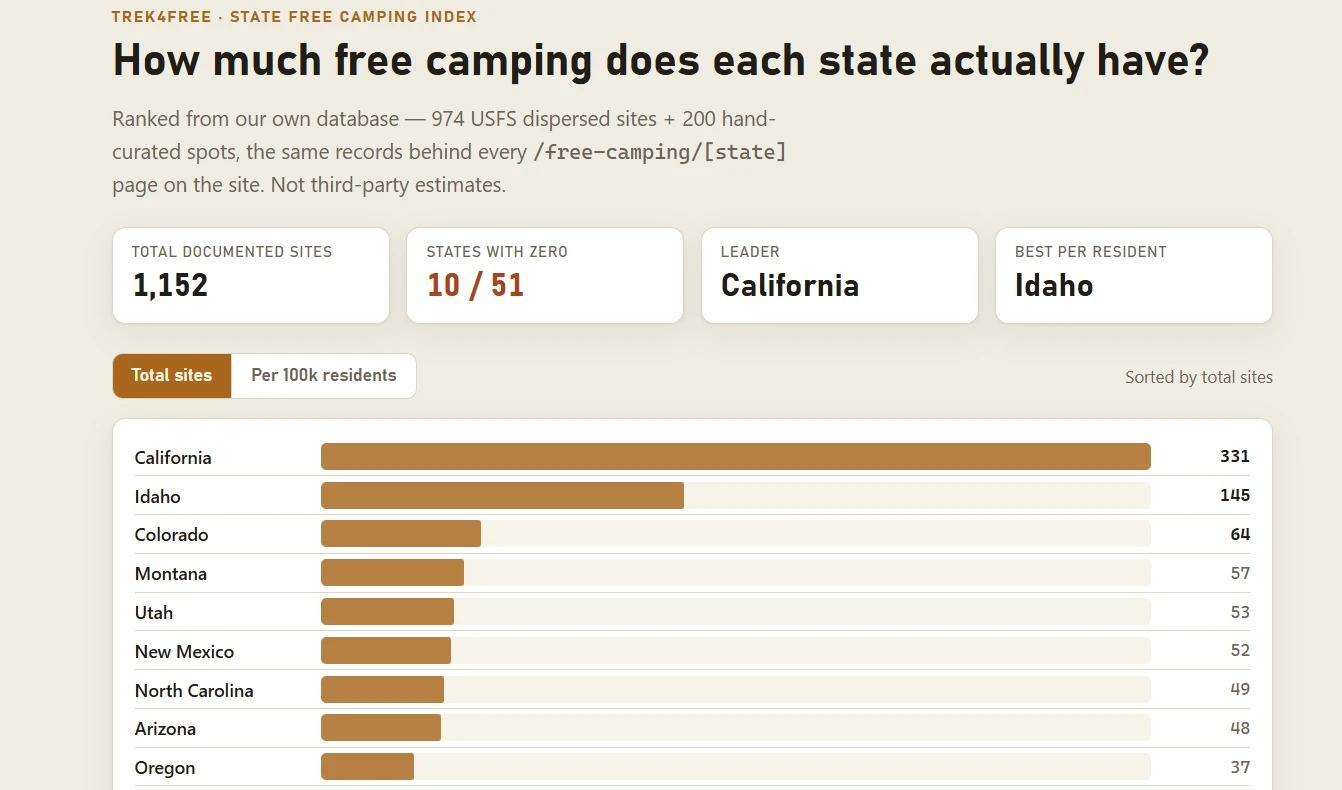
Instead of a composite index, this one’s a single, simple question: how much free camping does each state actually have, according to our own database? No estimates, no vibes. Just 1,152 documented sites — 974 from the U.S. Forest Service and 200 we’ve curated ourselves — counted state by state and ranked.
The Two Headlines, and Why They Disagree
California has the most free camping in the country, by a landslide: 331 documented sites. That’s nearly five times the next closest state.
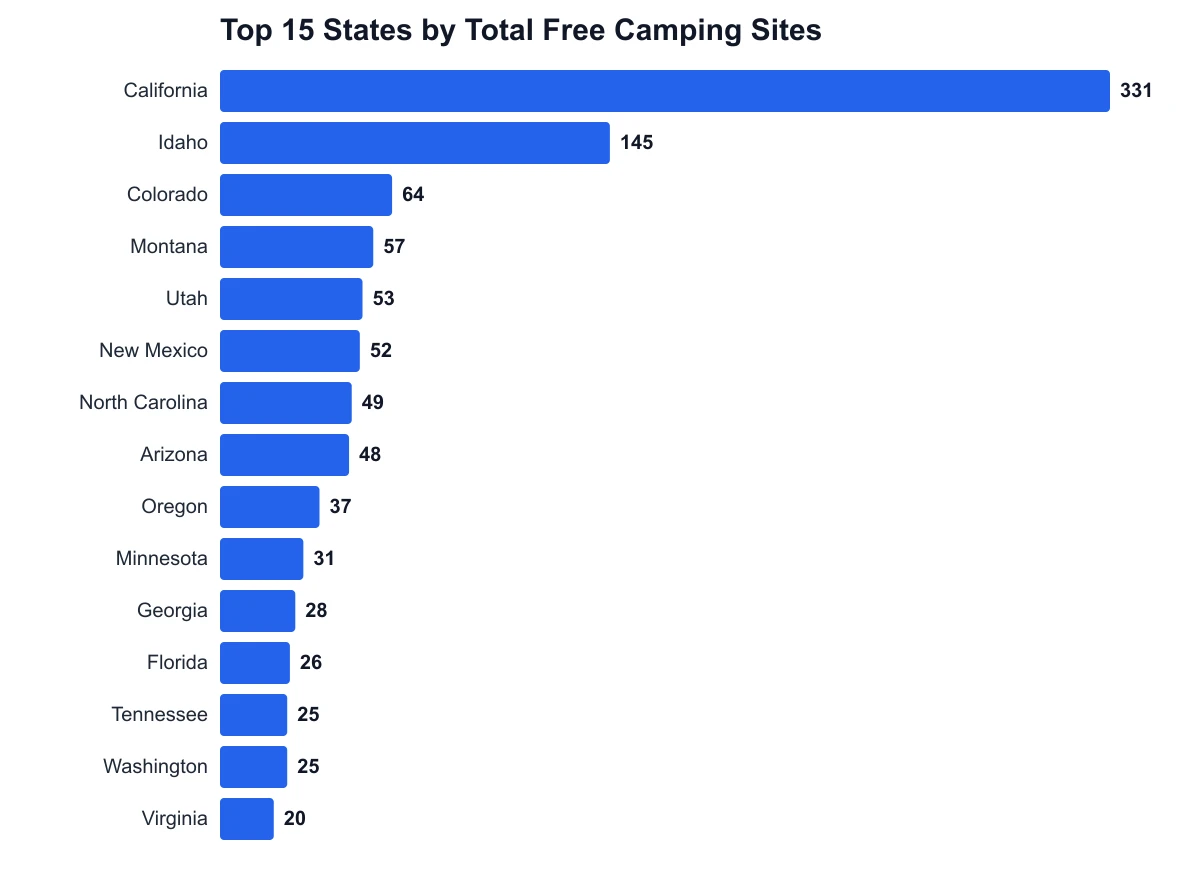
But if you actually live there, Idaho wins — by a lot. Idaho has 145 sites against a population of just over 2 million, which works out to 7.04 free campsites per 100,000 residents. California’s 331 sites, spread across nearly 40 million people, comes out to just 0.84 per 100,000.
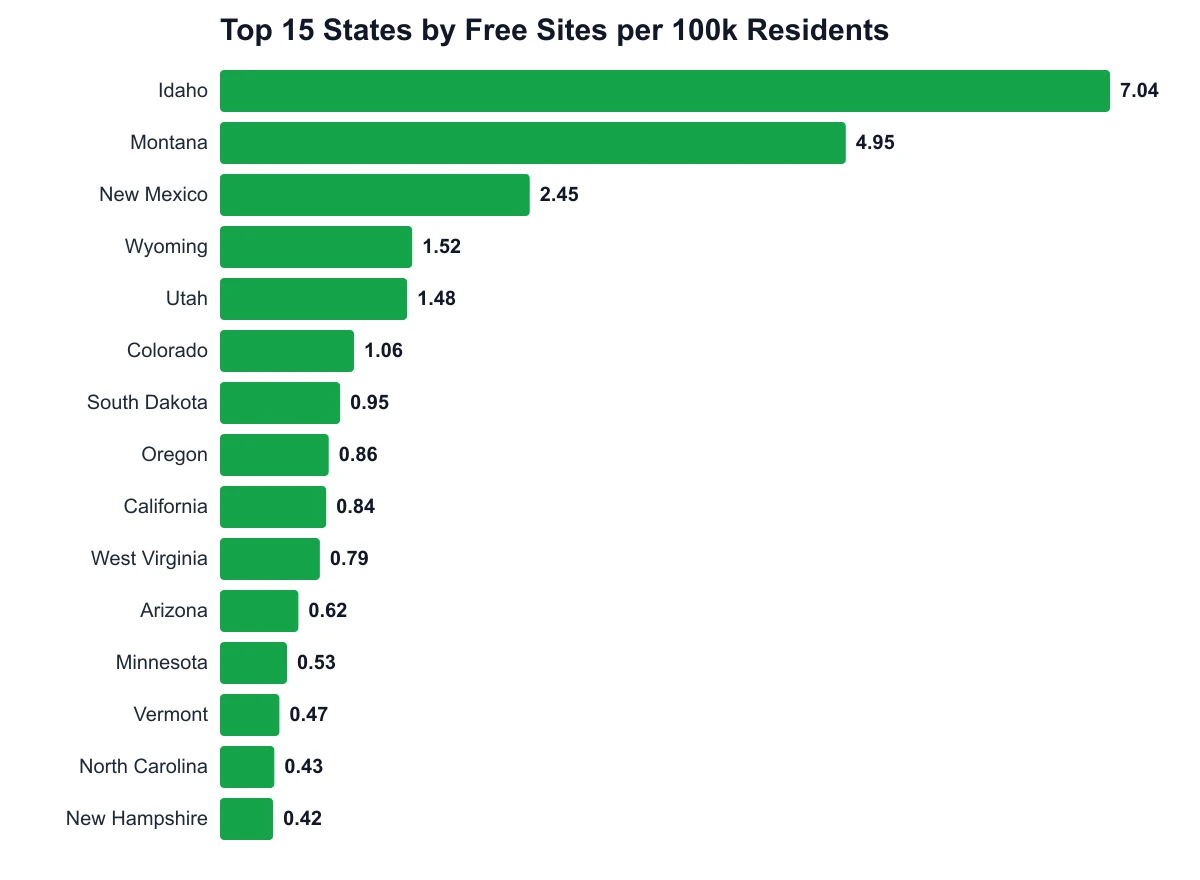
Same data, two completely different rankings, and an 8-to-1 swing depending on which one you ask. California has more free camping in absolute terms than anywhere else in the country. Idaho has more free camping relative to the number of people who’d actually be competing for it. Neither number is wrong. They’re just answering different questions — which is exactly the lesson our last data piece kept running into as well.
The Finding Worth Leading With: Ten States Have Zero
Ten states have no documented free camping in our database at all: Connecticut, Hawaii, Iowa, Maryland, Massachusetts, Nebraska, New Jersey, North Dakota, Ohio, and Rhode Island.
We checked this at the source file level before trusting it — not a lookup bug, not a state-derivation error. Zero records, confirmed directly in both underlying datasets.
Then we checked it against the federal-land percentages from our State Outdoor Index. Nine of those ten states have under 4% federal or public land. Free dispersed camping happens almost entirely on federal land — national forest, BLM — so a state that structurally doesn’t have much of that land simply can’t have much of this kind of camping. That’s not a coincidence and it’s not a gap in our data. It’s a real, causal explanation, and it’s a direct callback to a finding we’d already published.
Hawaii is the one exception worth a caveat, not a flat statement. It has 20.2% federal/public land — far more than the other nine zero-states — but that land is overwhelmingly military and protected conservation area, not the kind of national-forest acreage where dispersed camping typically happens. Hawaii’s zero could be a true reflection of that difference, or it could be a genuine gap in what we’ve catalogued there. We don’t know which yet, so we’re not asserting it either way.
The Number We Don’t Fully Trust: Nevada
Nevada is the mirror image of the Hawaii problem, and we want to flag it before anyone else does.
Nevada has the highest federal/public land share of any state in the country — 80.1% — and yet only 10 documented free camping sites, tied for one of the lowest counts in our entire database.
We don’t think that’s real. Nevada’s public land is overwhelmingly BLM desert, and both of our underlying source files lean toward U.S. Forest Service–cataloged sites specifically. That’s very likely a genuine hole in what we’ve documented so far, not an accurate picture of what’s actually out there. We’d rather tell you that directly than let “Nevada: only 10 spots” stand as a fact we’re not confident in.
The Full Ranking
Forty states have at least one documented site and a live page on our map. The other ten (listed above) don’t have enough data yet to generate one.
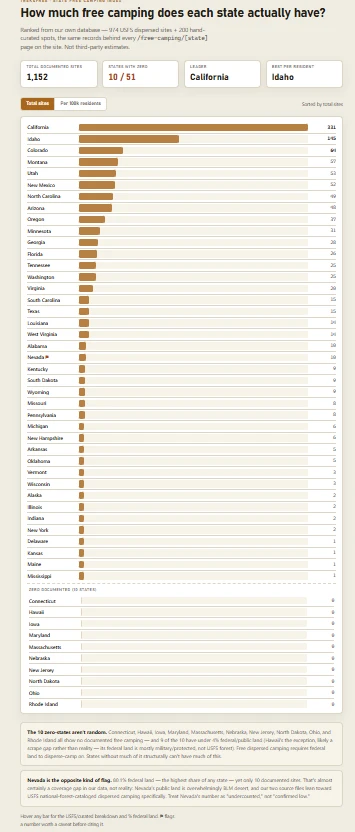
Here’s every state that does, linked straight to its full list:
| Rank | State | Total Sites | USFS | Curated | Per 100k Residents |
|---|---|---|---|---|---|
| 1 | California | 331 | 298 | 33 | 0.84 |
| 2 | Idaho | 145 | 141 | 4 | 7.04 |
| 3 | Colorado | 64 | 39 | 25 | 1.06 |
| 4 | Montana | 57 | 53 | 4 | 4.95 |
| 5 | Utah | 53 | 36 | 17 | 1.48 |
| 6 | New Mexico | 52 | 34 | 18 | 2.45 |
| 7 | North Carolina | 49 | 38 | 11 | 0.43 |
| 8 | Arizona | 48 | 32 | 16 | 0.62 |
| 9 | Oregon | 37 | 28 | 9 | 0.86 |
| 10 | Minnesota | 31 | 26 | 5 | 0.53 |
| 11 | Georgia | 28 | 27 | 1 | 0.25 |
| 12 | Florida | 26 | 23 | 3 | 0.11 |
| 13 | Tennessee | 25 | 23 | 2 | 0.34 |
| 14 | Washington | 25 | 19 | 6 | 0.31 |
| 15 | Virginia | 20 | 20 | 0 | 0.22 |
| 16 | South Carolina | 15 | 11 | 4 | 0.27 |
| 16 | Texas | 15 | 2 | 13 | 0.05 |
| 18 | Louisiana | 14 | 13 | 1 | 0.30 |
| 18 | West Virginia | 14 | 12 | 2 | 0.79 |
| 20 | Alabama | 10 | 10 | 0 | 0.19 |
| 20 | Nevada | 10 | 10 | 0 | 0.30 |
| 22 | Kentucky | 9 | 9 | 0 | 0.19 |
| 22 | South Dakota | 9 | 1 | 8 | 0.95 |
| 22 | Wyoming | 9 | 8 | 1 | 1.52 |
| 25 | Missouri | 8 | 4 | 4 | 0.13 |
| 25 | Pennsylvania | 8 | 8 | 0 | 0.06 |
| 27 | Michigan | 6 | 5 | 1 | 0.06 |
| 27 | New Hampshire | 6 | 5 | 1 | 0.42 |
| 29 | Arkansas | 5 | 3 | 2 | 0.16 |
| 29 | Oklahoma | 5 | 4 | 1 | 0.12 |
| 31 | Vermont | 3 | 3 | 0 | 0.47 |
| 31 | Wisconsin | 3 | 1 | 2 | 0.05 |
| 33 | Alaska | 2 | 1 | 1 | 0.27 |
| 33 | Illinois | 2 | 2 | 0 | 0.02 |
| 33 | Indiana | 2 | 1 | 1 | 0.03 |
| 33 | New York | 2 | 0 | 2 | 0.01 |
| 37 | Delaware | 1 | 0 | 1 | 0.09 |
| 37 | Kansas | 1 | 0 | 1 | 0.03 |
| 37 | Maine | 1 | 0 | 1 | 0.07 |
| 37 | Mississippi | 1 | 1 | 0 | 0.03 |
That’s every state with at least one documented free campsite, and the “USFS” and “curated” columns break down where each state’s count actually comes from — worth a glance if a state’s number looks surprisingly low or high. Texas and South Dakota, for example, both lean heavily on curated finds rather than Forest Service listings, which is a different kind of gap than Nevada’s.
What This Actually Means If You’re Planning a Trip
Raw count tells you where the biggest selection is. Per-capita tells you where you’re least likely to be fighting for a spot. Neither one tells you the whole story on its own — same lesson as the outdoor index, applied to one specific, very practical question.
If you’re chasing sheer variety, California and Idaho both deliver, just at completely different scales. If you’re chasing a place where free camping doesn’t feel picked-over, Idaho, Montana, and Wyoming’s per-capita numbers are hard to beat. And if you live in one of the ten zero states, that’s not a data failure on our part — it’s a real reflection of how little federal land your state has to disperse-camp on in the first place.
This is a companion piece to Every Place Looks Like Paradise Until You Check the Price, our broader State Outdoor Index. Every state above links to its full, current list of free campsites on the Trek4Free map — no login, no booking fee, updated as we find more.