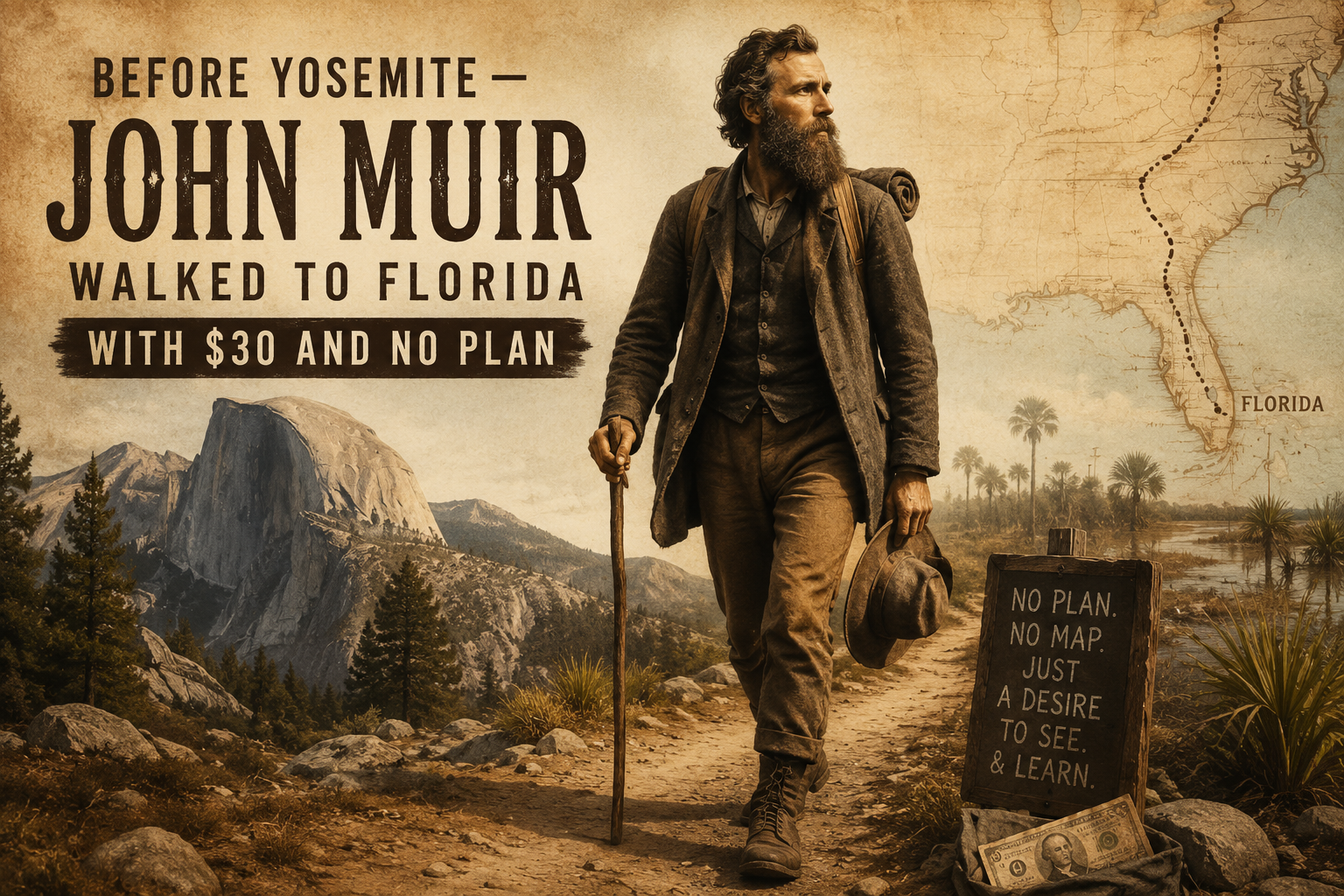
Before Yosemite — John Muir Walked to Florida With $30 and No Plan
Cedar Key, Florida. 1867.
He was on the floor of a stranger’s house, delirious. His skin had gone yellow. The fever came in waves — chills so hard his teeth knocked together, then heat so intense he could not remember his own name. He had been walking for three months. He had started in Indiana with thirty dollars and a journal. Now the money was gone, the journal was full, and he was not sure he was going to live.
A woman he had never met brought him a cup of tea made from tree bark.
He drank it. Then he drank it again the next day, and the day after that.
He lived.
That bark was cinchona — the same plant that would be synthesized into quinine, the same antimalarial compound that pharmaceutical companies would eventually sell for a thousand dollars a bottle. The Cherokee had known about it for centuries. The family that saved John Muir knew about it from living in a place where you either knew things like that or you died. Muir did not know either of them at the time. He just drank what they gave him and got better.
He was thirty years old. He had not yet seen Yosemite. He had not yet started a single national park. He had not yet become the father of American conservation.
He was just a young man who was not dead yet, lying on a stranger’s floor in a Florida swamp, deciding what to do next.
The Accident
He had not planned to walk to Florida. He had planned to work in a factory in Indianapolis for the rest of his life. He was good at it — machines, efficiency, design. He could look at a mechanism and understand it the way some people understand music. The factory paid steadily. The work was predictable.
Then a tool slipped and the point of it went into his right eye.
He lost the sight in that eye almost immediately. Then, in the days that followed, the sympathetic nervous system did what it sometimes does — the left eye went dark too. He lay in a darkened room for weeks not knowing if he would ever see again.
The sight came back. Slowly, then all at once.
When it did, John Muir walked out of the factory and did not go back. He had been given something back and he was not going to spend it indoors.
He bought a journal. He wrote on the cover: John Muir, Earth-Planet, Universe.
Then he started walking.
Indianapolis to Cedar Key
September 1, 1867. He set out from Indianapolis heading south. His plan, such as it was: walk to the Gulf of Mexico, find a boat, sail to South America, walk the Amazon. He was carrying a small plant press, the journal, and thirty dollars. He had no map that mattered. He had no contacts along the way. He had no credit and no account from which to wire himself funds — that would take days at a telegraph office and he would have to wait, sometimes in places he had not chosen and did not know.
He walked through Indiana and into Kentucky. Through Tennessee and into Georgia. The South was three years out of the Civil War and it showed — burned towns, suspicious strangers, roads that went nowhere, men with nothing left who might take what little he had. He moved through it all on foot, eating what he could find or buy cheap, sleeping in barns when farmers would let him and in the open when they wouldn’t.
In Savannah, the wired money had not arrived. He waited at the telegraph office. Then he waited again. He had almost nothing left to eat. He could not afford a room. He walked into Bonaventure Cemetery — a place of ancient oaks and Spanish moss on the edge of the marsh — and made his camp there among the graves. He slept in the cemetery for several days, eating crackers, waiting for the money to come.
It came. He moved south.
How did he eat? How did he survive? Where did he sleep? He figured it out one day at a time, the way you have to when there is no other option. He was not comfortable. He was not safe. He was also, by every account in his journal, exactly where he wanted to be.
Cedar Key
He reached the Gulf of Mexico at Cedar Key in late October 1867. He had walked approximately one thousand miles.
Cedar Key was a small fishing and lumber settlement on the Gulf — pilings in dark water, the smell of salt and sawmill pine, pelicans on the posts. He found work at a lumber mill. He was planning to wait for a boat south.
The malaria found him first.
He went down hard. High fever, chills, delirium — the whole progression. He made it to the home of a family named Hodgson, who took him in without knowing him and cared for him when he could not care for himself. The cinchona bark tea brought the fever down. He was sick for weeks. He came very close to dying in a Florida swamp, unknown, a thousand miles from anywhere he had ever lived, with nothing but a plant press and a journal to show for it.
He recovered. The Hodgsons fed him. He wrote about them with deep gratitude for the rest of his life.
Cedar Key is still there. It is a small island community on the Gulf Coast of Florida, accessible by road, quiet and real in the way that coastal towns are before the developers arrive. The manatees gather in the warm springs nearby — Crystal River is sixty miles north, one of the only places on earth where you can swim with them legally in the wild. Muir would have seen manatees in these waters. He wrote about the wildlife of Cedar Key with the same precise attention he brought to everything.
If you follow his path — if you drive the route he walked, if you stop at Cedar Key and put your feet in the Gulf — you are standing on the same ground where John Muir decided to keep living and figure out what came next.
West
He had planned to go to South America. The malaria had taken too much out of him for a jungle expedition. He booked passage instead to California.
The ship rounded Cape Horn. He arrived in San Francisco in the spring of 1868. He asked someone on the dock the fastest way out of the city. The man pointed east toward the mountains.
He walked to Yosemite Valley. It took him about a week.
He arrived and stood at the rim and looked down and later wrote that he could not find words for what he felt standing there. He was not a man who often ran out of words. The Valley ran about seven miles long and a mile wide, with granite walls rising three thousand feet on both sides and waterfalls coming off the rim like something from a dream.
He found a job at a sawmill in the valley run by a man named Hutchings. The cabin he lived in had a stream running through the floor — he had built it that way on purpose, to hear the water while he slept. He worked the mill during the day and spent every other hour walking, climbing, observing. He filled journals. He sent letters to botanists in the east. He measured the moraines and mapped the glaciers. He was not employed as a scientist. He had no degree in any of this. He just paid attention with total concentration for years and eventually knew more about the geology of Yosemite than anyone alive.
The Waterfall
There is one moment that stays with me from everything Muir wrote.
He was standing at the edge of Yosemite Falls — the tallest waterfall in North America, dropping 2,425 feet in three tiers off the valley rim. He was standing close enough to feel the mist. The sound at that proximity is not a sound so much as a pressure — you feel it in your chest before you hear it with your ears.
He became so absorbed in what he was seeing that he lost track of where he was standing. He came within a step or two of the edge. He caught himself only when the rock he was leaning on shifted.
He had walked a thousand miles through the post-Civil War South. He had survived malaria in a Florida swamp. He had rounded Cape Horn and crossed California on foot. And he almost ended everything standing at the rim of a waterfall because it was too beautiful to look away from.
I understand that completely. I have stood in places that did that to me. Places that pulled me so far inside themselves that the practical world — the footing, the time, the distance back to the car — went quiet. That is not carelessness. That is what beauty does when it is real.
What He Built
Muir eventually left the sawmill and began writing. His articles in national magazines described Yosemite and the Sierra Nevada to an audience that had never imagined them. He wrote not as a scientist but as a man who had been moved, which is a different and more powerful thing.
In 1889 he camped in the high country above Yosemite Valley with Robert Underwood Johnson, editor of The Century magazine. They looked at the damage being done by sheep grazing in the meadows — Muir called them “hooved locusts.” He told Johnson that federal protection was the only answer. Johnson agreed to run the campaign in the magazine if Muir would write the articles.
Yosemite National Park was created by act of Congress in 1890.
Muir went on to found the Sierra Club. He took President Theodore Roosevelt camping in Yosemite in 1903 — the two men slept under the stars at Glacier Point while the President’s formal party waited in the hotel below. After that trip Roosevelt expanded federal protection of wild lands dramatically.
All of it traces back to a thousand-mile walk. To thirty dollars and a journal. To a factory accident and a darkened room and the decision, when the light came back, to go outside and not come back.
The Redwoods
No account of Muir’s California is complete without the coastal redwoods.
You have to see them in person. I have, and I will tell you honestly that nothing prepares you for the scale. These are trees that were old when Washington was surveying the Shenandoah. Some of them were standing before the Roman Empire fell. The bark is soft — you can press your hand into it — and the color is a deep brick-red that does not look like the color of something alive. The canopy is so high above you that the light comes down filtered and strange, the way light comes into a cathedral.
Standing among them I had the feeling that these trees were built for a different world — a world whose scale was larger than ours, whose time moved differently. I thought about the fact that they survived. Loggers took most of them. What remains is what was saved, barely, at the last possible moment. That they are still there to see — that someone stopped the cutting in time — felt like a gift I had done nothing to deserve.
Muir fought for them. The groves that exist today exist in part because he stood in them and wrote about what he felt and people read it and decided the trees mattered.
Go There
Cedar Key, Florida — Gulf Coast island, about 50 miles southwest of Gainesville. Small, real, quiet. The same waterfront Muir reached in October 1867. Free to visit. Manatees in the warm months. Crystal River is 60 miles north — see the full guide to swimming with manatees on Trek4Free.
Yosemite National Park — Go, but go past the visitor center. Go past the parking lots and the shuttle bus and the photo spot everyone stands at. Walk until the crowd thins. Keep walking. The valley is seven miles long — most visitors see half a mile of it. The upper falls trail is 7.2 miles round trip and gains 2,700 feet. You will earn the view and it will be yours.
John Muir Trail — 211 miles from Yosemite Valley to the summit of Mount Whitney, the highest peak in the continental United States outside Alaska. All of it through the Sierra Nevada on public land. You do not have to do all 211 miles. Start anywhere.
Coastal Redwoods — Redwood National and State Parks, northern California coast near Crescent City. Free sections exist within the national park land. Prairie Creek Redwoods State Park has old-growth groves accessible from the road. Get out of the car. Walk in. Let your eyes adjust to the scale. Give it time.
These are real places. They are on public land. They are not behind a paywall. They existed before the parking lots and they will exist after — if enough people understand what they are looking at.
Muir understood. He walked a thousand miles to get there and then he spent the rest of his life making sure the places he loved would still be there when the rest of us finally arrived.
The fever broke. The family fed him. He booked passage west.
The rest is what it became.
A Note from Tortuga
The waterfall story is the one that gets me.
He walked a thousand miles through the post-Civil War South on foot, with no credit card and no bank account, sleeping in cemeteries when the money hadn’t wired through yet. He nearly died in a Florida swamp of malaria and a stranger brought him a cup of bark tea and saved his life. He rounded Cape Horn by ship and walked across California to Yosemite — a place he had only read about.
And then he almost walked off the edge of a waterfall because he could not look away.
I have felt that. I have stood in places so beautiful that the practical world went quiet — the footing, the time, the distance back, all of it — and there was just the thing in front of me. A canyon at first light. A ridge after a long climb where the whole valley opened up below and you could not believe it was real. That pull is not a weakness. It is the whole point.
What moves me about Muir is that he set out before there was any reason to believe it would work. No connection. No plan. Just $30, a journal, and the conviction that the outside world was worth more than whatever the factory was paying. He was right. He almost died proving it. And because he kept going — because that family in Cedar Key gave him bark tea and he was stubborn enough to get back up — we have Yosemite.
We have the redwoods.
The trail map on Trek4Free has hundreds of places you can drive to this weekend. Free, public, yours. No reservation required. You do not need to walk a thousand miles.
But if you want to understand why Muir did it — why Washington crossed the Blue Ridge in March with a blanket full of lice and loved every minute of it — go find a trail that makes the practical world go quiet for a while.
That is the whole thing. That is all it ever was.
— Tortuga