Blackbeard: The Pirate, the Pardon, and the Treasure Nobody Has Ever Found
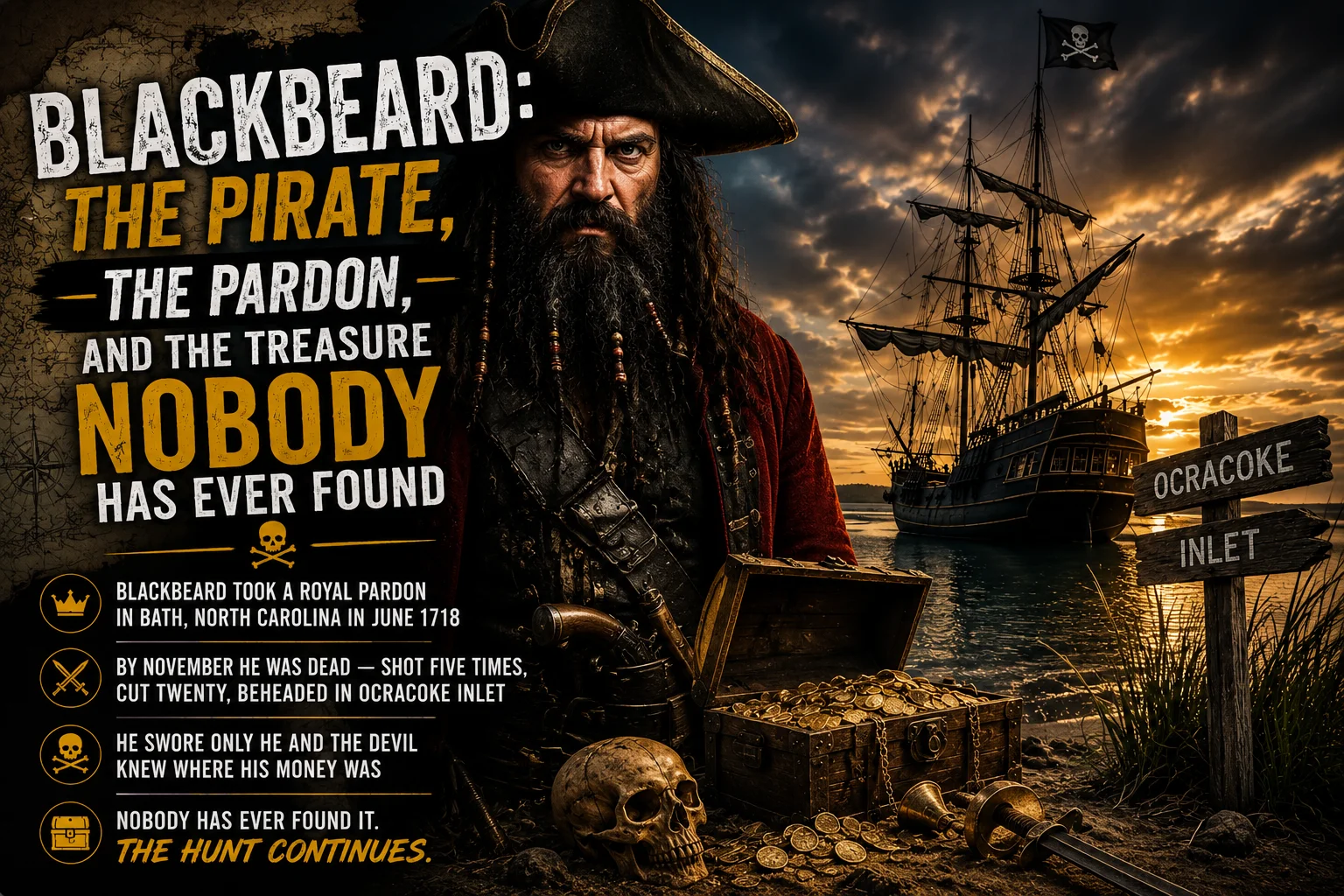
He took the King’s pardon in June.
He was dead by November.
One hundred and sixty-four days between the moment Edward Teach — Blackbeard — walked away from piracy with a royal governor’s signature clearing his name, and the moment his head was hanging from a ship’s bowsprit in Ocracoke Inlet.
He boasted that only he and the devil knew where his money was.
Nobody has ever found it.
The Pardon
In June 1718, Blackbeard sailed into Bath, North Carolina — at the time the colony’s oldest town and its seat of government — and accepted the King’s pardon from Governor Charles Eden. The deal covered every act of piracy committed before January 5, 1718. In exchange, Eden reportedly took a cut of the loot.
Bath was real. The pardon was real. For a few weeks, the most feared pirate on the Atlantic coast was, on paper, a free and lawful man.
He is believed to have kept a house on Plum Point, across the water from Bath, and used the town as a base to sell off captured cargo — sugar, indigo, whatever his crew had taken — with the governor’s tacit blessing. It didn’t last. Whether he ever really stopped raiding is still argued; what’s certain is that by the fall of 1718, Blackbeard was back on the water, and complaints about him were reaching Virginia. Governor Alexander Spotswood decided North Carolina wasn’t going to handle it, and sent the Royal Navy after him instead.
The Ambush
On November 21, 1718, Lieutenant Robert Maynard brought two Royal Navy sloops into Ocracoke Inlet, where Blackbeard’s ship Adventure was anchored. The water was shallow and cut with sandbars — Maynard’s larger ships couldn’t get close without running aground, so the fight had to wait for morning.
That night, by every account, Blackbeard’s crew drank.
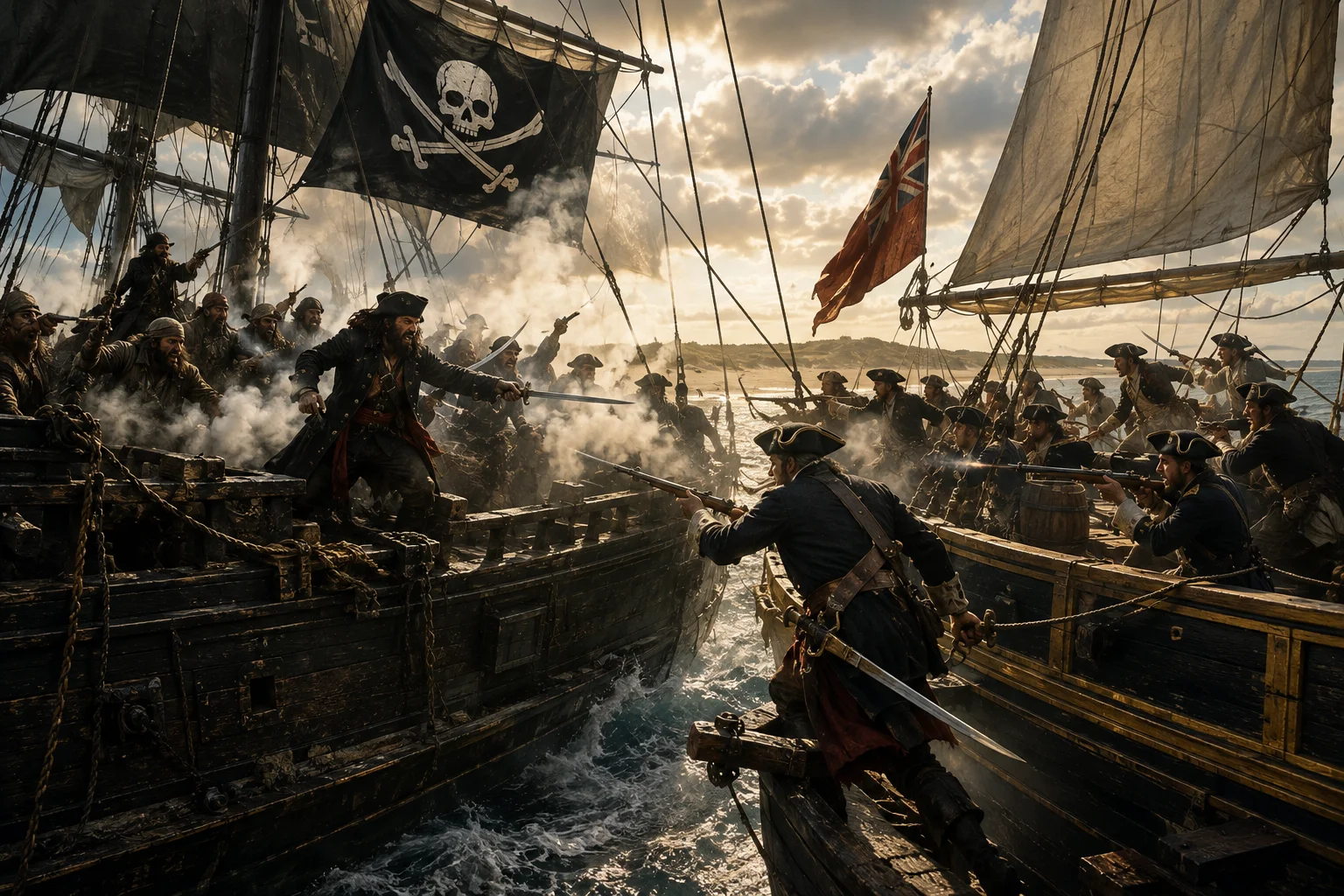
At dawn on November 22, Maynard made his move. He kept most of his men hidden below deck to make his numbers look smaller than they were — a trick that worked. Blackbeard, thinking he was facing a weaker crew, brought his ship alongside for the kill.
It became a close-quarters brawl on the deck of the Adventure — pistols, cutlasses, no room to maneuver. Blackbeard and Maynard fought hand to hand. By the time it was over, Blackbeard had taken five gunshot wounds and twenty sword cuts. Maynard cut off his head and hung it from the bowsprit. Local legend holds that his body, thrown overboard, swam a full circle around the ship before it finally sank.
The head was sailed to Virginia to collect the bounty.
The rest of him is still Ocracoke’s.
”Only He and the Devil”
Here’s the line that’s kept people digging on this coast for three hundred years. According to A General History of the Pyrates (1724) — a firsthand-adjacent account drawn from interrogations of Blackbeard’s captured crew — one of his men was asked whether his wife knew where his treasure was hidden. Blackbeard’s own answer, recorded by the author:
“That no Body but himself and the Devil, knew where it was, and the longest Liver should take it all.”
That’s not a modern legend somebody made up for the tourist trade. That’s a 300-year-old primary source, and it’s the reason “Blackbeard’s buried gold” has never gone away.
People have looked. Plum Point at Bath — his own home base — has been dug up more than once, along with sites in Georgia and New Hampshire tied to his crew. None of it has ever turned up a chest. Historians will tell you flatly: this is very likely a myth, the kind of story that grows every time it’s retold. But “very likely a myth” isn’t the same as “definitely nothing’s there” — and after three centuries, nobody has closed the book on it.
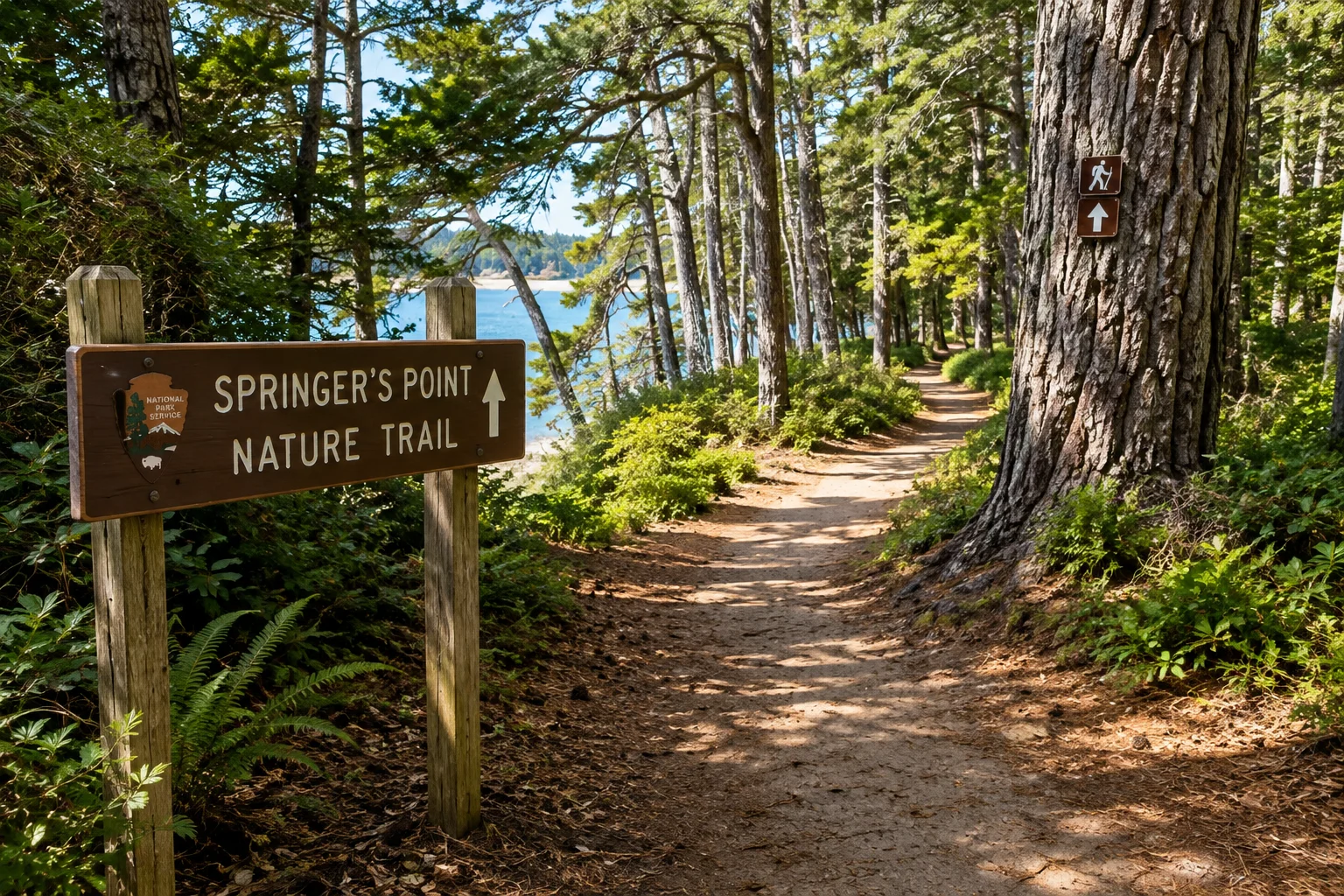
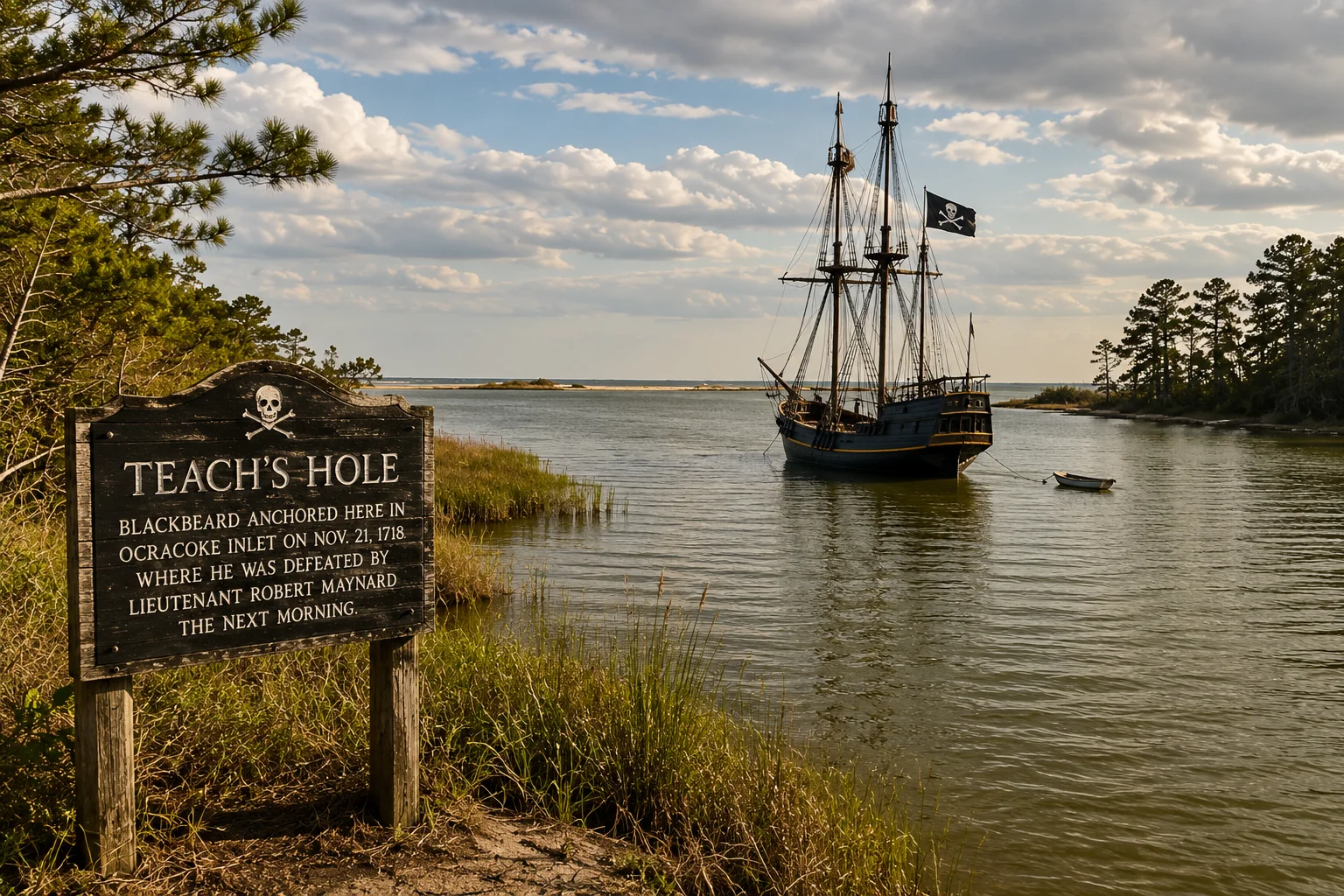
Springer’s Point, and the water beyond it — Teach’s Hole — where the fight actually happened.
This Part Isn’t Legend — There’s a Real Ship
Blackbeard’s flagship, the Queen Anne’s Revenge, ran aground near Beaufort Inlet in June 1718, months before Ocracoke. It sat lost for almost 280 years until a private research team found it on November 21, 1996 — cannons, anchors, a ship’s bell dated 1705.
It’s still an active underwater archaeological site today, protected by the state, with conservation work ongoing. Recovered artifacts — real cannons pulled off Blackbeard’s real ship — are on permanent display at the North Carolina Maritime Museum in Beaufort, about a two-hour drive from Ocracoke.
So this isn’t only a campfire story. There’s a documented shipwreck, real recovered weapons, and a museum you can walk into and stand in front of them.
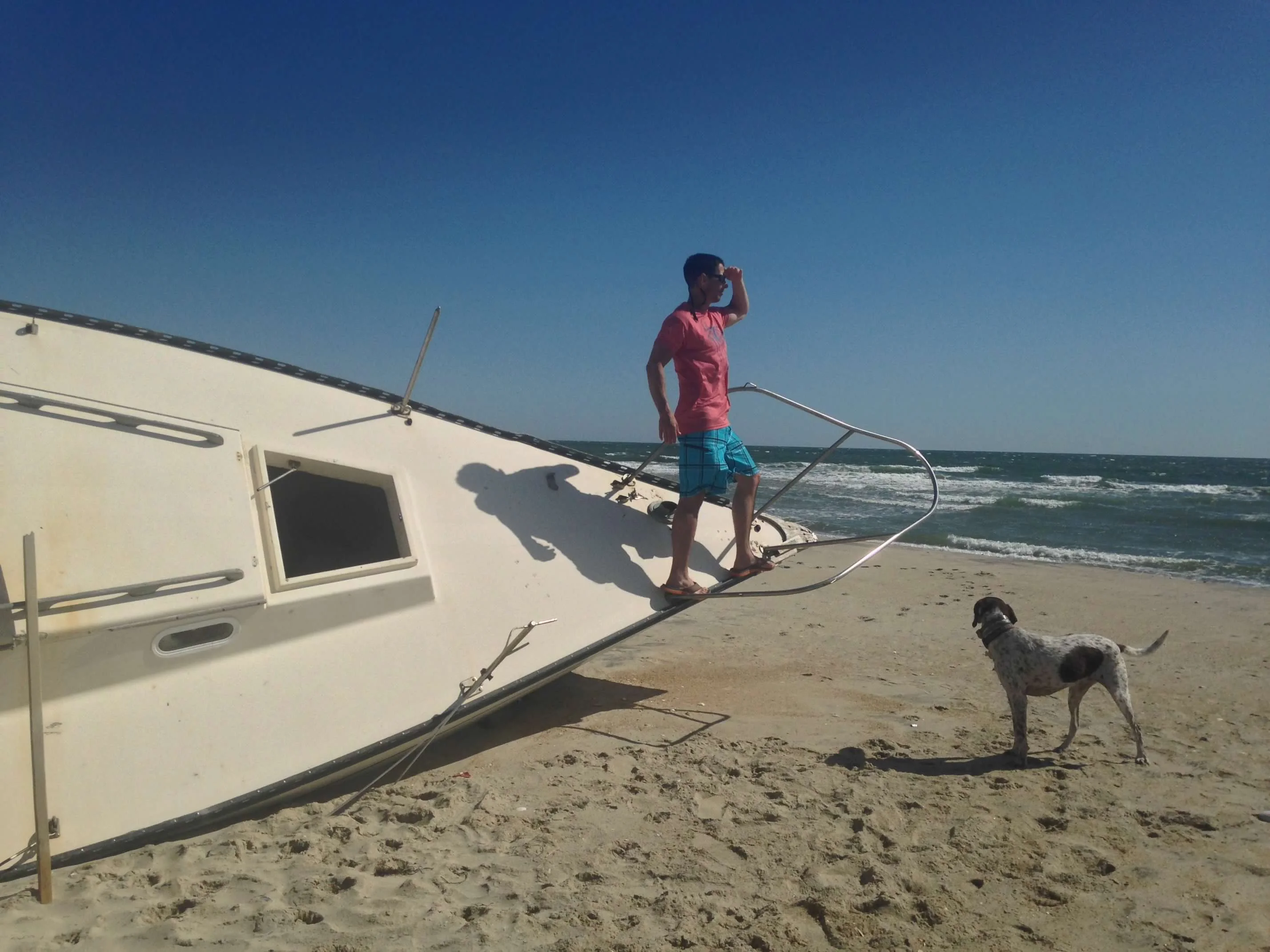
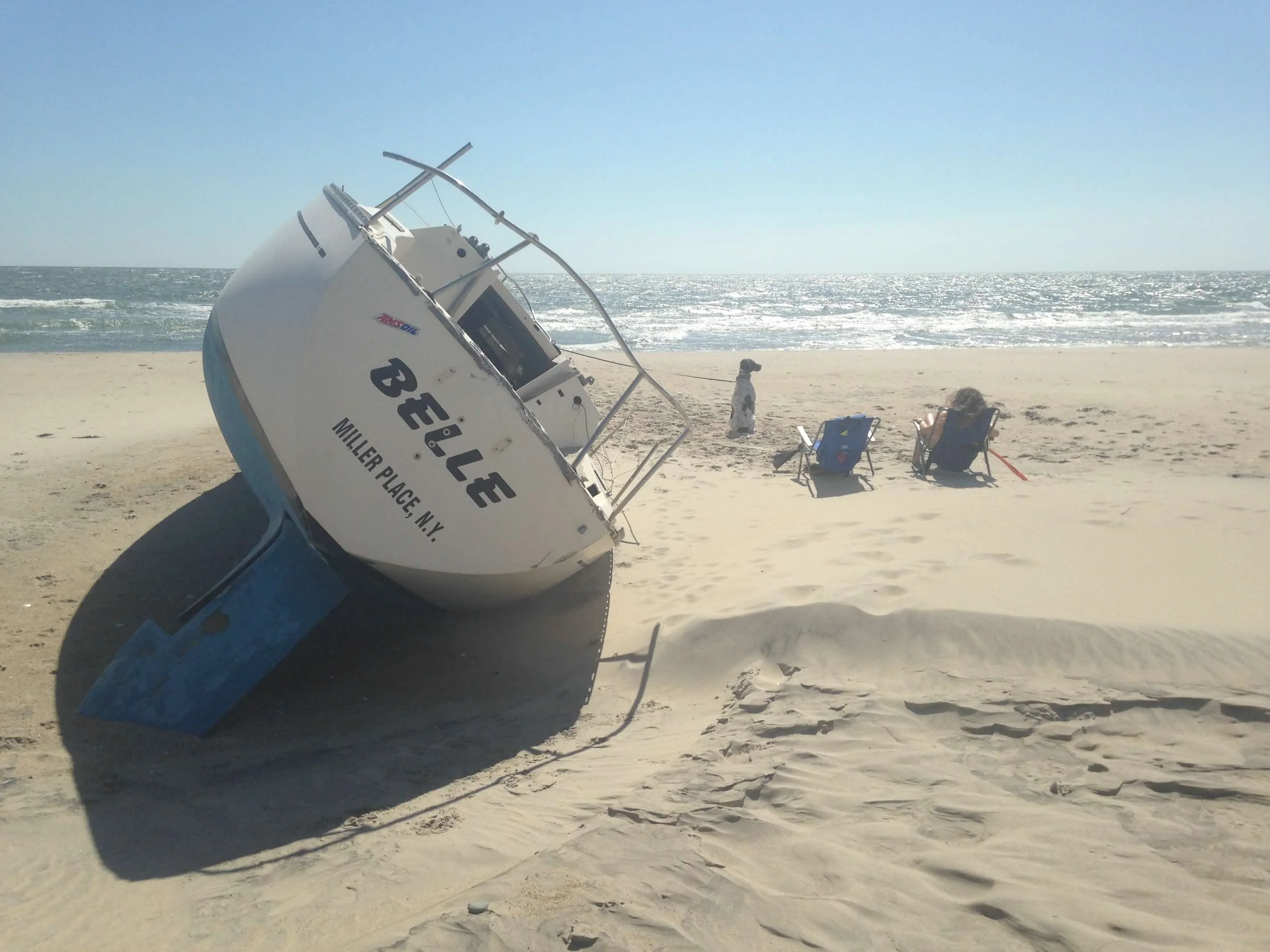
Not the Queen Anne’s Revenge — just a different wreck we came across on a different stretch of this same coastline. This is what happens on the Outer Banks. The ocean doesn’t stop taking ships just because the 1700s ended.
What’s There Today
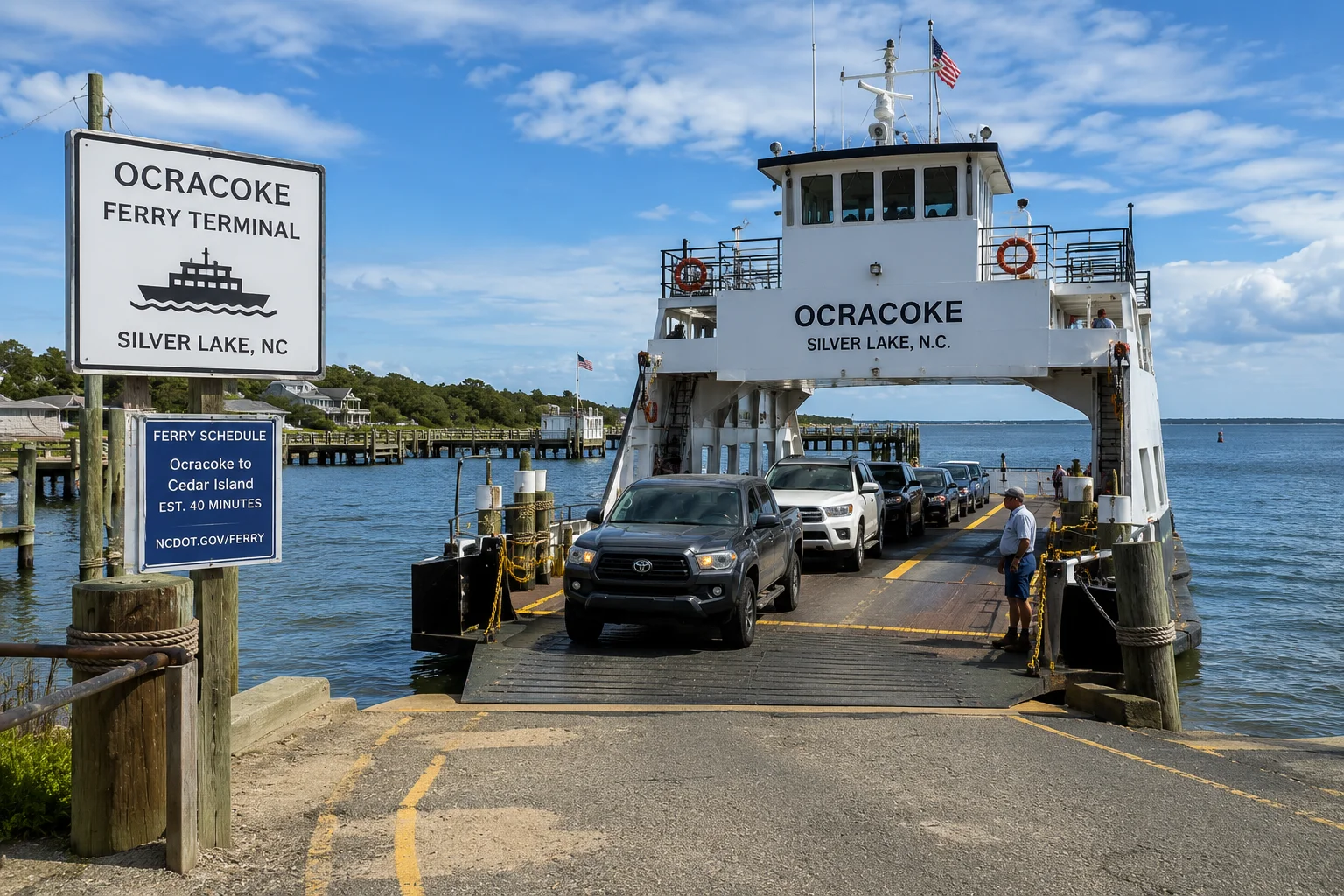
Getting there is part of the adventure. Ocracoke Island is only reachable by ferry or small plane — no bridge. The NC-DOT Hatteras–Ocracoke ferry is free, runs year-round, takes about an hour, and doesn’t take reservations — you show up, get in line, and wait your turn. Midday waits can run up to a few hours in season, which is honestly part of the experience: there’s no fast way onto this island, and that’s exactly why it stayed a pirate’s hideout in the first place.
Springer’s Point Preserve — a 122-acre protected maritime forest — is free, open year-round during daylight hours, and has no dedicated parking lot (park near the village or the ferry docks and walk or bike in). The 0.8-mile trail winds through live oak and yaupon forest and opens onto the sound at Teach’s Hole, looking out over the exact water where the battle happened. No entrance fee. No ticket booth. Just the trail and the water.
Camping is not free, worth being straight about — Ocracoke Campground (National Park Service) runs about $28/night, same as the other Cape Hatteras National Seashore campgrounds, and reservations go through recreation.gov.
Bath, North Carolina — where he took his pardon, and where Plum Point still sits across the water — is about a three-hour drive northwest and makes an easy pairing if you want to trace the whole 164-day arc from pardon to beheading in one trip.
A Word From Tortuga — Learn From Our Ticket
We’ve been to the Outer Banks more times than we can count. One trip stands out for the wrong reason.
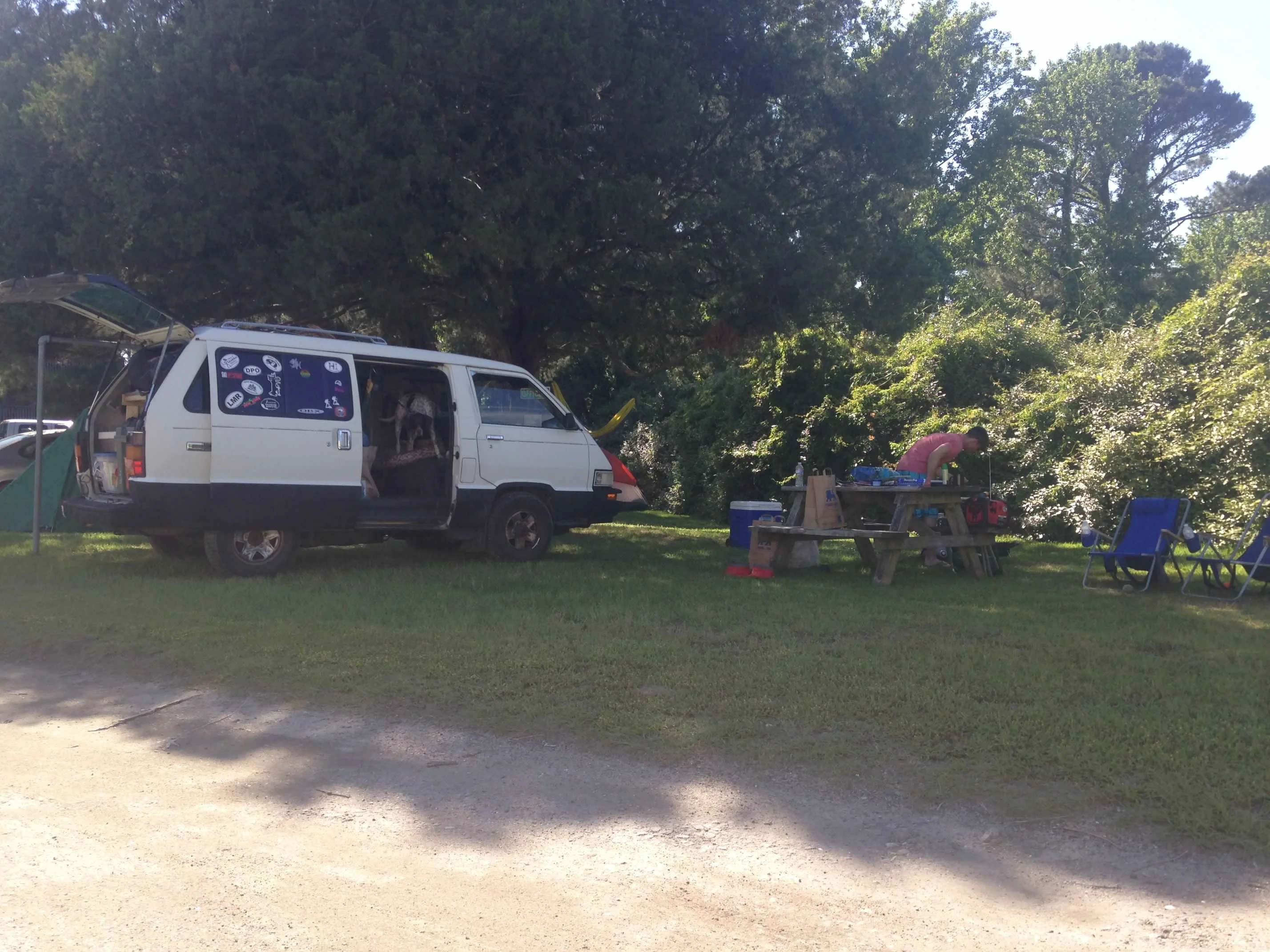
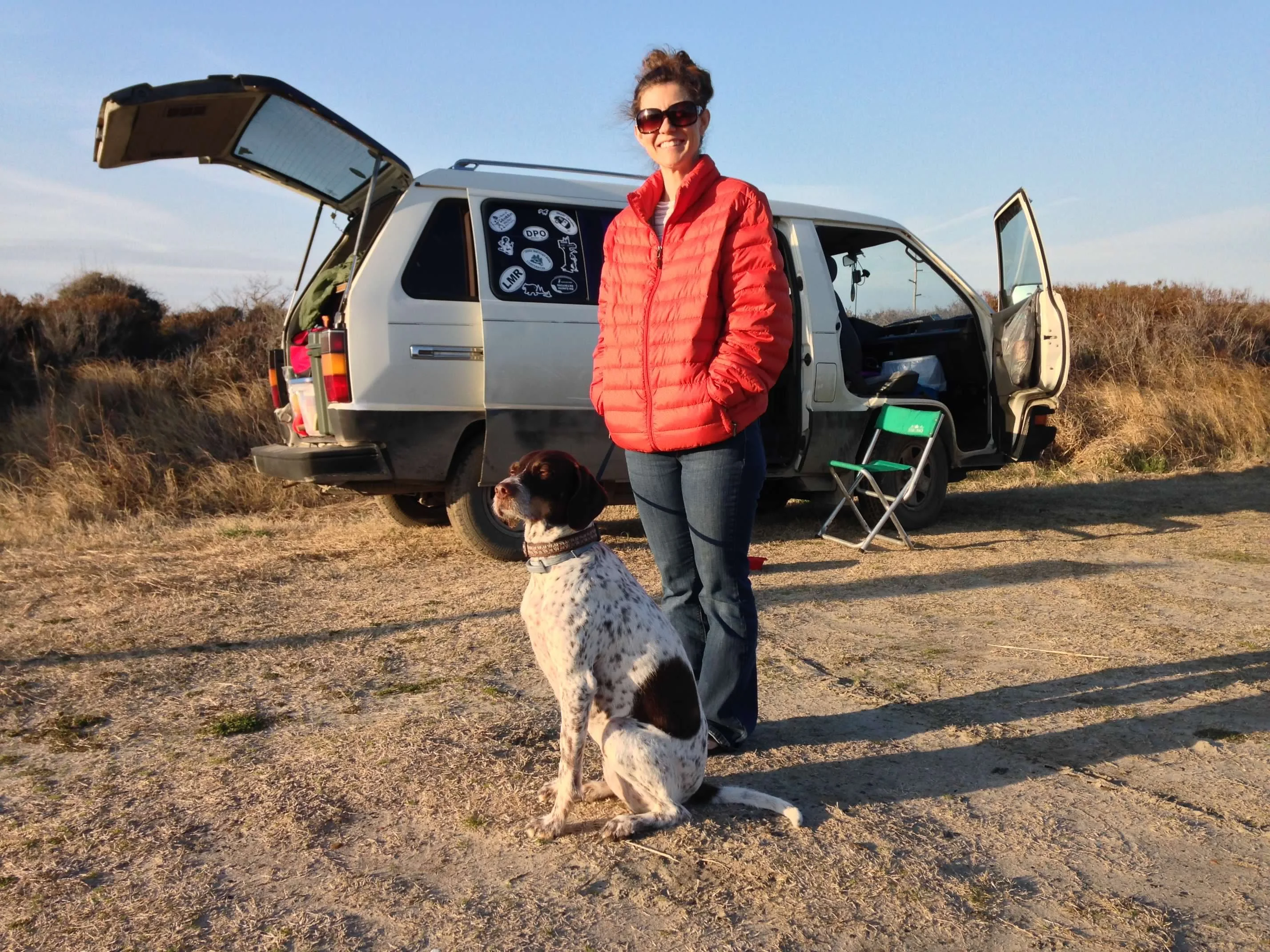
Our usual setup — a shaded hostel campground — next to the kind of dune country we ended up parked in instead that night.
We got off work at 5 p.m. on a Friday and headed straight for the beach — no plan beyond “get there.” That’s just how it goes some weeks: the job takes priority Monday through Friday, and the research for the weekend doesn’t happen until it’s already too late. We rolled in around 2 a.m., ready to set up at a Cape Hatteras National Seashore campground, and found out it wasn’t open yet. We’d missed the seasonal opening date by about a week. Nobody plans for that discovery at 2 a.m.
By then we were too worn out to safely keep driving, and every private campground and KOA within reach had long since stopped answering the phone. So we pulled off behind a sand dune to wait it out until sunrise.
A National Park Service ranger woke us up with a knock on the window. He searched the van — no contraband, no weapons, nothing to find — heard the whole story, and wrote us a warning citation for camping in a non-designated area. Fair enough. We were camping in a spot that wasn’t designated for it.
But here’s the detail that’s stuck with us ever since: he told us we didn’t actually have to leave. We could’ve stayed on that same stretch of sand all night — we just couldn’t call it “camping.” If we’d said we were recreating, not sleeping, we’d have been fine. Same van, same dune, same night. Just a different word.
We’re not passing that along as a loophole — enforcement is at a ranger’s discretion, and the smarter move is just checking seasonal opening dates before you leave work on a Friday. But if you ever end up stuck on the Outer Banks after a long week with nowhere to go: apparently “camping” and “recreating” are two very different things to the National Park Service.
Camp Near the Story
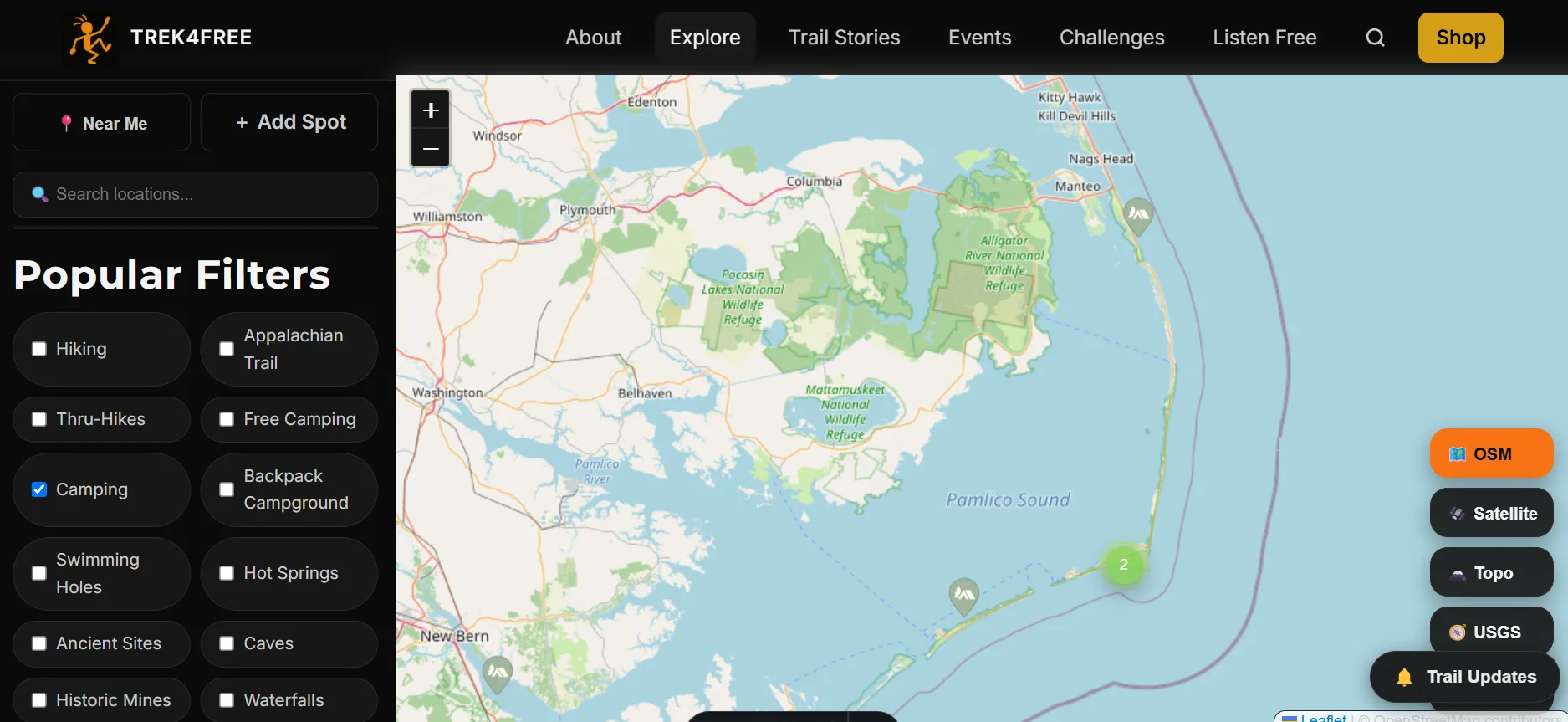
All four Cape Hatteras National Seashore campgrounds are on Trek4Free’s Explore map, strung out along NC-12 from Nags Head down to the ferry:
- Oregon Inlet Campground — the closest one to Nags Head/Kitty Hawk, just south over the Bonner Bridge, open year-round
- Frisco Campground — Hatteras Island, seasonal (April–November)
- Cape Point Campground — also Hatteras Island, near Buxton
- Ocracoke Campground — on Ocracoke Island itself, walking distance from the ferry dock and Springer’s Point
All four run through recreation.gov, all four require reservations, and none of them are free — but now you know exactly where they sit relative to the story.
The Adventure Is Already Here
No passport. No dive certification. No decade of academic credentials. A free ferry, a free trail, and a legend that’s never been solved — because after three hundred years, nobody has ever proven Blackbeard wrong.
He said only he and the devil knew where it was.
As far as anyone’s found, that’s still true.
Cape Hatteras National Seashore, of which Ocracoke Island is part, is administered by the National Park Service: nps.gov/caha. Recovered Queen Anne’s Revenge artifacts are on permanent display at the North Carolina Maritime Museum in Beaufort. For more of the Indiana Jones meets Regular Joe series: The Pirate, the Frontiersman, and the Lost Texas Silver Mine · Three Ships, One Storm, and the Coins That Still Wash Up · The Gold the Missile Range Is Hiding.