The Trader, the Freemasons, and the Lost Silver Mine of the Appalachians

A wounded bear led him to the cave.
At least, that’s how the story goes.
Nine years of expeditions. A fortune in silver bars and minted coins buried across the Kentucky mountains. Then — blindness, before he could ever find his way back.
Two hundred and sixty years later, people are still looking.
And the deeper you dig into the story, the stranger it gets — because the man who claimed to write it down may have hidden something else entirely inside the words themselves.
The Legend
Around 1760, an Englishman named Jonathan Swift — by some accounts a retired shipping man — claimed a wounded bear led him into a cave in the Appalachian mountains of what’s now eastern Kentucky. Inside, he said, was silver ore rich enough to mine.
For nine years, the story goes, Swift made annual expeditions into the wilderness, extracting silver, smelting it into bars and coins, and burying it in caches across the mountains — “thirty thousand dollars and crowns on a large creek,” according to the account, plus more marked and hidden near trees and landmarks along his route.
It didn’t end well. Attacks from Native tribes defending their land, and a mutiny among his own crew, eventually drove him out. Before he left for the last time, he’s said to have walled up the mine entrance. He intended to come back.
He went blind before he ever could.

The Journal — and the Detail That Changes Everything
The story survives because of a journal, supposedly left behind with a Tennessee woman named Mrs. Renfro, describing routes, landmarks, and mining sites. Copies have circulated for generations.
Here’s where it gets interesting.
Historians who’ve studied the journal closely — most notably researcher Joe Nickell, writing in The Filson Club History Quarterly in 1980 — found that entire passages were lifted almost word-for-word from Kentucky history books published decades after Swift’s supposed expeditions. The journal describes places using names and details that didn’t exist yet in the 1760s. And it’s saturated with Freemasonry imagery and symbolism — enough that Nickell concluded the document reads less like a mining log and more like an allegory written in Masonic code.
That detail gets more interesting the more you look into it.
Researcher Robert Prather has traced a real connection: Swift, by some accounts, was tied to George Washington’s own Masonic lodge. And Swift’s father-in-law, General Daniel Roberdeau, really did operate a lead mine in western Pennsylvania during the Revolutionary War — and lead deposits frequently carry silver as a byproduct. It’s not proof of anything. But it’s a real historical thread connecting a real Masonic network to a real Revolutionary-era mining operation, sitting right underneath a legend already soaked in Masonic symbolism.
Is the whole journal a coded allegory written by or for a Masonic circle, dressed up as a treasure map? Nobody knows. That’s exactly why people are still arguing about it.
What Science Says
The Kentucky Geological Survey — an actual state scientific body, not a treasure blog — looked into this directly. Their conclusion is about as flat a “no” as you can get: “It is very unlikely that there is any natural occurrence of gold, silver, or any precious metals in the Paleozoic rocks of eastern Kentucky.” They’ve fielded hundreds of public inquiries over the years and, in their words, “found nothing to substantiate this legend.”
There’s also a documented Jonathan Swift in the historical record — from Alexandria, Virginia. He was born in 1764. He would have been a small child during the years the legendary Swift was supposedly hauling silver out of the mountains.
So: geologically improbable, and the one paper trail that might confirm a real Swift doesn’t line up with the dates.
That’s the honest version. It doesn’t mean the legend isn’t worth chasing. It means it should be chased as what it actually is — folklore, not documented history.
Real Silver Still Turns Up in These Mountains
Here’s what keeps this from being just an old campfire story: real, well-documented fortunes keep coming out of ground like this — not proof of Swift’s mine, but proof the region isn’t fantasy.
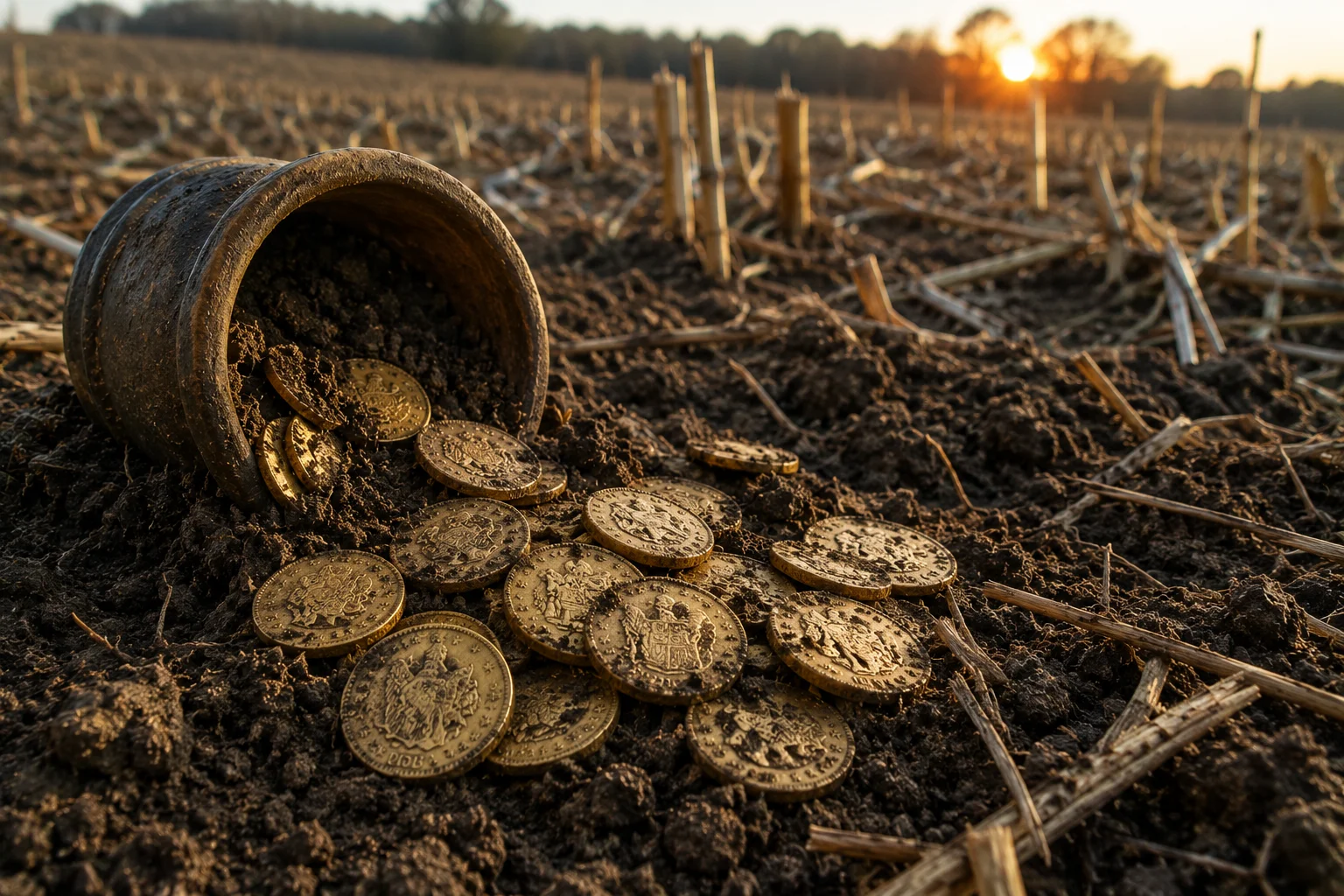
In 2023, a Kentucky farmer found over 800 gold and silver Civil War-era coins buried in a cornfield — Liberty Head gold dollars, Eagles, Double Eagles, worth more than $3 million. It’s now known as the Great Kentucky Hoard, one of the biggest coin-collecting stories of the decade, found just a couple hundred miles from Swift’s supposed mining grounds.
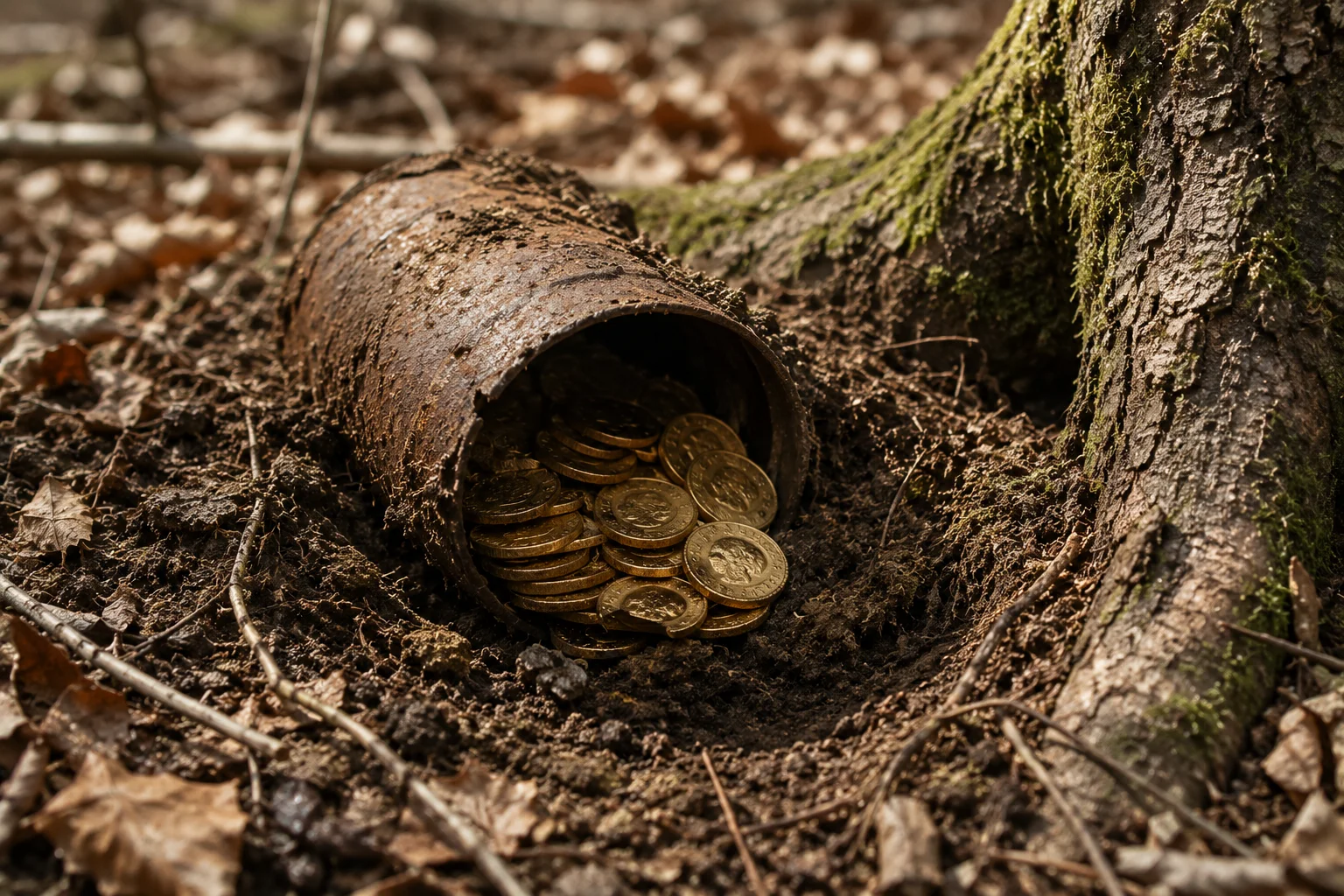
And in 2013, a couple out in Northern California — walking their dog on a trail across their own property, the same trail they walked all the time — noticed a rusted tin can with its lid barely poking out of the dirt near an old tree. Inside: gold coins. They kept digging, kept finding more, and over two weeks turned up eight cans holding 1,411 gold coins worth roughly $10 million — the largest buried-treasure coin hoard in American history, since called the Saddle Ridge Hoard. Different mountains entirely. But it’s the exact shape of story that makes Swift’s legend impossible to fully dismiss: ordinary people, familiar ground, something buried and forgotten that turns out to be real.
260 Years of People Who Couldn’t Let It Go
The search didn’t stop when Swift supposedly went blind. It’s never really stopped since.
- 1790s — organized search parties, including one led by Revolutionary War veteran Captain William “Billy Bush,” went looking not long after Swift’s own expeditions supposedly ended.
- 1940 — the Middlesboro Daily News ran a feature collecting Bell County oral tradition on the legend — including residents’ own skepticism, showing this was already treated as old folklore by then.
- 1980 — The Filson Club History Quarterly published Joe Nickell’s research debunking the journal’s authenticity — the piece that first traced the plagiarized passages and the Masonic overlay.
- Ongoing — mining companies have periodically raised money over the decades promising to finally open “Swift’s mines.” The ventures have never panned out.
The modern search community is still active. Researcher Michael Paul Henson published two books in the 1970s compiling journal versions, maps, and research — still the closest thing this legend has to a standard reference. Michael S. Steely and Robert Prather have both written their own books since. TreasureNet.com, a real and active treasure-hunting forum, has an entire dedicated section — “Lost Silver Mines - Jonathan Swift” — with threads still getting posts today, including one about Kentucky outdoors TV personality Tim Farmer weighing in on the legend.
What’s There Today
The legend’s fingerprints are all over real, visitable ground in the Red River Gorge, inside the Daniel Boone National Forest in Wolfe County, Kentucky — one of the most popular hiking and rock-climbing destinations in the state.
Swift Camp Creek and Silvermine Arch are real, named landmarks tied directly to the legend — Swift Camp Creek is supposedly where he was hurt and laid up for a time. Both sit inside public land anyone can hike to.
There’s a real, bookable John Swift’s Lost Silvermine historic campground near Slade, Kentucky.
Campton, Kentucky holds an annual Swift Silver Mine festival and has a historical marker for his reputed campsite — a small town that’s built part of its identity around a 260-year-old unsolved legend.

Find It on the Map
We put it on our own Explore map, filed right where it belongs — under Historic Mines:
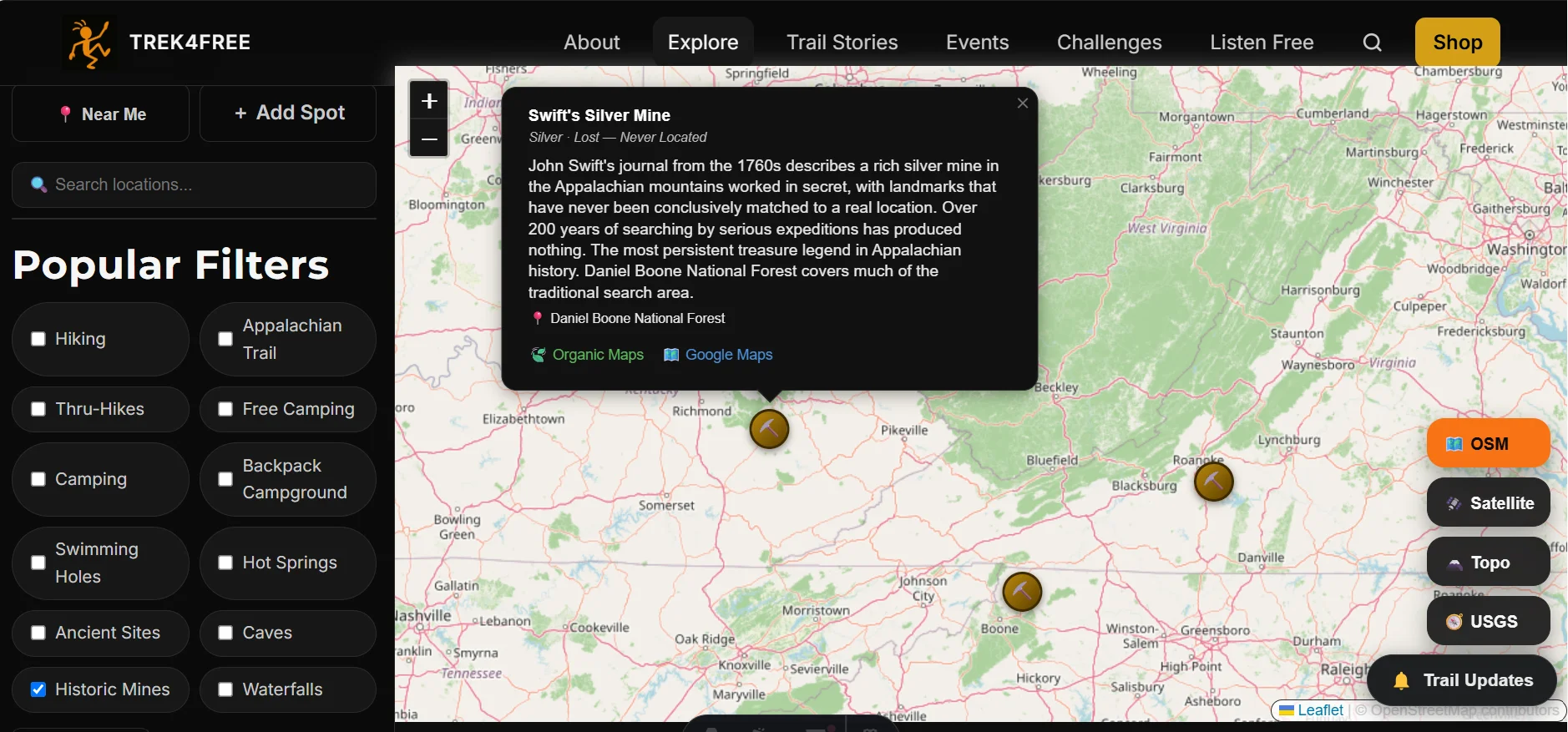
Silver · Lost — Never Located. John Swift’s journal from the 1760s describes a rich silver mine in the Appalachian mountains worked in secret, with landmarks that have never been conclusively matched to a real location. Over 200 years of searching by serious expeditions has produced nothing. The most persistent treasure legend in Appalachian history. Daniel Boone National Forest covers much of the traditional search area.
Pull up the Historic Mines filter yourself, and you’ll see it’s not the only one out there — the legend spans multiple marked locations across Kentucky and Virginia, because two and a half centuries of searchers have never agreed on exactly where to dig.
The Adventure Is Already Here
Nobody has found Swift’s silver. The state’s own geologists will tell you flatly it probably was never there to find. The journal that started it all might be a treasure map, or it might be a 260-year-old Masonic riddle wearing a treasure map’s clothes.
But the ground is real. The creek and the arch still carry his name. The town still throws a festival for him. And two hundred miles away, in a cornfield nobody thought twice about, a farmer just proved that this exact region still hands out real fortunes to people who weren’t even looking.
You don’t need to believe Swift found silver to believe something’s still out there.
You just have to go look.
Red River Gorge sits inside the Daniel Boone National Forest, administered by the US Forest Service. For more of the Indiana Jones meets Regular Joe series: Blackbeard: The Pirate, the Pardon, and the Treasure Nobody Has Ever Found · The Pirate, the Frontiersman, and the Lost Texas Silver Mine · The Gold the Missile Range Is Hiding.