What You've Walked Past
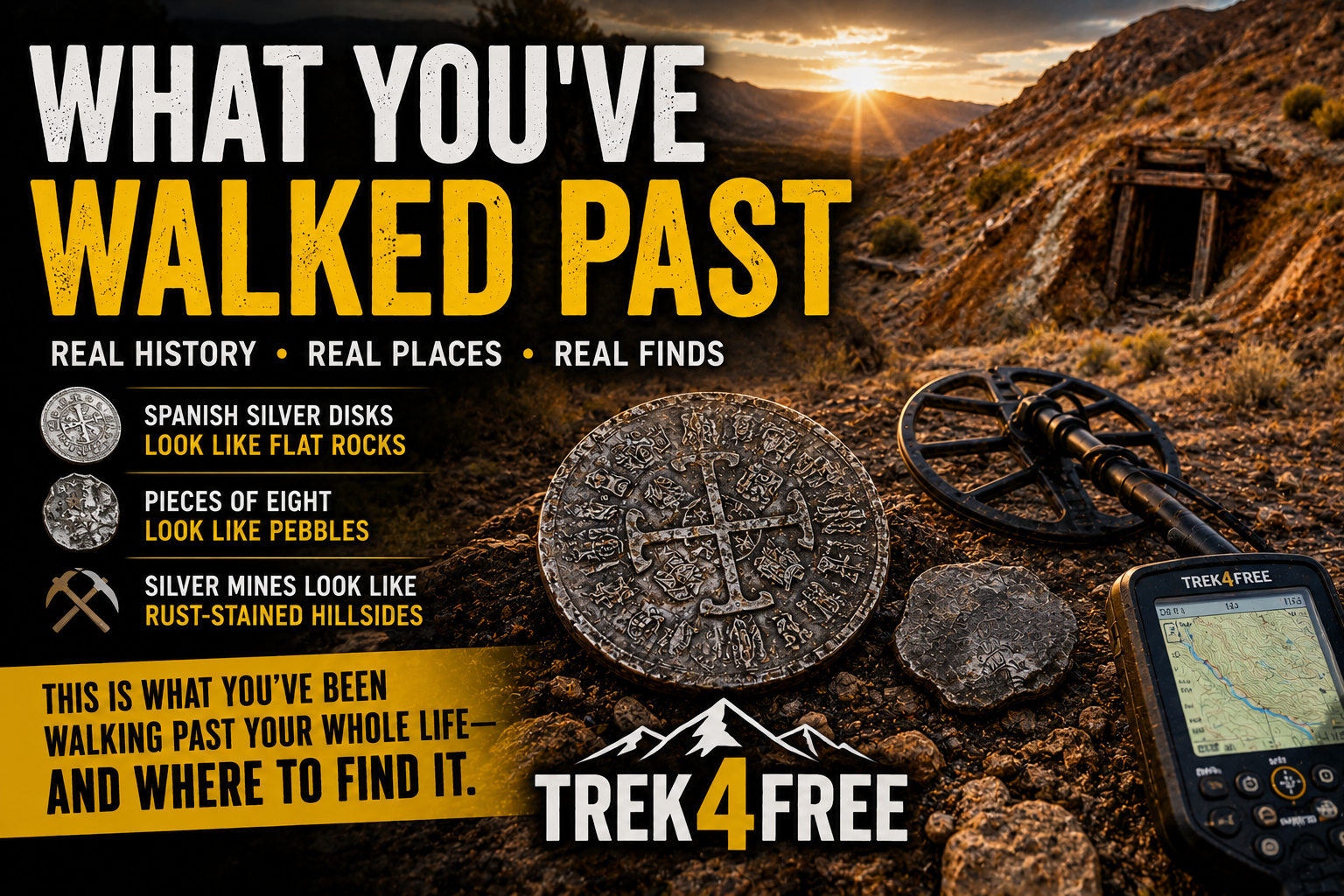
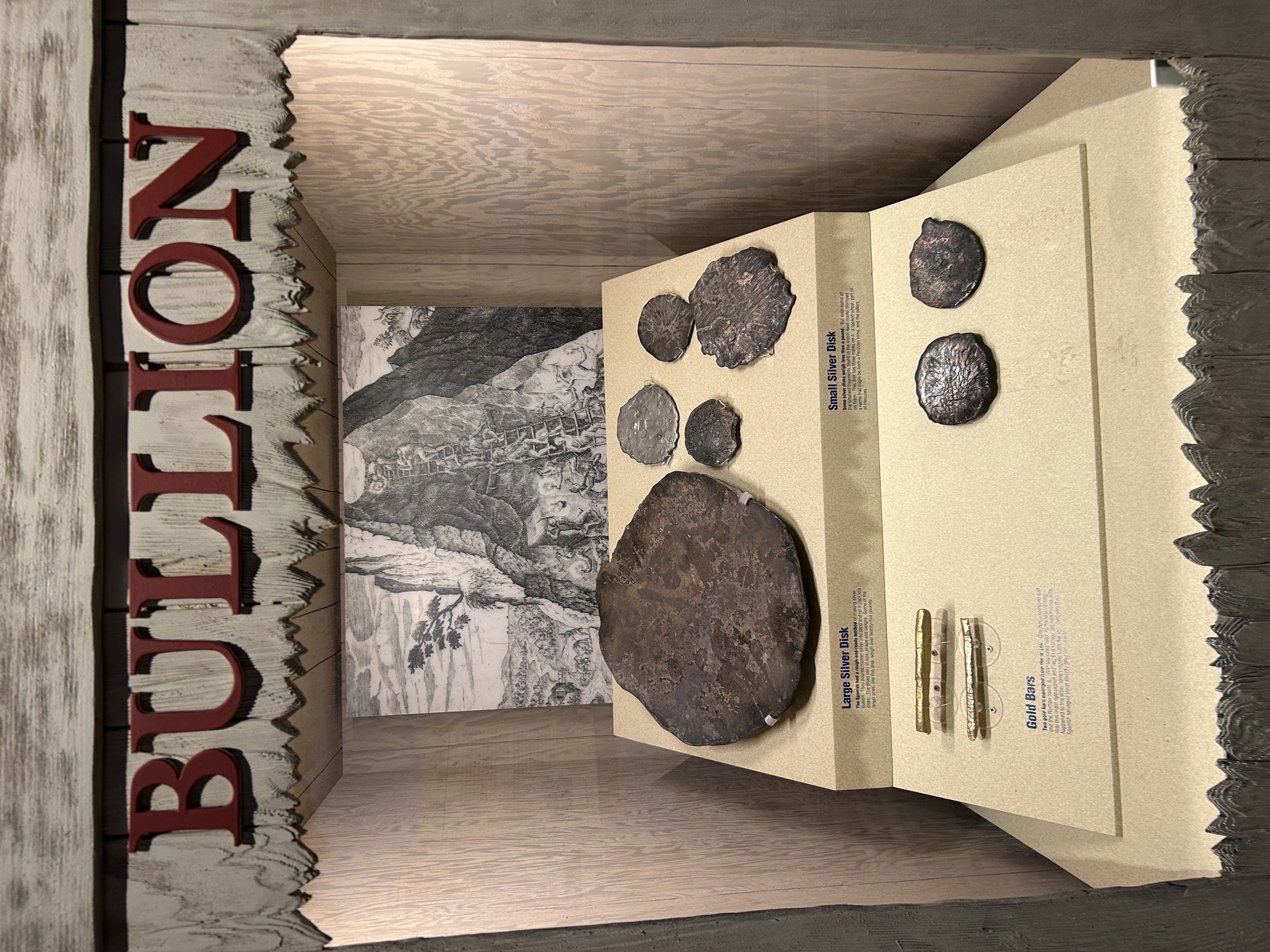
That gray disk on the museum shelf is silver.
Not the shiny silver you’re picturing. Not a gleaming coin with a king’s profile. A flat, rough, dark gray disk about the size of a dinner plate. Irregular edges. Weighs close to thirty pounds. Looks exactly like a piece of broken slate.
That is what Spanish silver looks like after 470 years on the ocean floor.
The Corpus Christi Museum of Science and History has several of them — pulled from three ships that sank off Padre Island in 1554. The largest disk in that display is bigger than most dinner plates. Nobody walking past it on a beach would stop to pick it up.
That is the whole problem. And the whole opportunity.
The Thing Nobody Tells You
Spanish bullion wasn’t coins. Not the raw silver coming out of the mines. It was poured.
Molten silver, ladled into a shallow stone mold, left to cool. The result is called a tortilla — a flat disk of raw silver, roughly circular, rough edges, whatever weight came out of the mold. These were the shipping containers of the 16th-century economy. You load them in a ship and sail them to Spain.
When the ship sinks, the silver doesn’t float away. It sits on the bottom and slowly acquires a coat of silver sulfide, marine sediment, and barnacle shell. After a few decades it looks like a rock. After a few centuries it is indistinguishable from the seafloor.
The coins are the same story, just smaller.
Spanish cob coins — macuquinas — were hand-cut chunks of silver, roughly the correct weight, stamped with a die. They were never perfectly round. After 470 years underwater they are black, matte, small, and irregular. They look like a dark pebble with a faint cross pattern if you hold them in direct sunlight and look carefully.
Most people walk right past them.
The crossbow in that same museum display was invisible. Completely encrusted in concretion. The wood had rotted away inside a perfect mold of marine sediment. Archaeologists injected casting material into the void and pulled out the exact shape of a crossbow. The ocean had preserved the form of an object while the object itself disappeared.
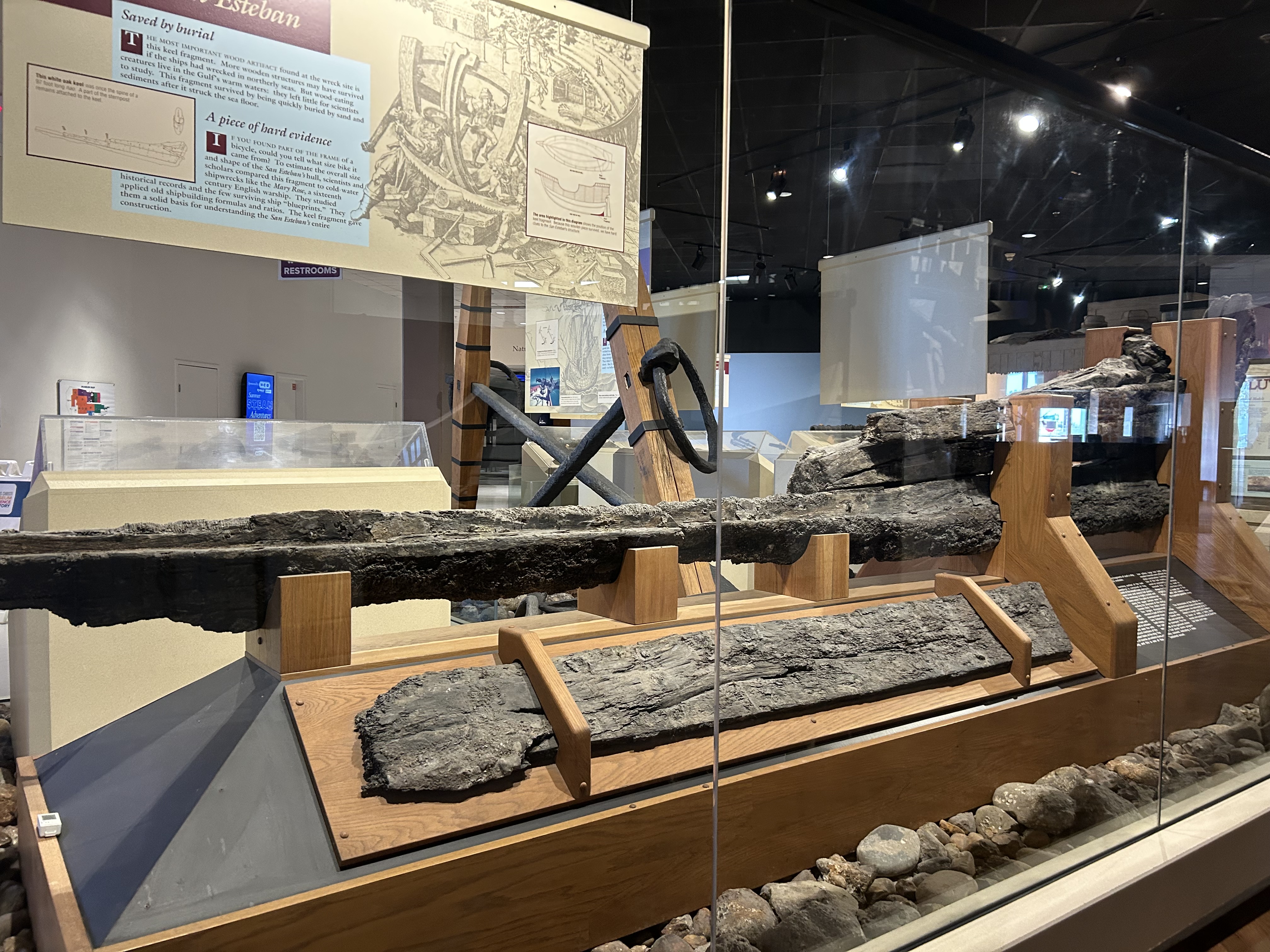
Gold is different. Gold never corrodes. Not in saltwater, not in 470 years, not ever. A gold bar from a 1554 shipwreck comes up with a dull metallic sheen, still gold. The small gold bars in that same display case — surprisingly thin, surprisingly small — would still read as metal if you found them. Gold is chemically immortal. Everything else disguises itself.
What a Silver Mine Looks Like From the Outside
You’re not looking for a hole in the ground with a sign.
You’re looking for what geologists call a gossan — an iron hat. When a silver-bearing sulfide deposit sits near the surface and weathers over centuries, the iron oxidizes and bleeds outward, leaving a stain on the rock face. Red. Orange. Yellow. Like someone streaked the hillside in rust.
Every experienced Spanish minero knew: rusty hillside means sulfides below. Sulfides mean silver.
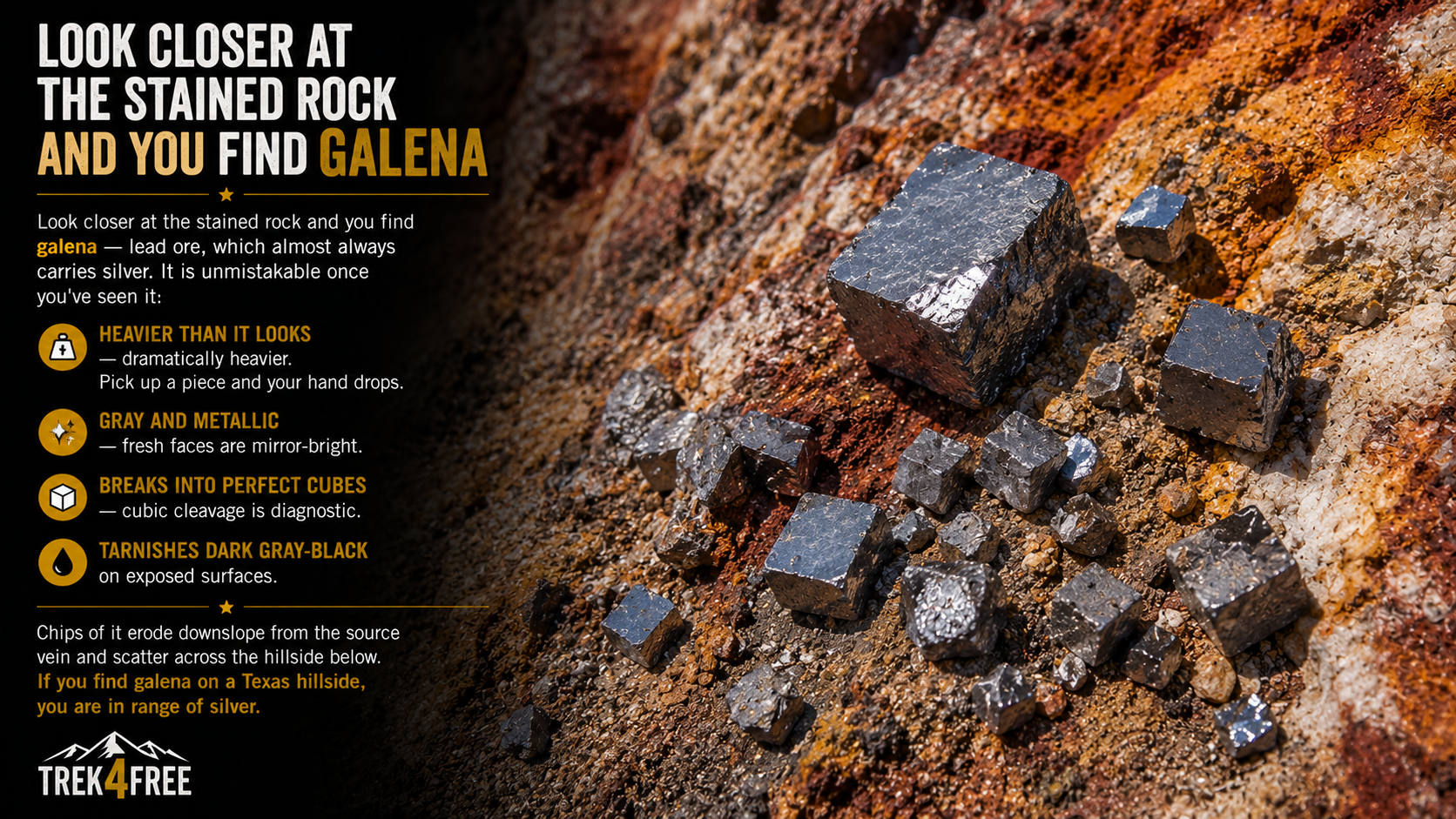
Look closer at the stained rock and you find galena — lead ore, which almost always carries silver. It is unmistakable once you’ve seen it:
- Heavier than it looks — dramatically heavier. Pick up a piece and your hand drops.
- Gray and metallic — fresh faces are mirror-bright.
- Breaks into perfect cubes — cubic cleavage is diagnostic.
- Tarnishes dark gray-black on exposed surfaces.
Chips of it erode downslope from the source vein and scatter across the hillside below. If you find galena on a Texas hillside, you are in range of silver.
A Spanish mine site leaves evidence that survives 400 years:
Arrastra — a circular grinding floor, 10 to 20 feet across, with a center post hole. A heavy drag stone was pulled around the circle by mules to crush ore. The grinding groove in flat rock is permanent. These still exist at dozens of Southwest sites.
Adit openings — horizontal tunnel mouths cut into hillsides following a vein. Usually only four to five feet tall. Probably collapsed, but the depression and the waste rock dumped outside the entrance remains.
Tailings piles — the waste rock heaped outside the mine. The Spanish only processed high-grade ore and threw the rest away. Rockhounds find galena and silver minerals in Spanish tailings today.
Slag and charcoal — glassy black waste from smelting, and charcoal pits from the smelting fires. Find these and you have found a processing site — proof someone was working ore here.
The Spanish were in these hills. They left evidence. It is still there.
The Lost Ones
Here is what we know is still out there — documented, located on a map, unrecovered.
Texas
The San Saba / Los Almagres mine near Menard is the most researched lost mine in Texas. The Lipan Apache knew it for generations before any European arrived. The Spanish sent military expeditions to find it and defend it. Jim Bowie hunted it obsessively — and nearly died for it at Calf Creek in 1831. The Presidio San Saba ruins stand in Menard today, publicly accessible. The mine itself has never been conclusively located.
The full story: The Pirate, the Frontiersman, and the Lost Texas Silver Mine →
The Lost Padre Mine in the El Paso area — Franciscan mission silver, sealed when the missions were abandoned. Franklin Mountains State Park borders the search area.
Sublett’s Mine in the Big Bend — placer gold and silver described by a dying man, never relocated. Big Bend National Park covers the surrounding country.
New Mexico
Victorio Peak is potentially the largest single treasure cache in North American history. Gold bars, Spanish colonial artifacts, and a reported Apache treasury hidden in a cave system in the San Andres Mountains. The United States military controls the land as White Sands Missile Range. Civilian access has been denied since the 1950s despite decades of legal challenges. The missile range sits directly on the reported location. Whatever is in that cave is still there.
The Lost Adams Diggings on the New Mexico / Arizona border — a placer gold canyon described as a floor paved with nuggets, found once in the 1860s and never found again despite 150 years of serious searching. Apache-Sitgreaves National Forest and Gila National Forest cover the search area. Multiple professional expeditions failed to relocate it.
Arizona
Colossal Cave near Tucson — a Wells Fargo train robbery gang hid their silver inside the cave in 1884, were captured before they could retrieve it, and the silver was never recovered. You can tour the cave today. The silver is presumably still somewhere in those passages.
These are the ones that made it into written records. The ones where someone told a story before they died.
There are others that died with their finders.
Find Them Yourself
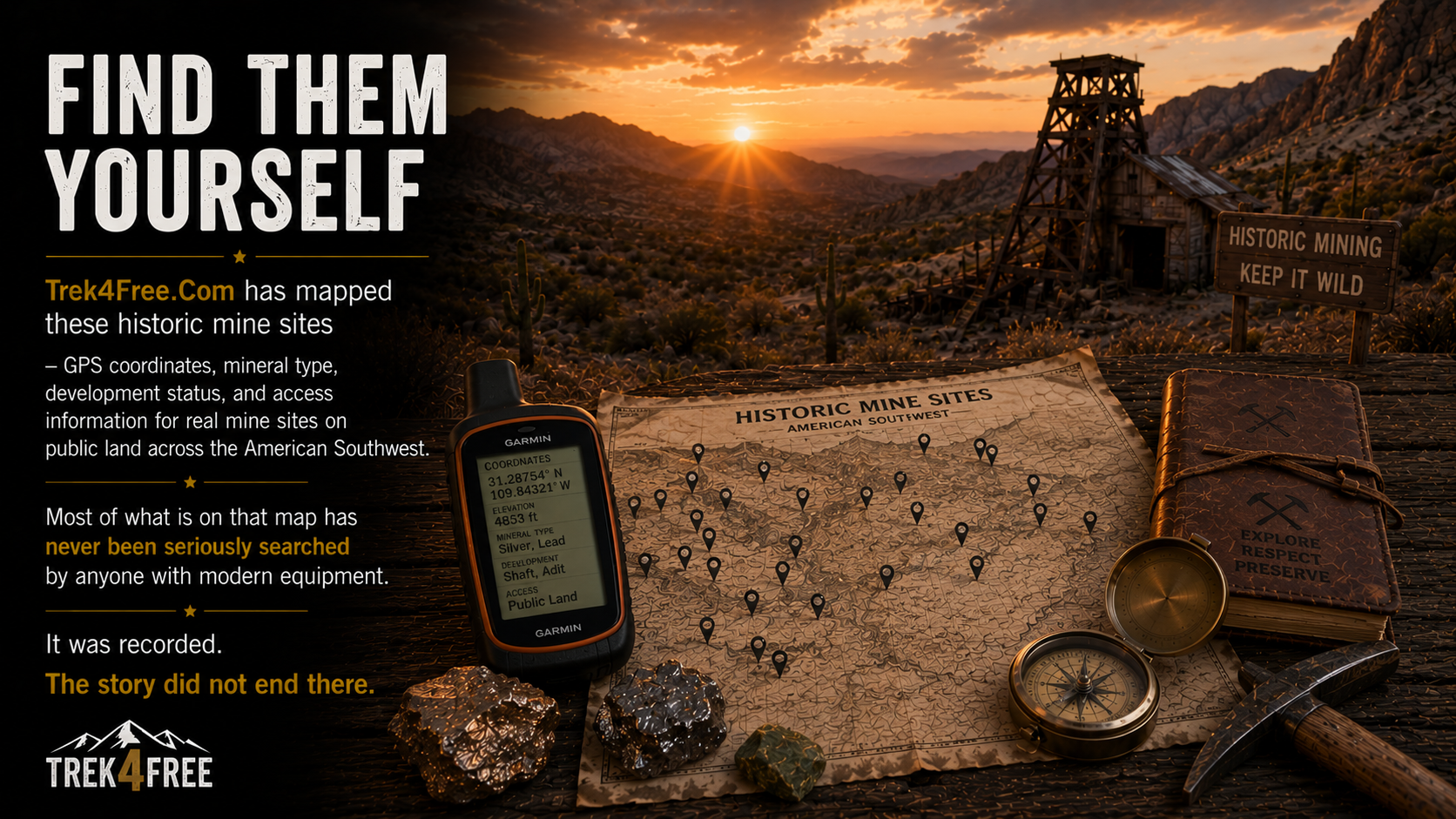
Trek4Free has mapped historic mine sites from the USGS Mineral Resources Data System — GPS coordinates, mineral type, development status, and access information for real mine sites on public land across the American Southwest.
Most of what is on that map has never been seriously searched by anyone with modern equipment. The USGS recorded the location and moved on. The story did not end there.
→ Explore Historic Mine Sites on Trek4Free
If You Find Something
On federal public land — look freely. Collect surface specimens for personal use. Do not excavate or disturb any site older than 50 years. The Archaeological Resources Protection Act makes that a federal crime with serious penalties.
On Padre Island National Seashore after a storm — photograph everything in place before touching it. Report finds to the National Park Service. Texas owns all submerged cultural resources in state waters. Reporting puts your name in the official record.
The treasure hunter who reports a find gets their name attached to history. The one who pockets it gets a federal charge.
And honestly — a silver disk with documentation and a discoverer on record is a piece of history. A silver disk in your garage is just a rock nobody can explain.
The Practical Guide
The history is in this article. The mechanics — how to use the USGS MRDS database to find recorded mine sites, how to file a mining claim under the 1872 Mining Act, what metal detector equipment works for silver and gold, how to read BLM land records, and what you can legally do when you find something — live in the companion guide.
→ How to Claim a Mine: The Practical Legal Guide (coming soon)
The maps are free. The land is yours. Now you know what you’re looking for.
Trek4Free Treasure Series
- What Happened on the Lamar Peninsula →
- The Pirate, the Frontiersman, and the Lost Texas Silver Mine →
- Three Ships, One Storm, and the Coins That Still Wash Up →
- Victorio Peak, New Mexico — coming soon
- The Lost Adams Diggings — coming soon
- Colossal Cave and the Wells Fargo Silver — coming soon