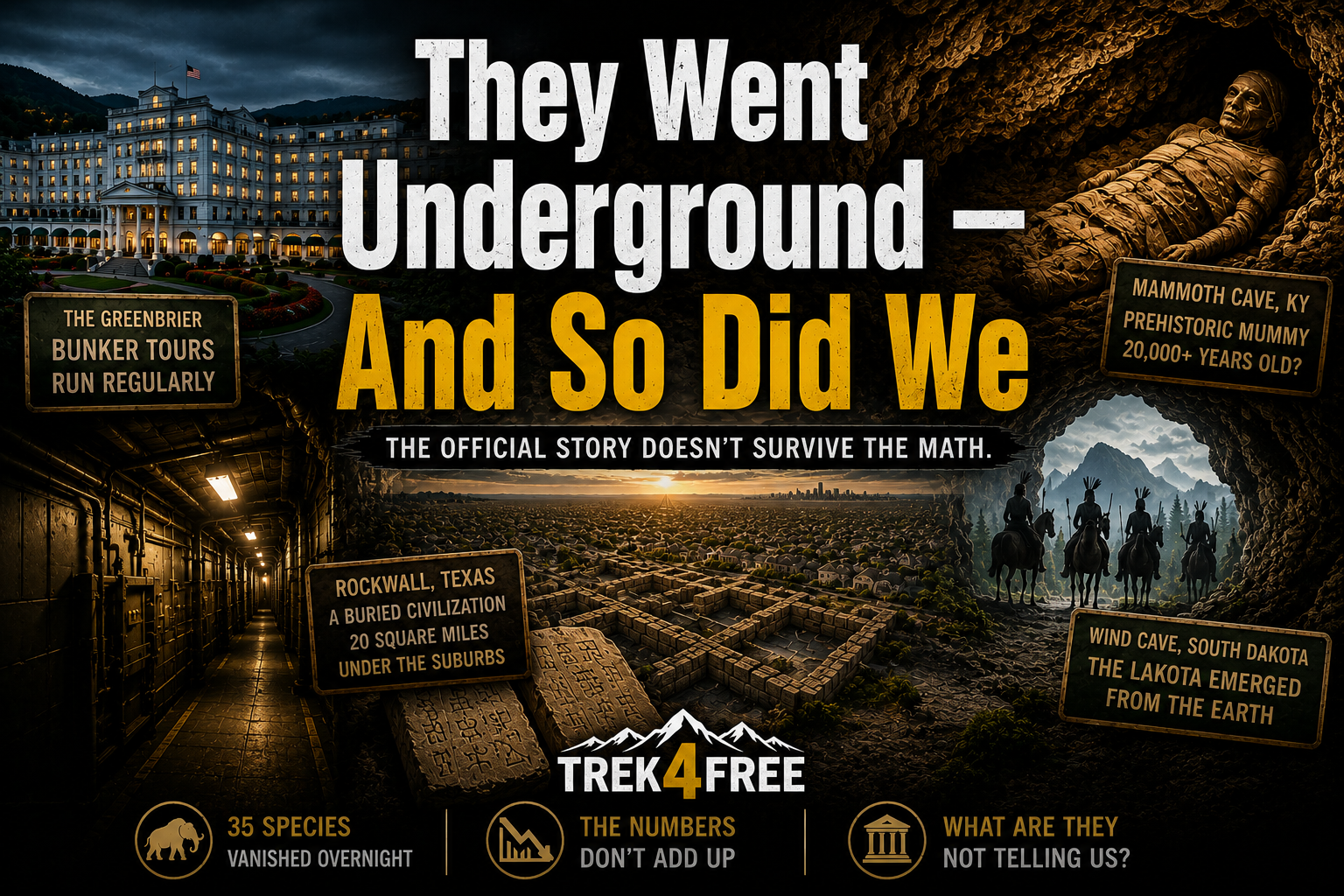
They Went Underground — And So Did We
The hotel is still open.
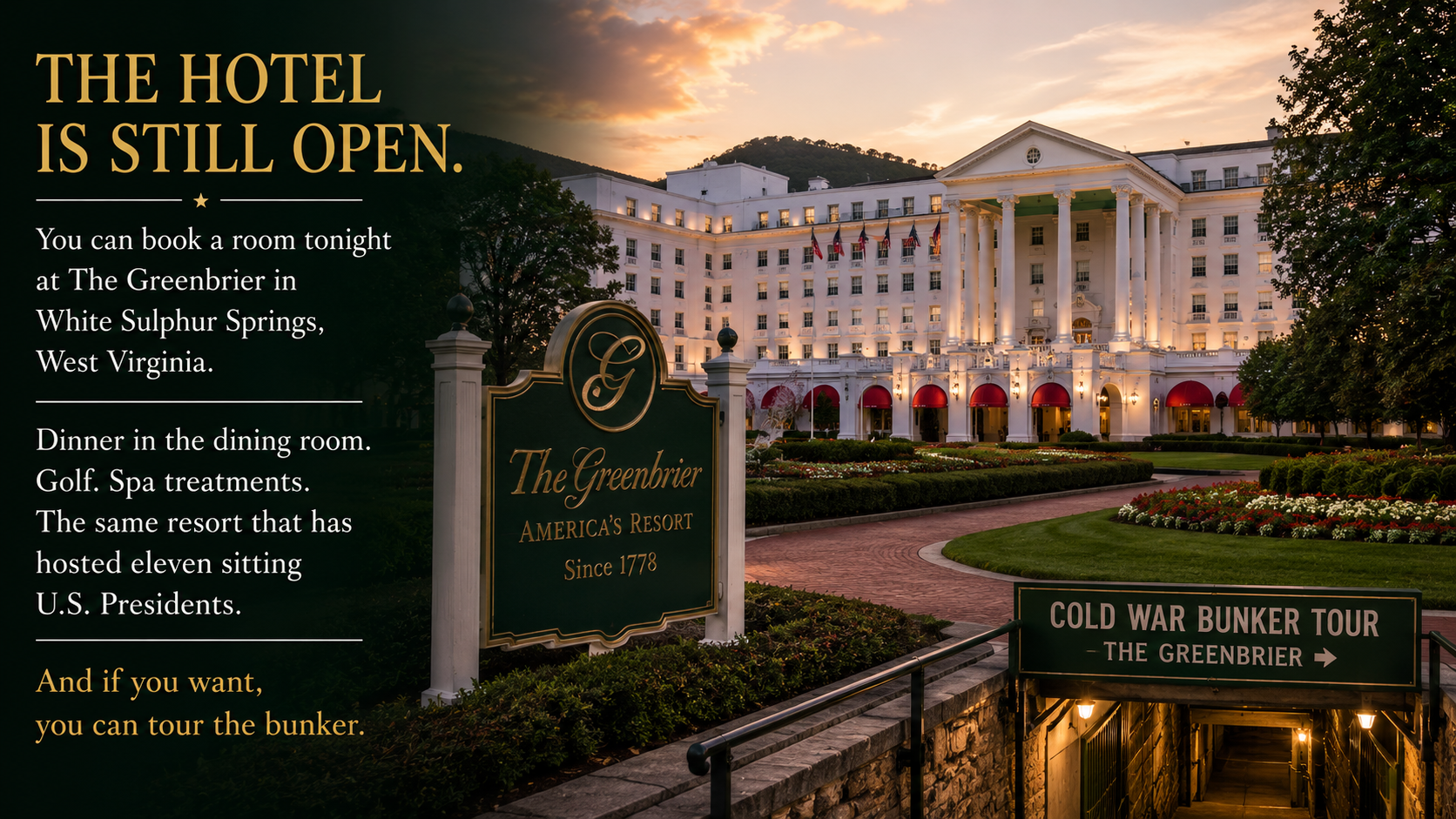
You can book a room tonight at The Greenbrier in White Sulphur Springs, West Virginia. Dinner in the dining room. Golf. Spa treatments. The same resort that has hosted eleven sitting U.S. Presidents.
And if you want, you can tour the bunker.
In 1958, the United States government secretly built a facility beneath The Greenbrier’s new West Wing. The workers were told they were constructing a conference center and exhibition hall. Nobody was told what they were actually building.
What they built was a city underground.
Project Greek Island. Designed to house all 535 members of Congress plus approximately 1,100 support staff. Eighteen-inch steel blast doors. Decontamination chambers. A full broadcast facility to let Congress address the American people after nuclear war. A hospital. Diesel generators. Years of food stored and rotated.
A permanent maintenance staff lived on-site for thirty-one years, posing as hotel employees, keeping everything operational and ready.
A Washington Post reporter named Ted Gup exposed it in 1992. The government immediately decommissioned it — a secret facility is useless once known. The Greenbrier turned it into a tourist attraction.
Tours run today. You can walk through the blast doors. You can stand in the dormitory where the Senate would have slept.
Here is the thing that matters.
The most powerful people on earth — people with access to every scientific resource, every rational analysis, every capability the United States government could provide — looked at what was coming and dug.
Not metaphorically. Literally. They moved earth, poured concrete, sealed steel doors, and stocked years of food. Because when the world above becomes dangerous, humans go underground.
They always have.
The question is what they were running from.
What Actually Happened 12,000 Years Ago
Before we go underground, we need to talk about what was above.
Thirty-five species of large animals disappeared from North and South America between 12,000 and 10,000 years ago. Mammoths. Mastodons. Saber-toothed cats. Dire wolves. Giant ground sloths the size of elephants. American horses. Camels. Giant beavers. Glyptodonts — armadillos the size of Volkswagens.
Gone. All of them. In what geologists call a blink.
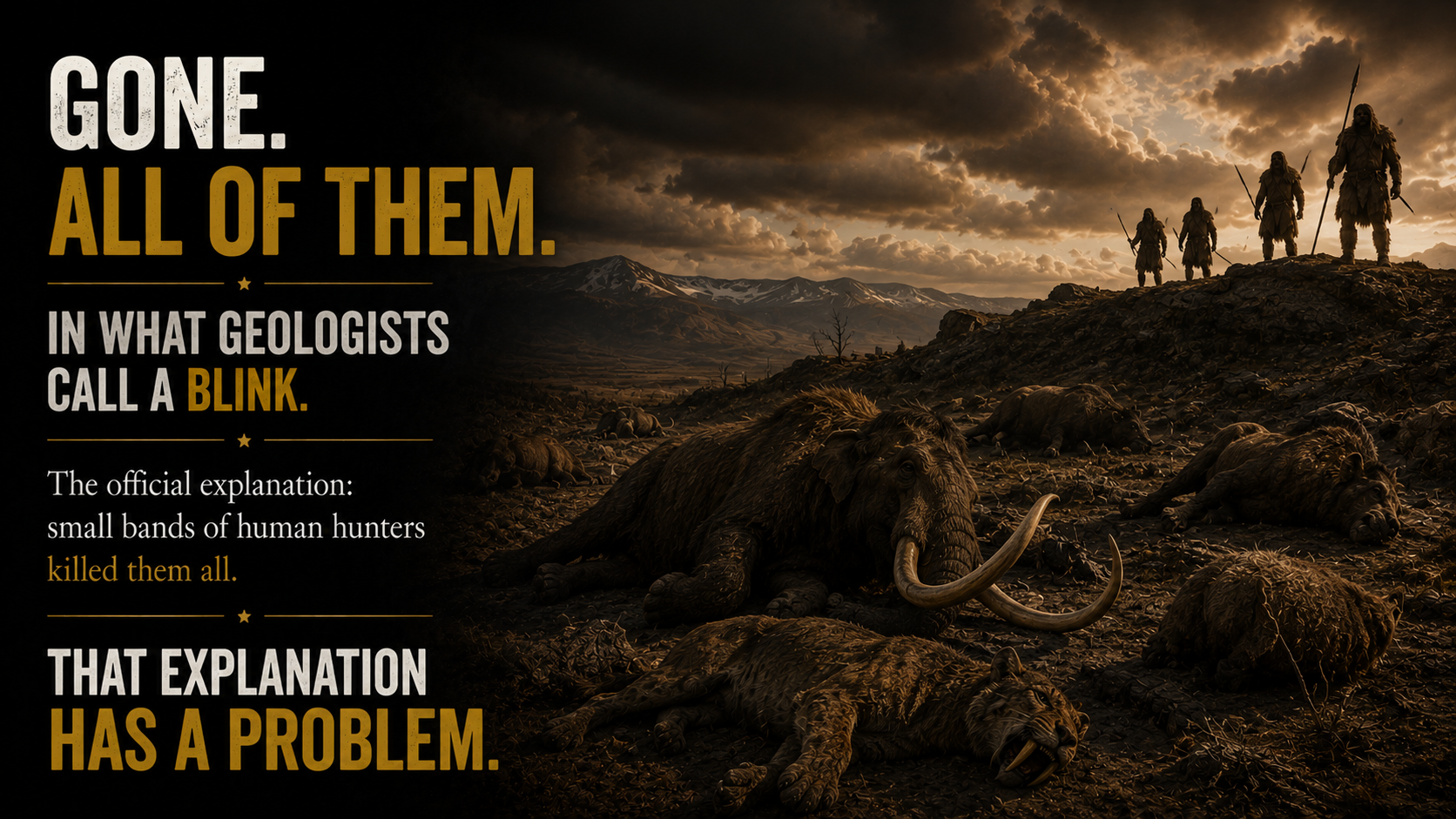
The official explanation: small bands of human hunters killed them all.
That explanation has a problem.
In Africa — where modern humans evolved and lived alongside megafauna for hundreds of thousands of years — most of those large animals still exist today. Elephants. Lions. Hippos. Rhinos. Because when humans and megafauna evolve together, they develop a balance. The animals learn to fear humans, populations adjust, the system stabilizes.
The North American extinction theory requires newly arrived hunters — small bands with stone-tipped spears — to have driven 35 species simultaneously to extinction across two continents in a few thousand years. Without leaving a hunting record that matches the scale of the kill. Without doing the same thing in Africa, where they had hundreds of thousands of years to do it.
That is not math. That is speculation wearing the costume of science.
In 2007, a team of scientists published a paper in the Proceedings of the National Academy of Sciences — not a fringe journal, the most prestigious scientific publication in the United States. Their evidence: a thin layer found at sites across four continents, sitting precisely at the stratigraphic boundary where the megafauna disappear. In that layer: nanodiamonds, platinum, iridium, shocked quartz. The same chemical fingerprint found at every confirmed cosmic impact site in the geological record.
Something hit. Around 12,900 years ago. The sky caught fire. Ice sheets destabilized. Floodwaters surged across continents. Temperatures dropped catastrophically. The event is called the Younger Dryas impact, and the evidence for it is in the rock.
And whatever civilization existed before it — reset.
Built Before It Should Exist
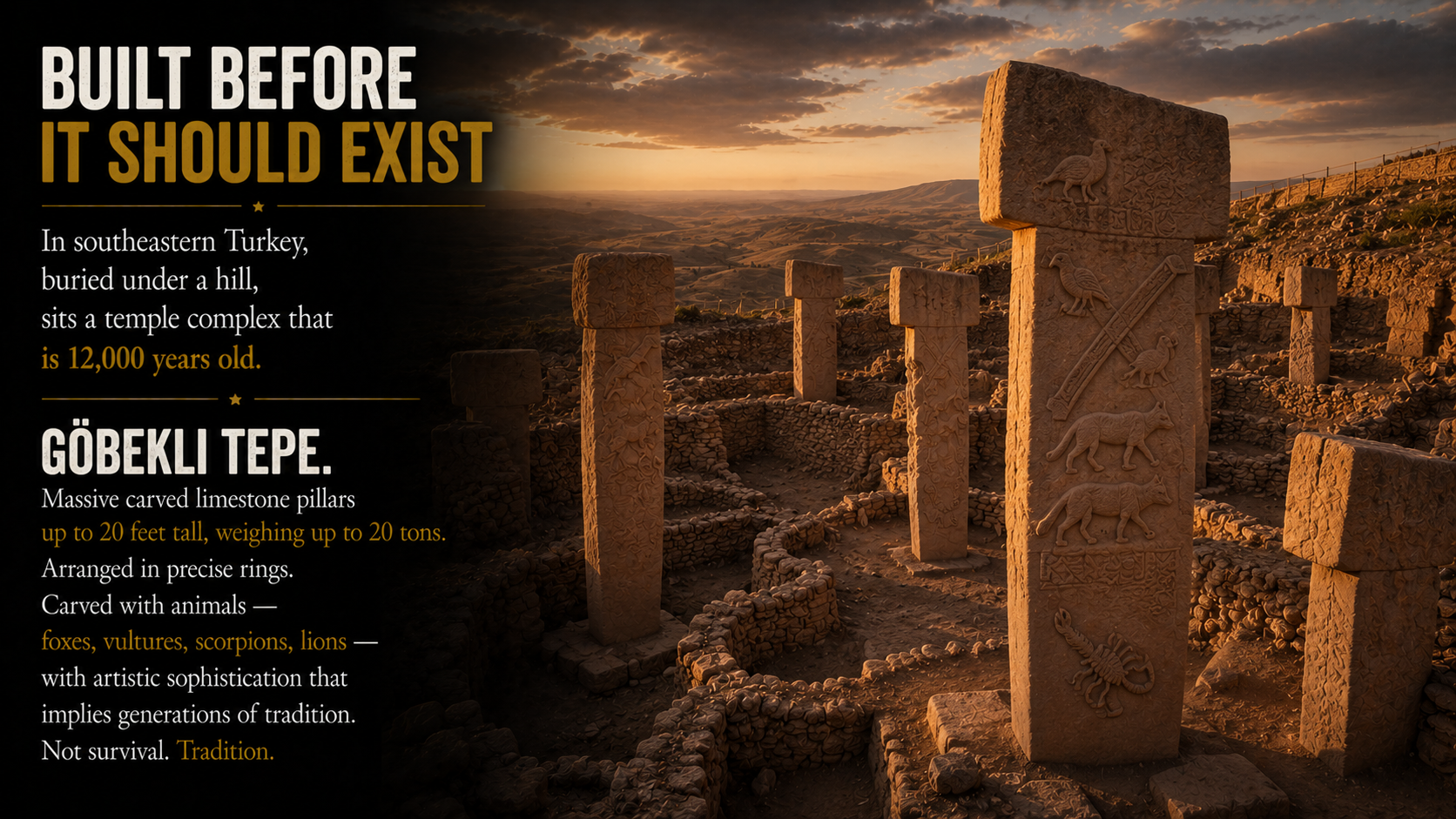
In southeastern Turkey, buried under a hill, sits a temple complex that is 12,000 years old.
Göbekli Tepe. Massive carved limestone pillars up to 20 feet tall, weighing up to 20 tons. Arranged in precise rings. Carved with animals — foxes, vultures, scorpions, lions — with artistic sophistication that implies generations of tradition. Not survival. Tradition.
The academic consensus: hunter-gatherers built it. People with no agriculture, no settled society, no food surplus to feed a construction workforce.
Then they deliberately buried it. Every bit. Covered it in rubble and sediment and walked away.
No one has a satisfying explanation for why a hunter-gatherer society would build the most sophisticated structure of the ancient world — and then bury it.
Unless they were not walking away. Unless they were preserving it.
From something coming.
The Ones Who Went Down
If something catastrophic happened 12,000 years ago — and the geological record says something did — then what we find underground is not mythology. It is response.
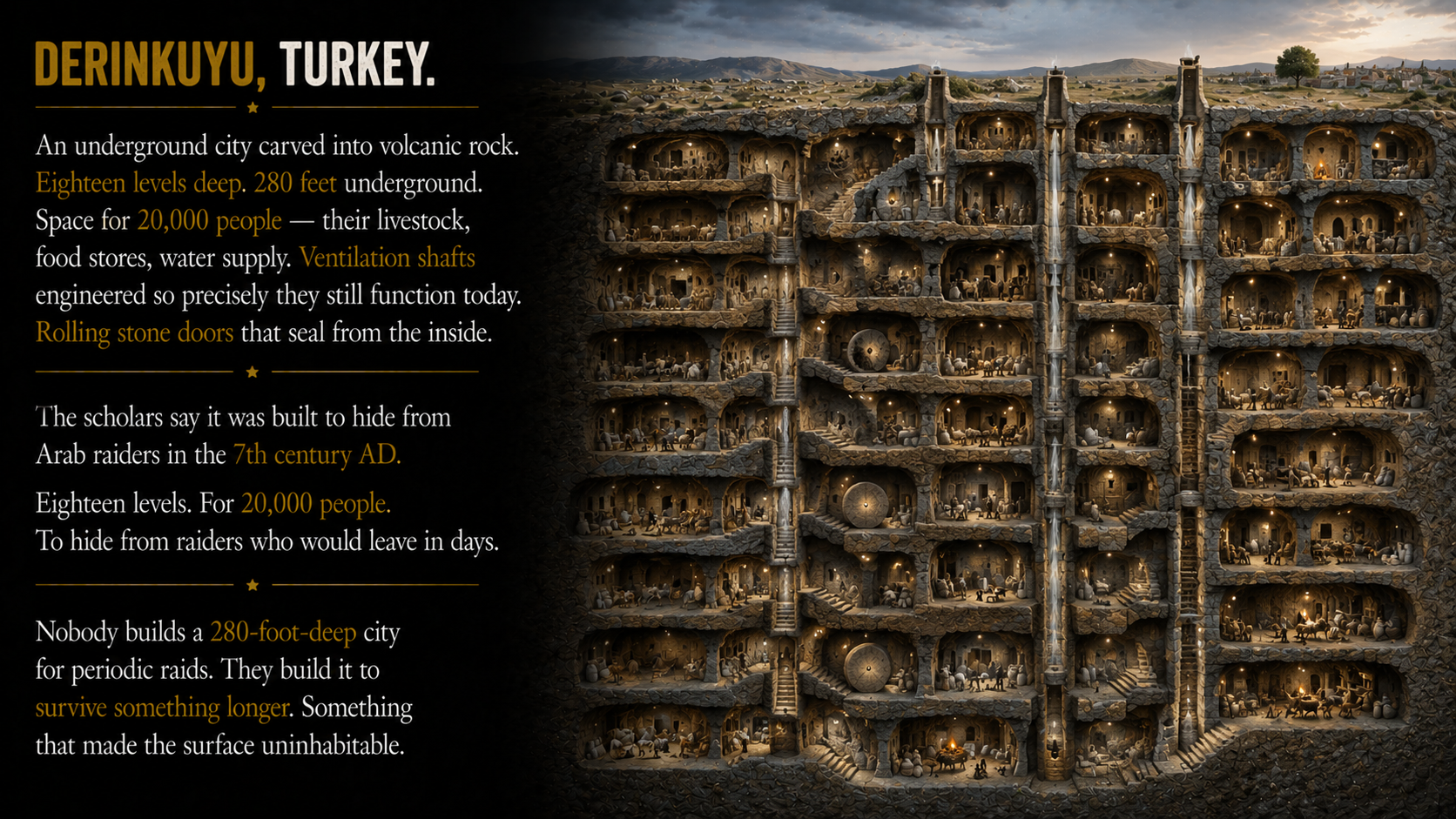
Derinkuyu, Turkey. An underground city carved into volcanic rock. Eighteen levels deep. 280 feet underground. Space for 20,000 people — their livestock, food stores, water supply. Ventilation shafts engineered so precisely they still function today. Rolling stone doors that seal from the inside.
The scholars say it was built to hide from Arab raiders in the 7th century AD.
Eighteen levels. For 20,000 people. To hide from raiders who would leave in days.
Nobody builds a 280-foot-deep city for periodic raids. They build it to survive something longer. Something that made the surface uninhabitable.
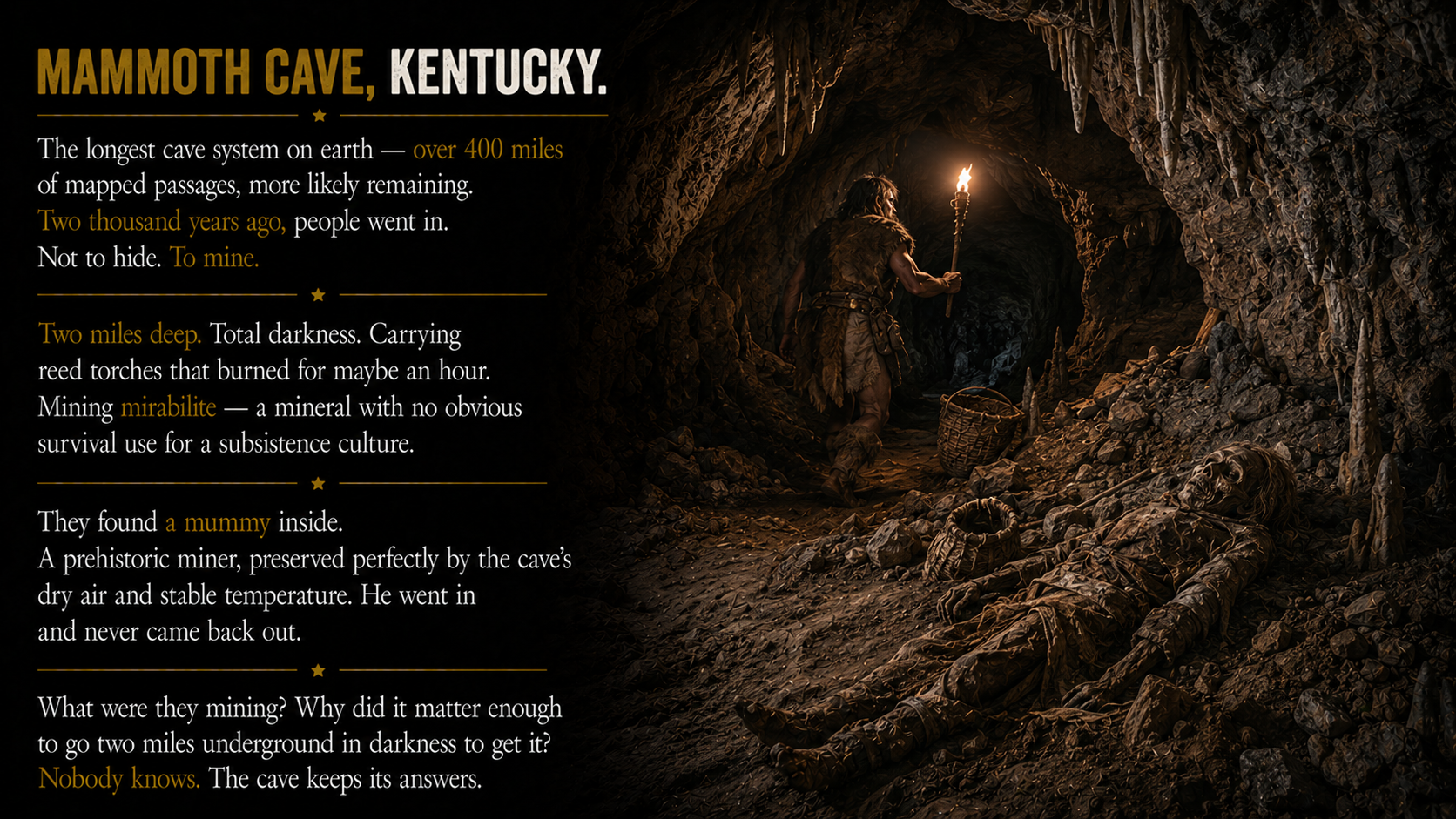
Mammoth Cave, Kentucky. The longest cave system on earth — over 400 miles of mapped passages, more likely remaining. Two thousand years ago, people went in. Not to hide. To mine.
Two miles deep. Total darkness. Carrying reed torches that burned for maybe an hour. Mining mirabilite — a mineral with no obvious survival use for a subsistence culture.
They found a mummy inside. A prehistoric miner, preserved perfectly by the cave’s dry air and stable temperature. He went in and never came back out.
What were they mining? Why did it matter enough to go two miles underground in darkness to get it? Nobody knows. The cave keeps its answers.
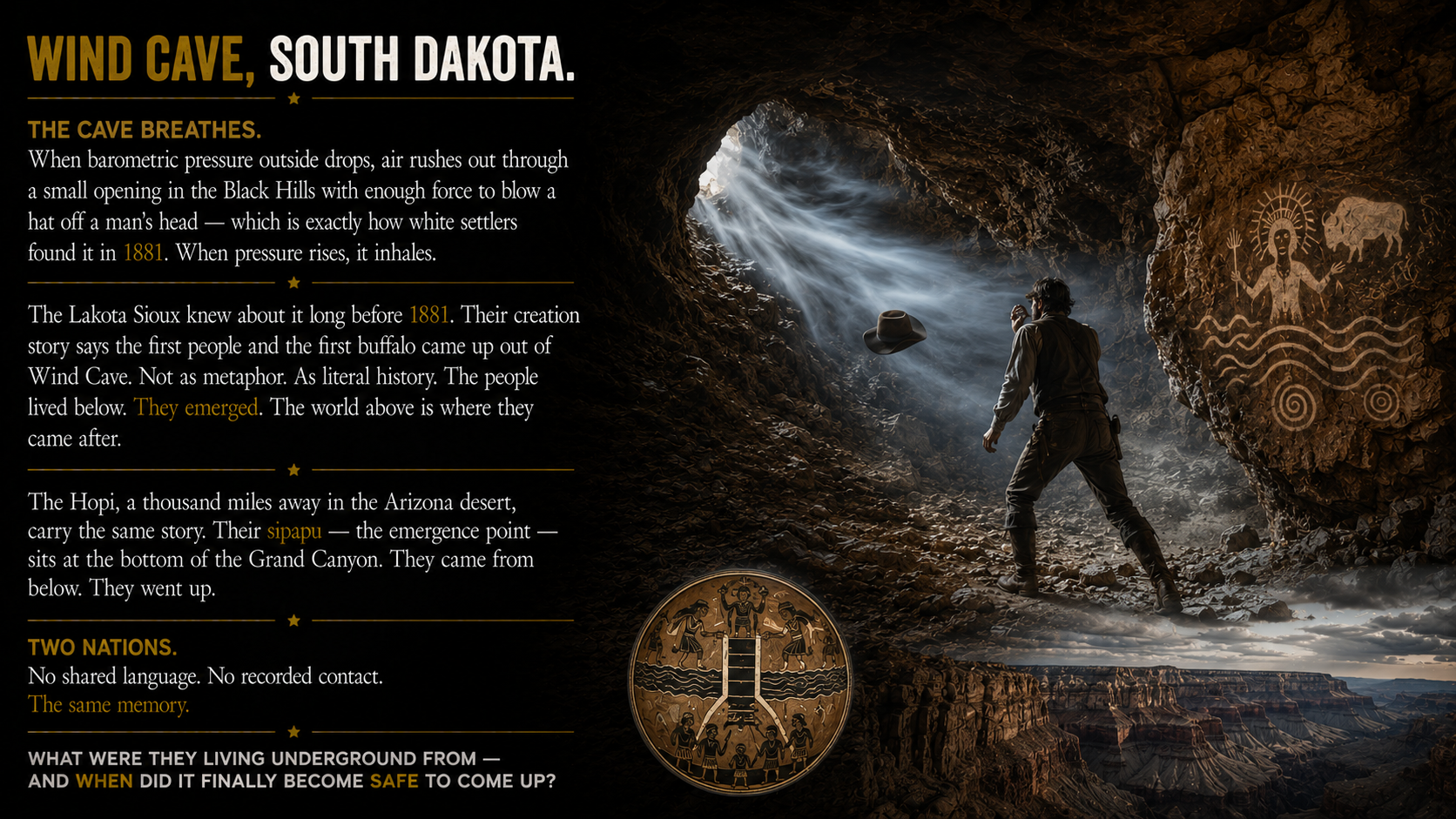
Wind Cave, South Dakota. The cave breathes.
When barometric pressure outside drops, air rushes out through a small opening in the Black Hills with enough force to blow a hat off a man’s head — which is exactly how white settlers found it in 1881. When pressure rises, it inhales.
The Lakota Sioux knew about it long before 1881. Their creation story says the first people and the first buffalo came up out of Wind Cave. Not as metaphor. As literal history. The people lived below. They emerged. The world above is where they came after.
The Hopi, a thousand miles away in the Arizona desert, carry the same story. Their sipapu — the emergence point — sits at the bottom of the Grand Canyon. They came from below. They went up.
Two nations. No shared language. No recorded contact. The same memory.
What were they living underground from — and when did it finally become safe to come up?
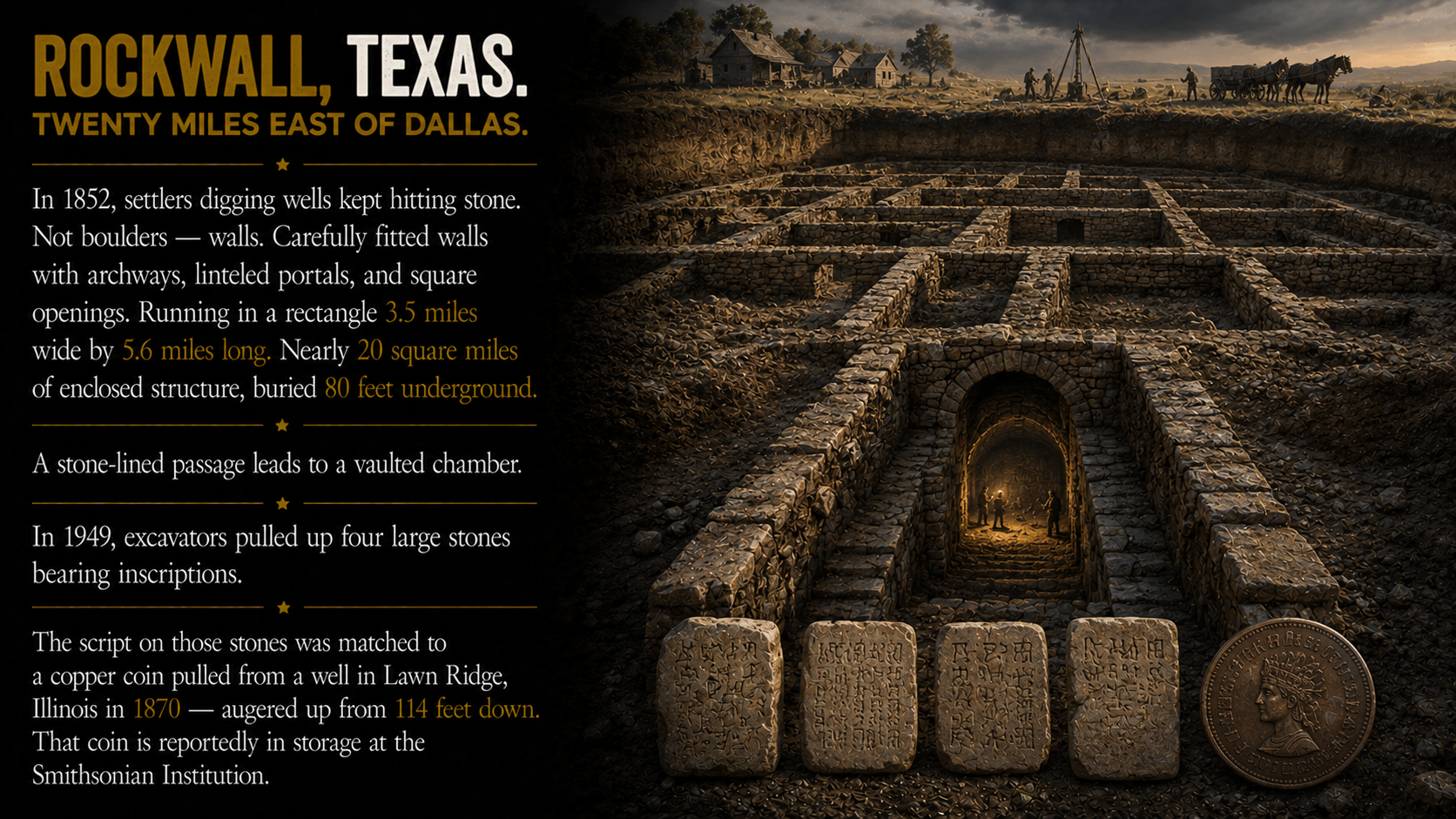
Rockwall, Texas. Twenty miles east of Dallas.
In 1852, settlers digging wells kept hitting stone. Not boulders — walls. Carefully fitted walls with archways, linteled portals, and square openings. Running in a rectangle 3.5 miles wide by 5.6 miles long. Nearly 20 square miles of enclosed structure, buried 80 feet underground.
A stone-lined passage leads to a vaulted chamber.
In 1949, excavators pulled up four large stones bearing inscriptions. The script on those stones was matched to a copper coin pulled from a well in Lawn Ridge, Illinois in 1870 — augered up from 114 feet down. That coin is reportedly in storage at the Smithsonian Institution.
The wall’s composition includes minerals — niobium, tourmaline, titanite — that don’t naturally occur together in that region. In 1999, researchers found the structure generates measurable electrical energy when vibrated. Researchers who study such things have a name for that property: piezoelectric. The same property that makes granite-and-quartz structures resonate under pressure.
The town has been named Rockwall since 1873. The walls are still there, under the suburbs, under the shopping centers, under the new housing developments going in every year.
Whatever civilization built that enclosure — 20 square miles of fitted stone, a vaulted chamber, inscriptions matching artifacts found in another state — is gone. The walls are not.
Who Controls What We’re Allowed to Know
The Church said the earth was flat because a round earth threatened the cosmology that maintained the Church’s authority. Galileo proved otherwise. The Church placed him under house arrest for the last nine years of his life.
The mechanism was not stupidity. It was institutional self-preservation.
Academic institutions run the same mechanism with different tools. Grant funding flows toward conclusions that confirm previous grant-funded conclusions. Careers are built on established timelines. A geologist who examines the weathering on the Sphinx and concludes — based on the geology alone, not ideology — that it must be at least 10,000 years old gets attacked by Egyptologists. Not because his geology is wrong. Because his geology is expensive.
Dr. Robert Schoch of Boston University did that analysis in the 1990s. The erosion patterns on the Sphinx show water damage consistent with heavy, sustained rainfall. Egypt has not had that kind of rainfall since before 7000 BC at the earliest. The geology says the Sphinx is older than Egypt.
The Egyptology establishment pushed back hard. They did not produce geological counterevidence. They produced credential challenges.
There is a coin from a well in Illinois that carries the same script as stones pulled from a buried city in Texas. It sits in a Smithsonian drawer. There is no exhibit.
The question is not whether powerful institutions suppress inconvenient evidence. The question is what evidence is inconvenient enough to suppress — and what picture assembles itself from the pieces they missed.
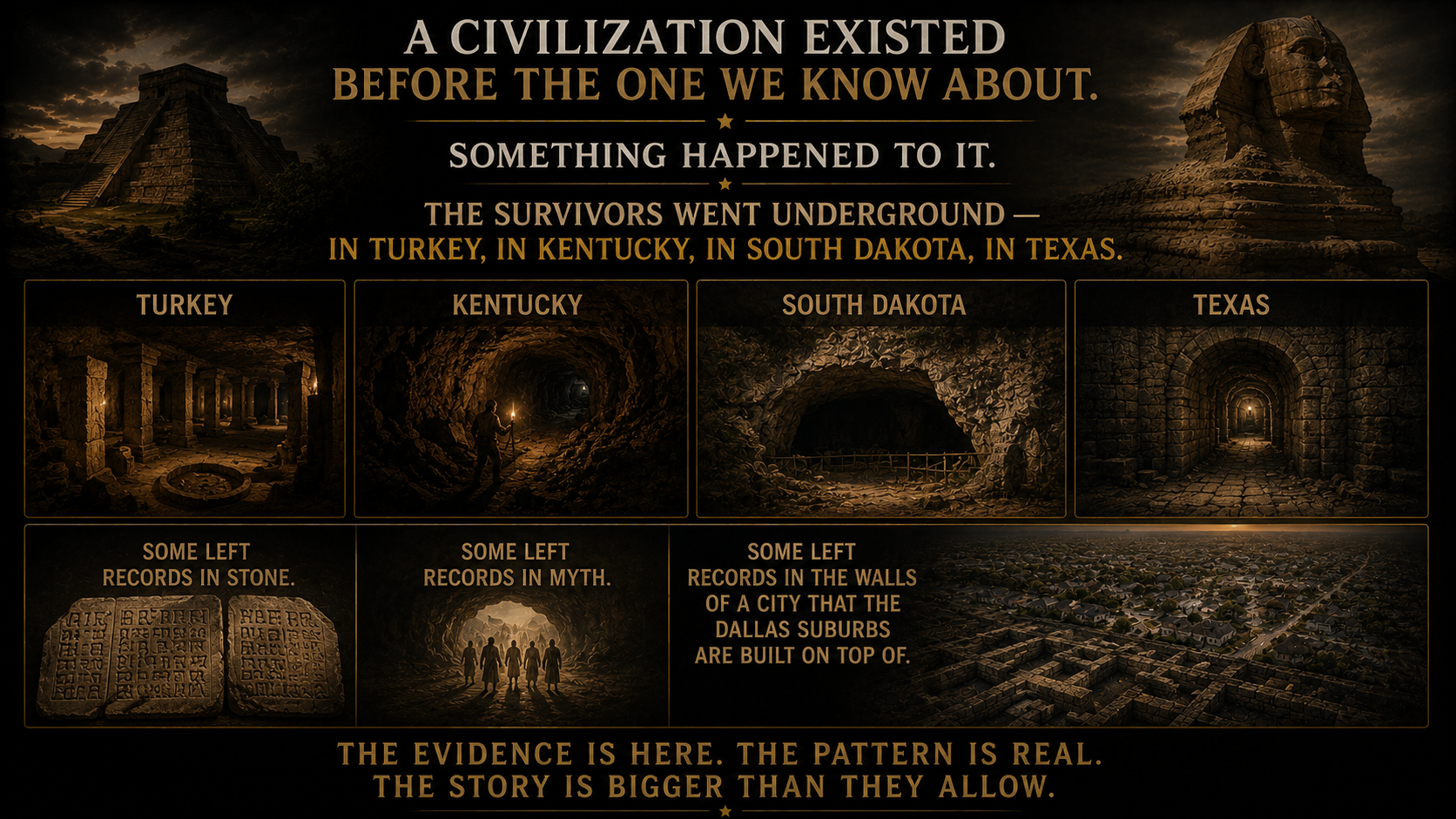
A civilization existed before the one we know about. Something happened to it. The survivors went underground — in Turkey, in Kentucky, in South Dakota, in Texas. Some left records in stone. Some left records in myth. Some left records in the walls of a city that the Dallas suburbs are built on top of.
The most powerful people in the 20th century, with full knowledge of history, looked at what was coming and did the same thing. They built Project Greek Island and stocked it with years of food and called it a hotel renovation.
The instinct is not ancient. The instinct is human.
And it keeps getting activated.
What are we being told not to look for?
Trek4Free is going deeper on each of these locations. Every one of them is real. Every one of them is visitable. The ground is still there.
The Greenbrier — White Sulphur Springs, West Virginia. Bunker tours run regularly. The hotel is open year-round. New River Gorge National Park is 45 minutes away — free camping, world-class whitewater, Appalachian trail access. The same mountains the bunker is buried under.
Wind Cave National Park — Hot Springs, South Dakota. Free to visit. Cave tours available year-round at modest cost. One of the longest cave systems in the world, in the heart of the Black Hills. Bison still graze on the surface above the place the Lakota say everything began.
Mammoth Cave National Park — Mammoth Cave, Kentucky. The longest cave system on earth. Free day-use access. Cave tours run daily. The passage where the prehistoric miner’s mummy was found is deep in the system — and the cave goes deeper still.
Rockwall County Historical Foundation Museum — Rockwall, Texas. Twenty miles east of Dallas. Exhibits on the rock wall’s history and the ongoing debate about its origins. Sections of the wall have been exposed and are accessible. Free to visit.