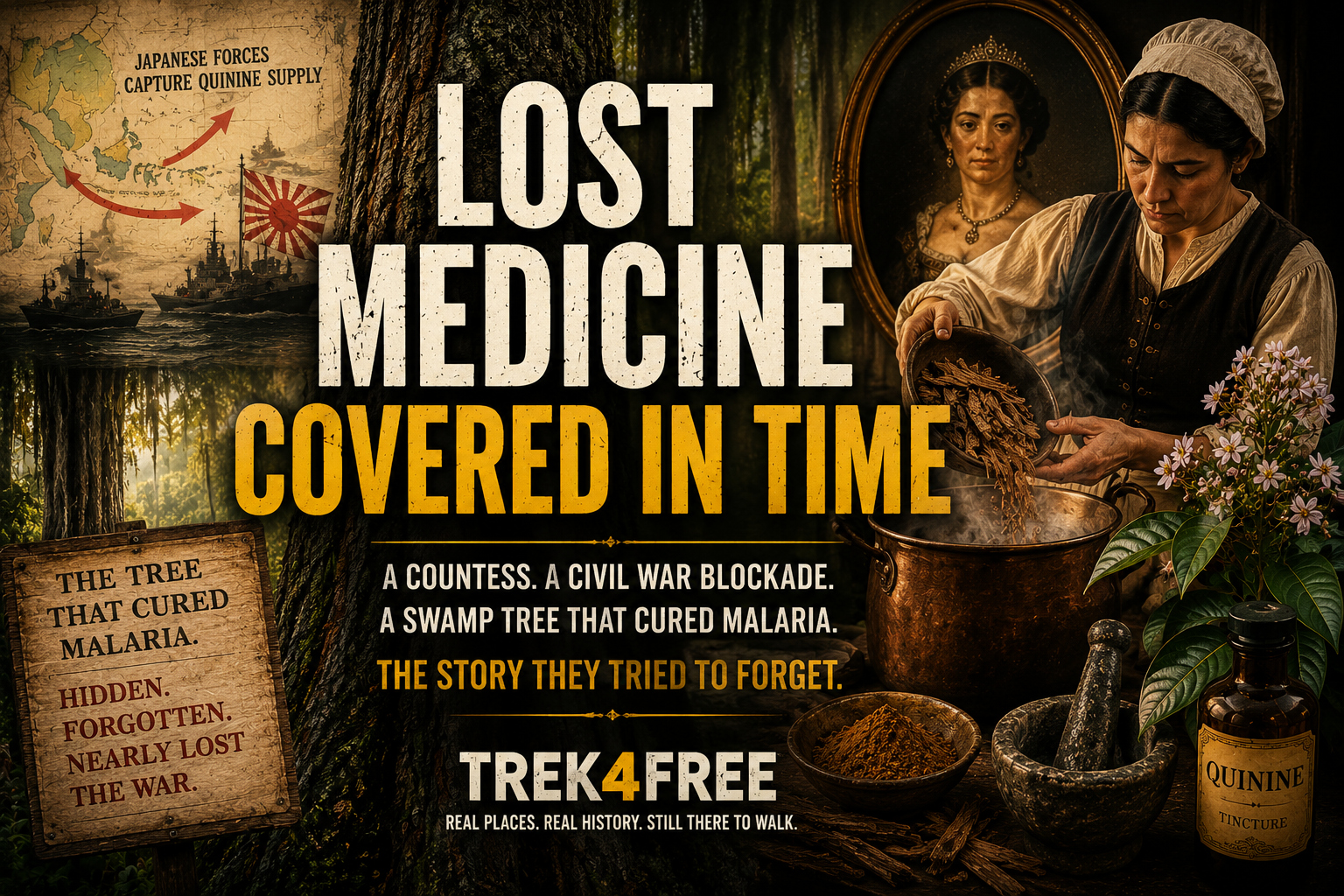
Lost Medicine — Covered in Time
It starts as a headache.
Then the chills. The kind that rattle your teeth in July heat.
Then the fever. 104. 105. The kind that makes you see things that aren’t there.
No urgent care. No IV drip. No prescription with a list of side effects longer than your arm.
You have two choices: wait and see if your body wins. Or find the bark.
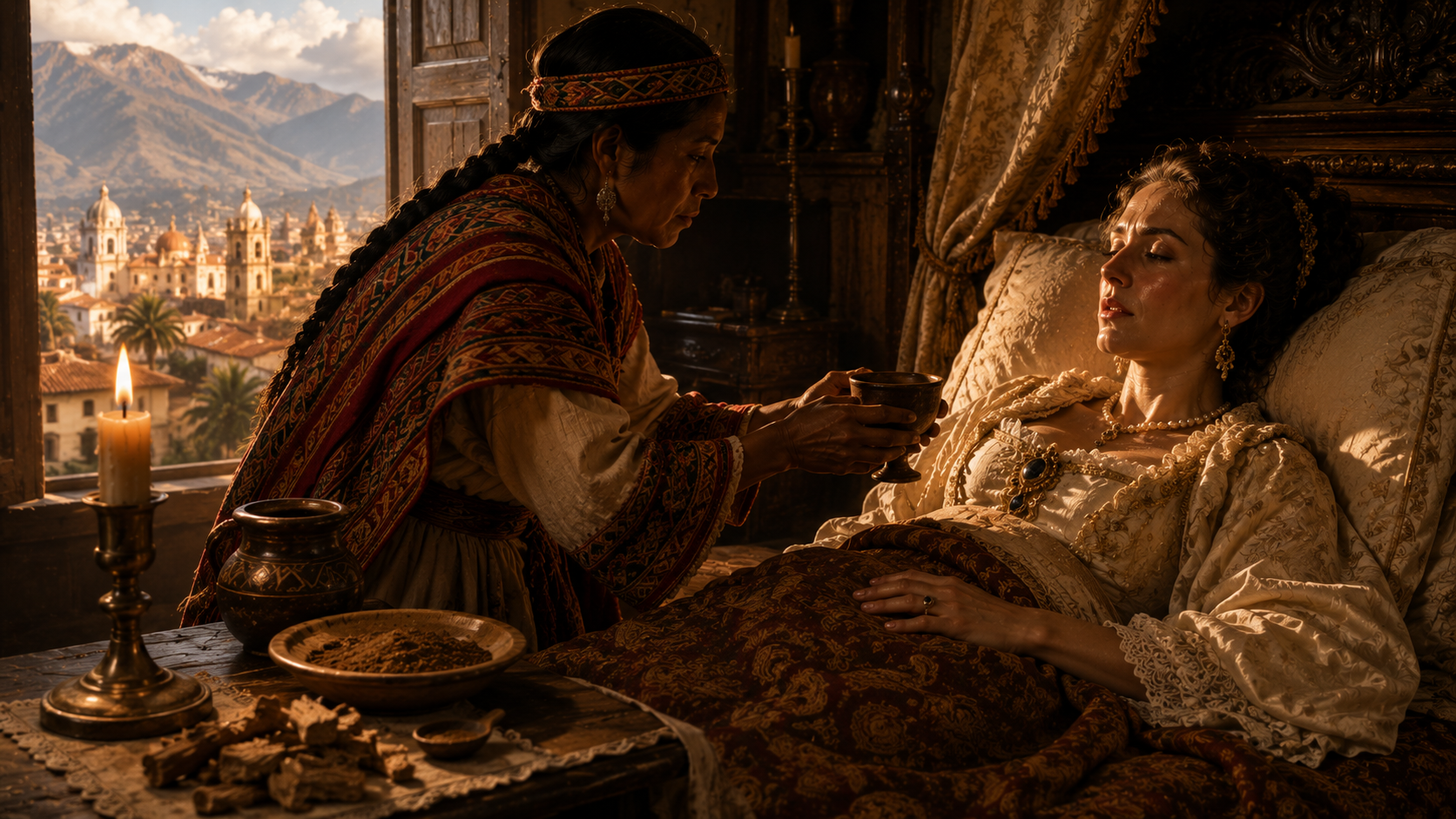
The Countess — Lima, Peru, 1638
Her name was Ana de Osorio. Countess of Chinchón. Wife of the Spanish Viceroy — the most powerful woman in South America.
The fever had her.
The Quechua people of the Andes brought something to the Spanish. The bark of a mountain tree. Ground to powder. Dissolved in water.
She drank it.
The fever broke. It didn’t come back.
The story says she had the bark distributed to the poor of Lima dying of the same fever. Word spread. Jesuit missionaries carried it back to Europe. They called it Jesuit’s Bark.
Protestant Europe refused it for decades. If the Catholics were pushing it, it had to be a trick.
Oliver Cromwell — the most powerful man in England — died of malaria rather than take Jesuit’s Bark.
Pride killed him. The medicine was sitting right there.
The tree was eventually named Cinchona — after the Countess. The active compound inside the bark — quinine — wouldn’t be identified for another 182 years.
The Most Valuable Bark in the World
For two centuries, cinchona bark is the only reliable malaria treatment on earth.
Empires are built on it. Colonies are held by it. Armies live or die by their supply of a single South American tree.
The British — practical as always — mix the powdered bark with gin and sugar to make it drinkable.
That is where tonic water comes from. The gin and tonic is empire medicine. Every time you order one at a bar, you are drinking the descendant of a malaria treatment developed in the 1600s.
But cinchona only grows in the Andes — Peru, Bolivia, Ecuador. Later the Dutch transplant it to Java in the East Indies. The supply is controlled by whoever controls the mountains and the plantation. And in America — there is none.
Which becomes a very serious problem in 1861.
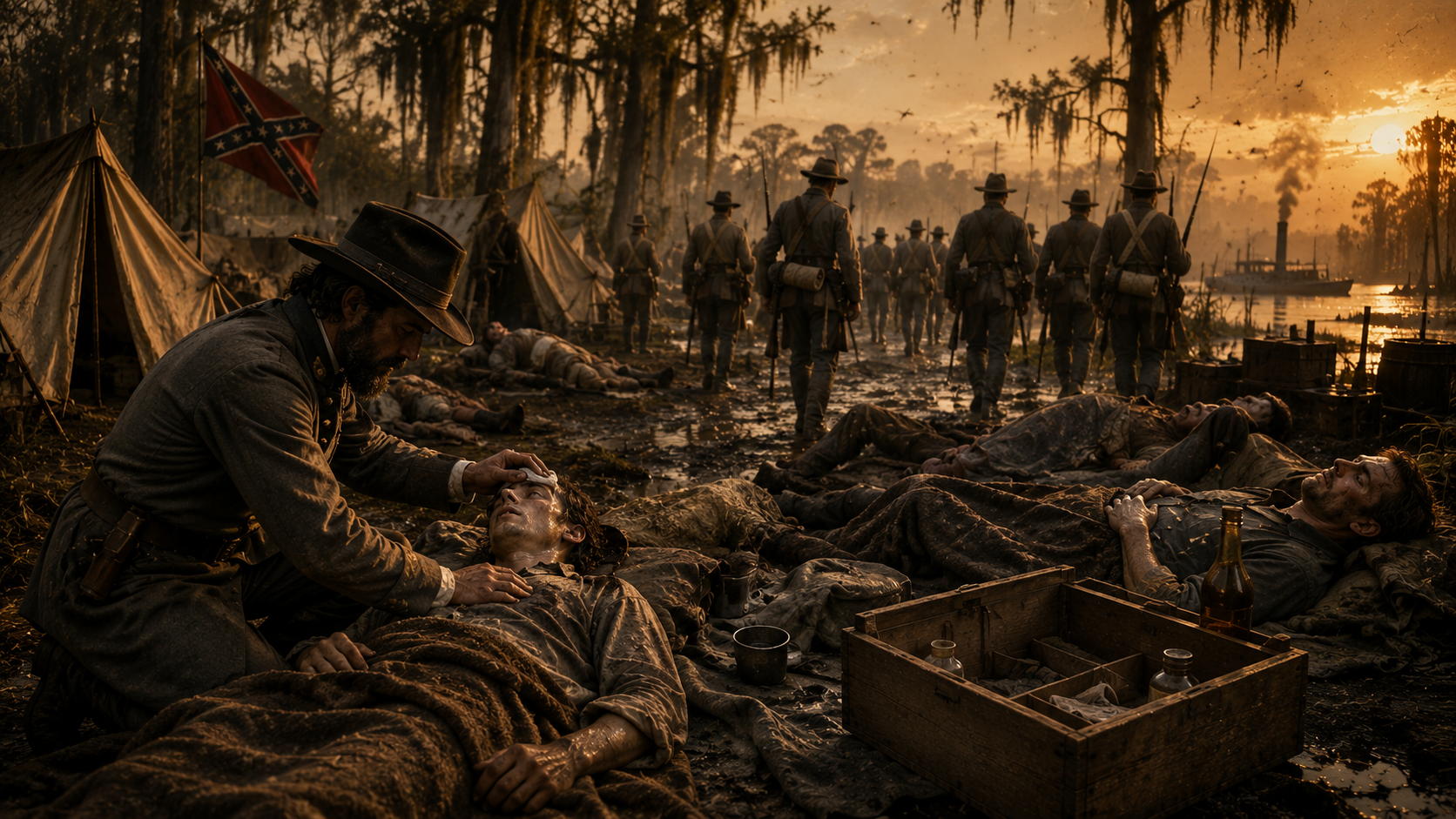
The Confederate Gap — and the Paid Collectors
The Union blockade cuts the Confederacy off from everything imported.
Including quinine.
Confederate soldiers are dying of malaria by the thousands — not from bullets, not from cannon. From mosquitoes. The Confederacy has an army and no medicine for the fever that is eating it alive.
A Virginia botanist named Francis Peyre Porcher is commissioned by the Confederate government to catalogue every Southern plant that could replace what the blockade cut off. He publishes it in 1863 — Resources of the Southern Fields and Forests.
He finds it.
Pinckneya bracteata. Georgia fever bark. Growing in the wet forests and swamp edges of Georgia, Florida, and South Carolina — the whole time. Named for Charles Cotesworth Pinckney, a South Carolina Founding Father who signed the Constitution.
The Cherokee and Creek had been using it for fevers for generations before any European arrived. William Bartram — the great Southern naturalist — documented it in 1773. Nobody in Richmond had bothered to ask.
Quinine — extracted from cinchona bark — is not folk medicine. It is still an FDA-approved drug. It became the foundation of modern malaria treatment. The Cherokee were using the American version of it for centuries before Western medicine gave it a Latin name. The Georgia militiamen who survived swamp fever and shipped to Cuba carried that knowledge in their blood — something their grandmothers taught them that pharmaceutical companies would later figure out how to isolate, patent, and sell.
And just like ginseng in the Appalachian mountains — people were paid to collect it.
Families who knew the swamps knew where the trees grew. They brought in bark for cash, the same way Appalachian mountain families brought in sang. Wild harvesting. Family knowledge of locations kept secret and passed down. The same economy, a different tree.
The war ends. The blockade lifts. Quinine comes back through normal supply chains.
The fever bark gets covered again. The paid collectors go back to ginseng.
The knowledge goes quiet. Until it’s needed again.
Japan’s Masterstroke — and the Birth of Synthetic Medicine
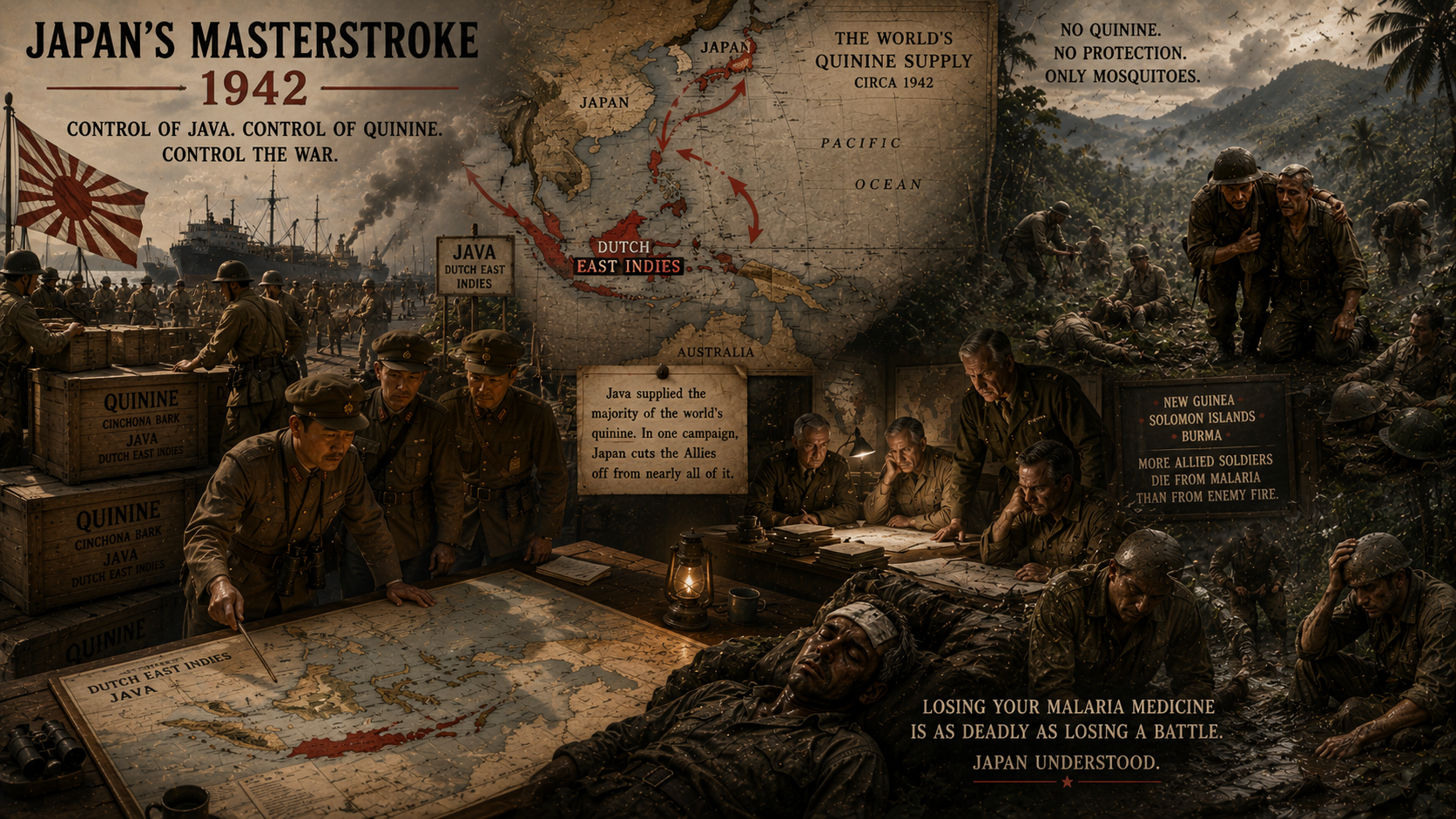
Japan invades the Dutch East Indies. Java. Home of the world’s cinchona plantations.
They know exactly what they are capturing.
Java supplied the majority of the world’s quinine. In one campaign, without targeting a single Allied soldier directly, Japan cuts the Allied forces off from nearly all of it.
Allied commanders in the Pacific watch their armies begin to collapse — not from combat. From mosquitoes. In New Guinea, the Solomon Islands, Burma — more Allied soldiers fall to malaria than to Japanese fire. Entire divisions are combat-ineffective. Generals are sending sick men into battle because there is no one else to send.
Japan understood something the history books understate: losing your malaria medicine is as deadly as losing a battle. They may not have won the war with that single move — but they came closer than any textbook gives them credit for.
The United States is now desperate.
And desperation produces invention.
American chemists, working against the clock, develop Atabrine — a synthetic substitute. It works. It has side effects. It turns your skin yellow. Soldiers refuse to take it. The Army has to station officers at mess halls to watch men swallow it.
But it works. And now the knowledge lives in a laboratory — not in a tree.
After the war, chloroquine and other synthesized compounds replace quinine entirely. The pharmaceutical industry patents the compounds. The cinchona tree becomes a historical curiosity.
The bark that saved the world for three hundred years is now a footnote.
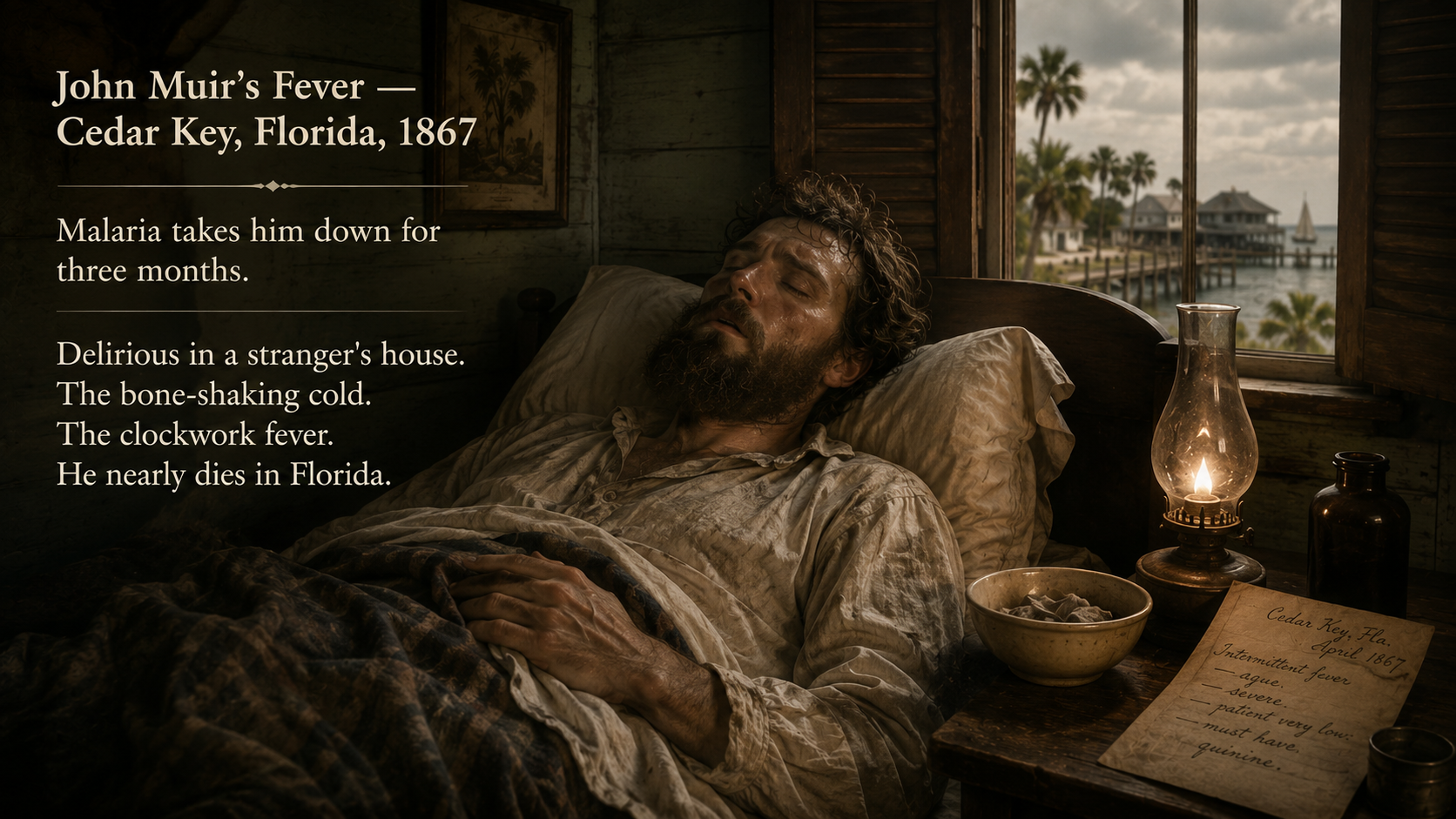
John Muir’s Fever — Cedar Key, Florida, 1867
One man understood what this fever meant before the war, before the labs, before any of it.
- John Muir begins walking from Indiana to the Gulf of Mexico — a thousand miles on foot. He wants to see the tropical plants. He reaches Cedar Key on Florida’s Gulf Coast.
Malaria takes him down for three months.
Delirious in a stranger’s house. The bone-shaking cold. The clockwork fever. He nearly dies in Florida before he ever sees California, before he ever stands in Yosemite, before he becomes the man we know.
He survives. He goes on to everything.
But those three months in the Florida swamps gave Muir something most men in a comfortable life never get — a bone-deep understanding of what it costs to survive in a place that doesn’t want you there. It changed how he saw wild land. It changed everything he wrote afterward.
His full story is coming to Trek4Free — the walk, the plants nobody else noticed, and the man who almost never made it to the mountains.
What Else Have We Forgotten
Here is what actually happened.
The quinine compound was isolated, synthesized, patented, and manufactured into a pill. The pharmaceutical industry handed us that pill and called it the answer. The bark — the thing that worked reliably for three hundred years — became folk medicine. Snake oil. Something uneducated people believed before we knew better — at the exact same moment pharmaceutical companies were synthesizing those same plants into pills and charging accordingly.
Meanwhile the pill’s side effects fill a page and a half of small print.
The Cherokee knew about Pinckneya before Columbus landed. The Quechua of Peru knew about cinchona before the Spanish arrived. That knowledge was not lost because it didn’t work. It was buried because you cannot patent a tree.
The same pattern runs through every one of these stories. Sang hunters in the Appalachian hollows keeping their patches secret because the location had cash value. Georgia families collecting fever bark for Confederate apothecaries. Generations of people who knew things the medical establishment didn’t bother to ask about — until crisis forced them to ask.
Then the crisis passed. The knowledge got covered again.
What else is growing in a swamp right now that we’ve been trained to dismiss?
Last week, a gardener at the Aransas County History Center planted an herb garden. One of the plants is called Duranta — a flowering shrub native to the Gulf Coast and tropical Americas. The description card says it treats malaria and intestinal worms. The knowledge is still out there. Someone just bothered to plant it and write it down.
That is the Foxfire moment. Happening right now. In your town.
The old way of preparing fever bark — whether cinchona from the Andes, Georgia fever bark from the Southern swamps, or Duranta from your own backyard — was never complicated. Strip the inner bark. Dry it in the shade. Boil it in water for twenty minutes. Strain it. Drink it bitter, or cut it with a little honey if you had it. Your grandmother’s grandmother knew this. The knowledge fit in one sentence.
If you grow Duranta: the leaves are what traditional medicine uses. The berries are dangerously toxic — to people, to children, to pets. Bright and golden and deadly. Do not eat them, do not let children near them. The plant that heals and the plant that harms are growing on the same branch. That is true of most things worth knowing.
The bark didn’t stop working.
We just stopped looking.
Lost Medicine — Covered in Time is part of the Trek4Free history series. Real places. Real history. Still there to walk.
Okefenokee National Wildlife Refuge, GA — Canoe and kayak trails through the Georgia swamp where fever bark still grows. Free day-use access. Stephen C. Foster State Park is the western entry.
Altamaha River WMA, GA — Georgia DNR public land in the river corridor. One of the wildest stretches of the Georgia coast. Pinckneya country.
Cedar Key, FL — The Gulf Coast town where John Muir nearly died of malaria in 1867. Still small, still wild, still worth the drive.
Chickamauga & Chattanooga National Military Park, GA — The Georgia militia that shipped to Cuba in 1898 trained and mustered near here. Free to visit, open year-round.