Car Camping Hacks That Actually Work (KISS Edition)
Car Camping Hacks That Actually Work (KISS Edition)
Keep it simple. That is the whole framework.
The outdoor industry will sell you a $60 collapsible sink, a $45 portable spice rack, and a $30 silicone campfire spatula. None of those things are the reason your camping trips go well or badly. Here are the things that actually matter — most of them cheap, some of them free, all of them discovered through trips that went wrong before they went right.
The Window Problem
Sleeping in your car means sleeping in a glass box. Everyone can see in. The sun starts cooking it at 6am. If you’re parked in a campground, you have neighbors. This is the one problem most people don’t solve adequately before their first trip, and it makes a miserable night.
Each window has its own answer, and none of them are complicated.
Side windows — the trash bag: Regular black trash bags, nothing special. Roll down the window a few inches, slide the bag in, roll the window back up. The glass clamps it in place. A small amount sticks out on the outside, but you can tuck it to minimize that. No cutting, no tape, no tools. Roll the window back down in the morning and you’re done. About fifty cents per window.
Rear window — your bins do this for free: If you’re running a sleeping platform built on storage bins, the bins themselves block most of the rear glass. You’re already covered without thinking about it.
Front windshield — the obvious answer: A standard reflective sun shade. You probably already own one — the accordion-fold kind that lives in your back seat. Lay it across the dash at night. Blocks light, adds a small thermal barrier, folds back up in the morning. The front of the car is usually aimed into the campsite rather than toward neighbors, so it’s less of a privacy issue anyway, but the sun comes up early and it will wake you up without one.
Temperature reality: The bag-and-foil system buys you 10–15 degrees compared to an uncovered car. In the Texas summer, that’s not enough to sleep comfortably through a hot afternoon nap. The real answer is to target weather: you’re looking for the campsite nights in the 65–75° range. Check the overnight low, not the daytime high. A forecast that hits 95° during the day but drops to 62° overnight is a great camping window. A forecast that stays at 78° overnight is not, regardless of what it does during the day.
The Hitch Cargo Carrier — and the Problem Nobody Mentions
A hitch cargo carrier is the game-changer for SUV camping. The MaxxHaul 60” aluminum carrier gives you an external platform for the big stuff — a Contico tough box, camp chairs, a cooler — and keeps all of that out of your sleeping space.
The problem nobody mentions until they’ve scraped bottom on three parking lot entrances: a loaded carrier sits low, and without a hitch riser it will drag on every dip, curb cut, and steep driveway you encounter. It’s not subtle — it’s a grinding, scraping reminder that you forgot something.
The fix is a hitch riser extension. It inserts into your receiver before the carrier, raising the whole platform enough to clear normal road transitions. The right rise height also keeps the rear hatch clearance — you can still lift the tailgate over the box without hitting it.
Level Sleep
Most people overthink this. The back of an SUV has a natural upward slope — you’re already angled slightly feet-down, which is the comfortable direction. Park facing into the campsite and the slope usually works in your favor. If the site is awkward, look for a slightly better spot before reaching for any equipment.
No jacking. No wheel chocks. Just park smart.
Airflow Is the Real Answer
The window covers buy you privacy and cut some heat. What actually lets you sleep is airflow.
A DeWalt 20V MAX cordless fan runs on the same batteries as your tools, puts out real air movement (650 CFM), and sits wherever you need it. Keep two 2Ah batteries and the charger in one of your totes — the charger runs off your car’s 12V outlet or a power bank at camp. Rotate batteries through the night if it’s a hot one.
The reason this matters: cracking a window for airflow invites bugs and, in the wrong forecast, rain. Both require more gear to manage — bug screens, additional covers — and neither is worth dealing with if you can just run the fan and stay sealed. Pick your nights accordingly.
The Shelf System and the Food Setup
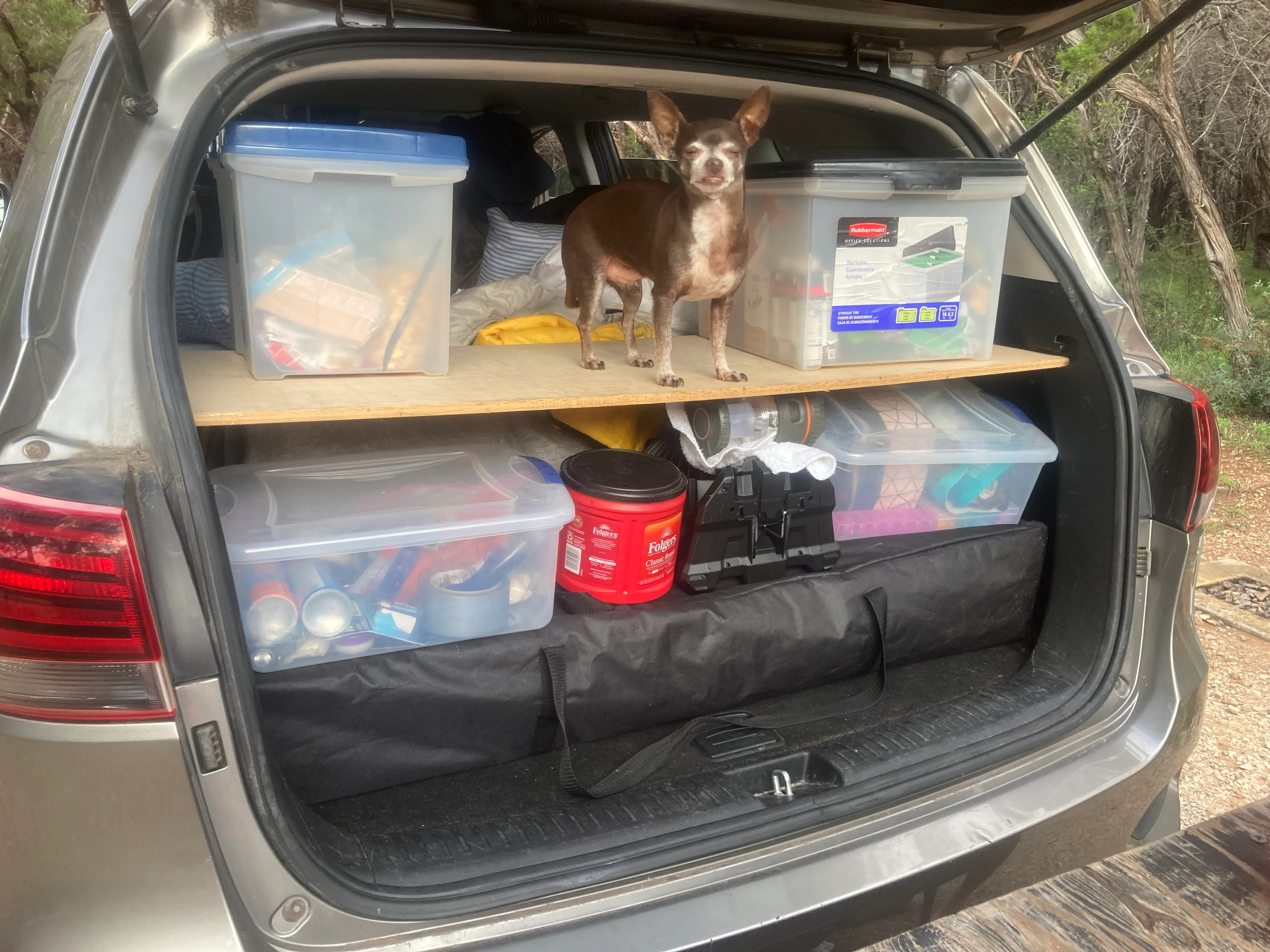
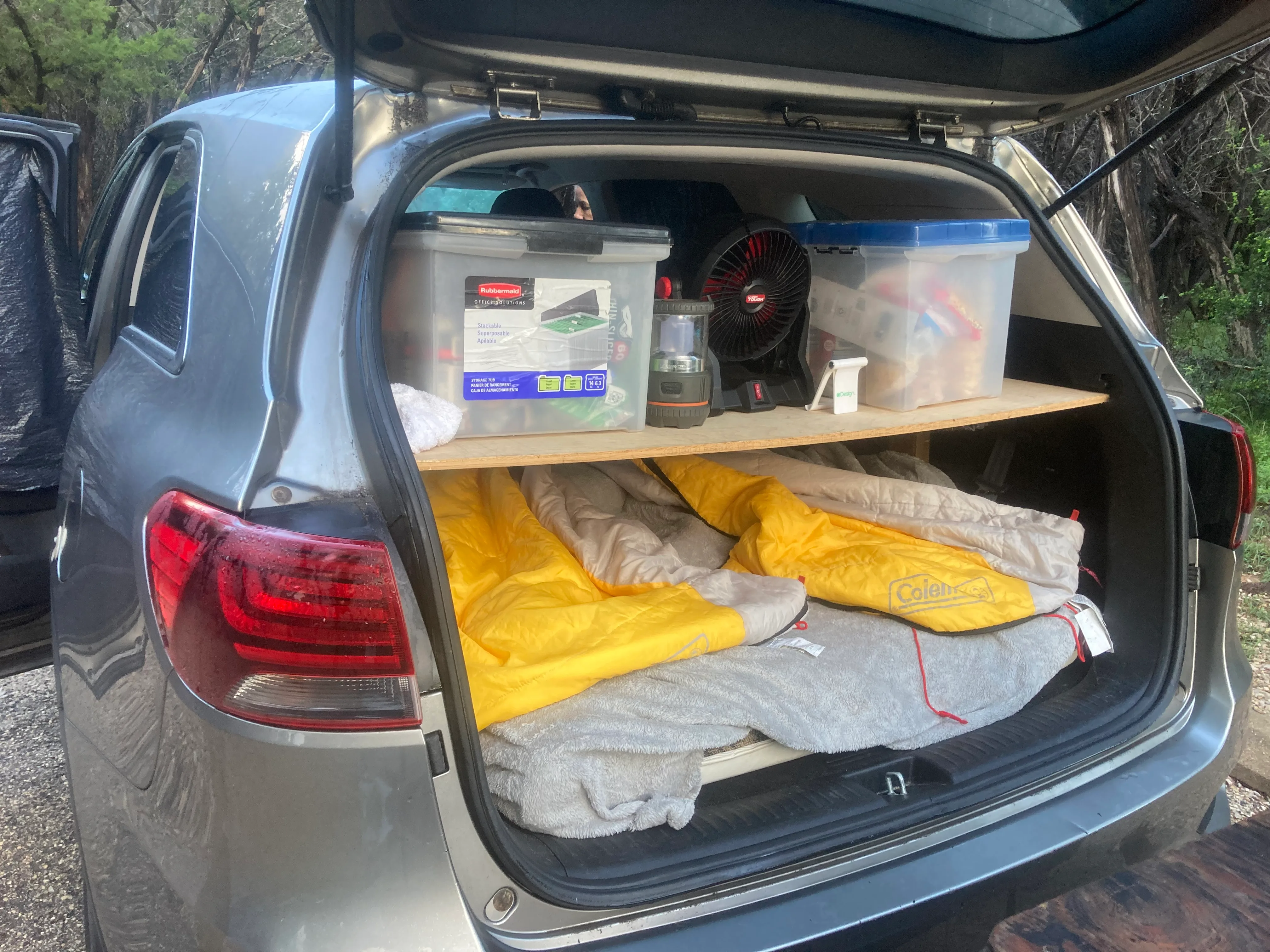
The sleeping surface is foam pads directly on the folded-down cargo floor. Rear seats fold flat, pads go in. That’s the bed — no elevated platform, no frame, no build project.
The shelf sits at the foot end. Your feet go under it while you sleep. Everything on the shelf is food, organized and out of the way, and it stays inside the car. Food never goes in the outside box. This matters in bear country, it matters in campgrounds where critters are active, and it’s also just simpler — you know where everything is and nothing gets rained on.
The food system:
- Dry box — cereal, bread, crackers. Anything shelf-stable that doesn’t need cold.
- Canned box — heavier items. Soups, beans, whatever you’re eating that night. Try to buy food you don’t have to cook or refrigerate.
- Soft-sided cooler — freeze large 1-gallon water bottles and use them as your ice. No melt water, no soggy food, no mess. When one thaws enough, you drink it.
Two notes on canned food: buy pop-top cans whenever you can find them. And bring a can opener anyway. You will eventually need it.
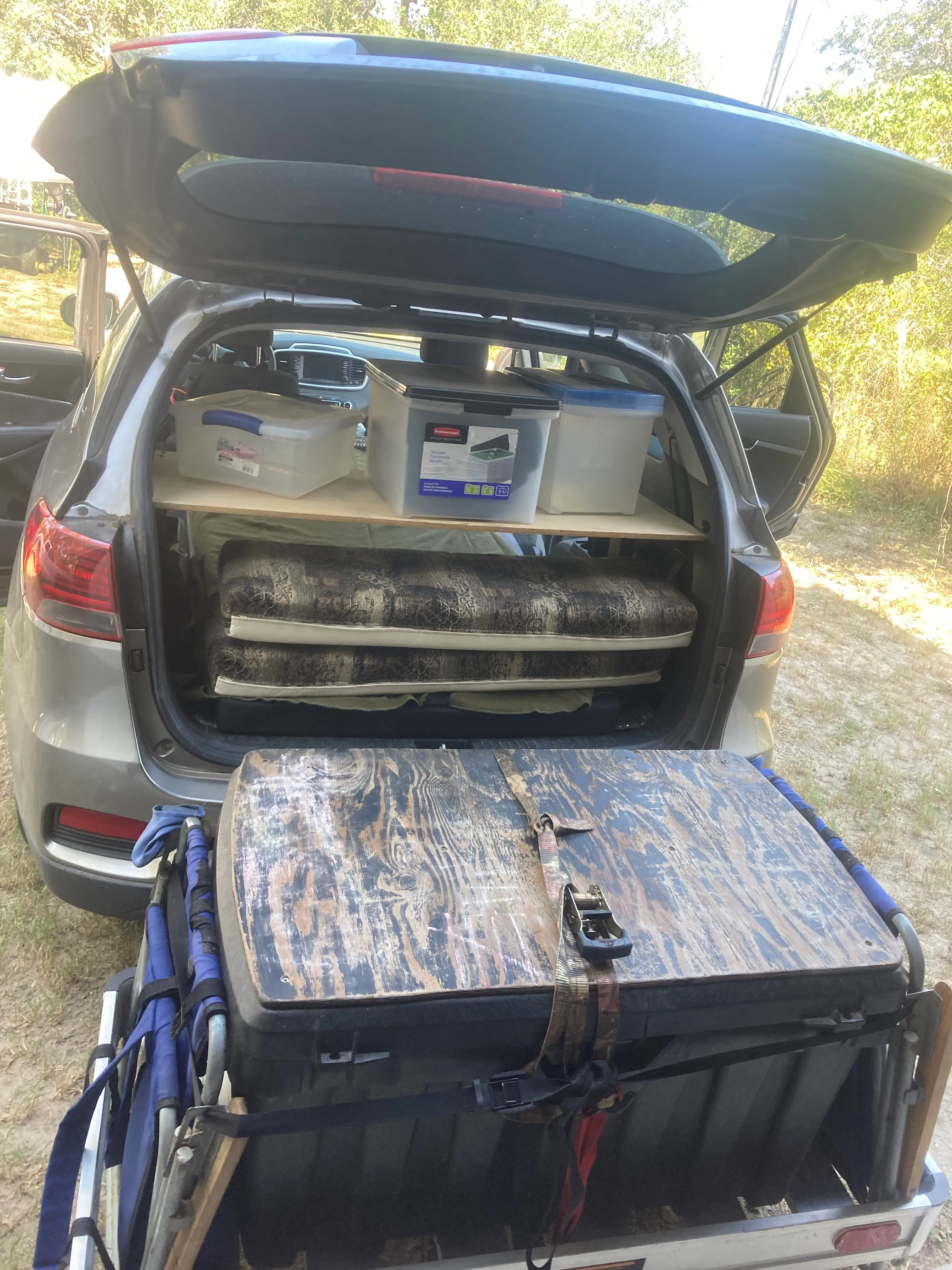
The outside box holds what you don’t want inside: dirty running gear, the camp burner (usually a single-burner propane stove, sometimes a double-top burner when the cooking situation calls for it), and anything that smells or takes up space. The burners fit in the box well. The food does not go in it, ever.
The Bathroom
The real hack here is site selection: always try to camp somewhere with a toilet. Compost toilets, pit toilets, vault toilets — all fine. This is a much easier problem to solve at the planning stage than at 2am in the dark.
What’s always in the kit regardless: toilet paper, baby wipes, and a small garden trowel. The TP lives in a repurposed coffee can with a lid — stays dry, costs nothing. The trowel is for emergencies only — dig a cat hole, bury it, cover it completely. I carry it because I’ve seen too many people who didn’t, and leaving waste on top of the ground is one of the worst things you can do out there. The baby wipes are for everything else. And this is non-negotiable: baby wipes never go into any toilet system of any kind. Doesn’t matter what the package says. They go in a zip-lock bag, then in the trash, then out of the forest with you. No exceptions, no arguing with the septic system.
For longer dispersed trips where there’s no toilet in range, a five-gallon bucket with layered trash bags handles it — full explanation in what nobody tells you about dispersed camping →. In car camping mode, the bucket isn’t really feasible. Which is why you pick the site with the toilet.
What Actually Earns Its Weight
After enough trips, the gear list collapses to the things you use every time and the things you bring every time but never touch. Ruthlessly eliminate the second category.
Things used on every trip:
- Headlamp on your head (not in a bag) — the Coast WPH20R is 2000 lumens and magnetic. Attach it to the ceiling of your car for a hands-free interior light.
- One-burner propane stove + fuel
- Pour-over coffee setup — non-negotiable
- Sawyer Picaridin insect repellent — doesn’t eat your car’s plastic trim or your glasses frames the way DEET does
- Rain shell — packable, in the door pocket, not in a bin
Things that sound essential but aren’t:
- A camp kitchen organizer (the bins do this)
- A fancy folding table (tailgate or a flat rock does this)
- A generator (a small power bank handles phone + headlamp; anything bigger means you’re not camping, you’re bringing your house)
Target the Weather
This one isn’t a hack — it’s the mindset. Car camping is a better version of itself when you pick the window instead of the weekend. The best camping trip you take this summer will probably not be on a Saturday. It’ll be the Tuesday-Wednesday window after a front moves through, when the overnight lows drop into the 60s, the campgrounds are half-empty, and the air smells like the rain that just cleared.
Watch the forecast. Hit the window. That’s the whole hack.
Find free dispersed camping on our explore map — filter by Free Camping to see National Forest and BLM sites where you can pull off a forest road and set up exactly like this. No reservation required.