The Pee Bottle Under the Bridge: Why We're Losing Our Freedom
The Pee Bottle Under the Bridge: Why We’re Losing Our Freedom
I was on my morning walk on the beach.
There’s a bridge near where we live on the Gulf Coast — the kind of spot where the water comes in quiet and you can watch the light come across the bay before anyone else is up. It’s one of the reasons we are out the door before dawn. We go for the silence and the birds and the water.
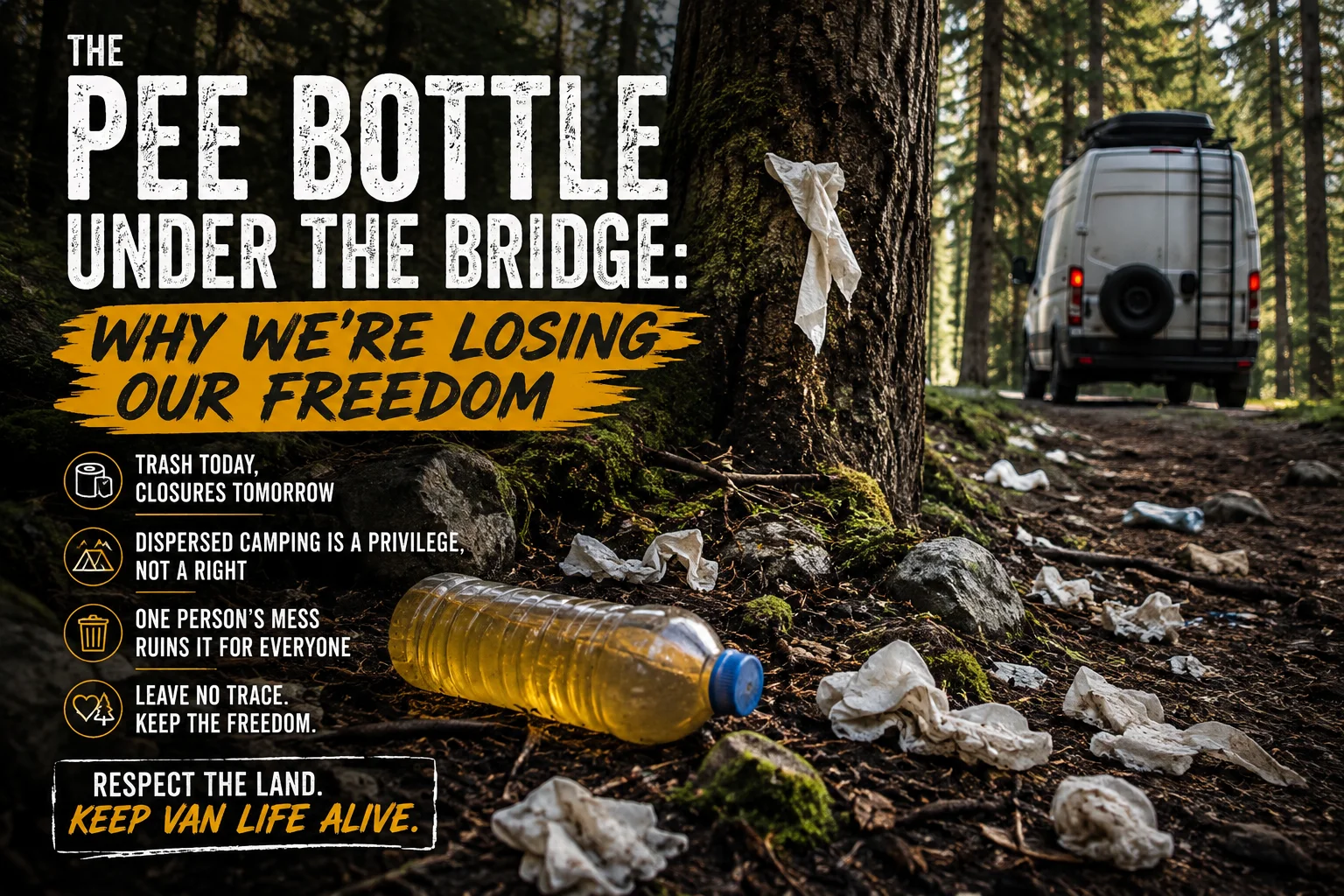
That morning I found the pee bottles.
Not one. Several. Lined up under the bridge as if someone had arranged them. Yellow plastic bottles full of human urine, left on a public beach as if somebody else was going to clean it up.
I have dogs with me. I walk this beach every morning. This is where I live.
That is what’s killing van life. Not the government. Not corporate campgrounds. Not local ordinances. The people doing it to themselves — and taking the rest of us with them.
Behind Every Tree
I’ve also been to national forests — the dispersed camping areas that are supposed to be the best kept secret in the outdoor world. Free land. No reservations. No fees. Pull off the forest road, set up camp, wake up with nobody within earshot.
Behind every tree: a pile of toilet paper.
Not one tree. Every tree. Years of it. Built up over seasons of people who couldn’t be bothered to bury it, pack it out, or apparently even think about the person who would come after them.
I have dogs. I’m crouching in the brush behind a tree and I find someone else’s waste — not buried, not covered, just sitting there with the toilet paper still on top of it. Years of that. Decades.
The land can absorb a lot. A person here, a person there, doing it right — the forest handles it. What the forest cannot handle is everyone doing it wrong in the same spots, year after year. And that’s exactly what’s happening at the popular dispersed camping areas across the country.
The Walmart Story
On the East Coast, Walmart ended overnight RV and van parking.
Not everywhere, not all at once — but location by location, the policy changed. And when you ask why, the answer isn’t complicated: people turned the parking lots into something nobody wanted to deal with. Trash left out. Waste on the pavement. Sites that looked, by morning, like something between a campground and a dumpster.
Walmart didn’t make a political decision. They made a math decision. The cost and headache of managing what was happening in those lots exceeded whatever goodwill they got from being van-life friendly. So they stopped.
The people who abused those spaces are long gone. They moved on to the next welcoming parking lot. And the thousands of van lifers who used those spots responsibly — who cleaned up after themselves, who were quiet, who were grateful — they lost access. Permanently.
That’s how this works. One group causes the problem. Everyone pays for it.
The Math Is Simple
Here’s what I want people to understand: this is not about feelings. It’s not about respect in the abstract. It’s math.
When a dispersed camping area becomes a cleanup problem, the land management agency has two choices: hire staff to clean it up at taxpayer expense, or close the area. Those are the options. And in an era of budget cuts and understaffed national forests, the answer is increasingly: close it.
When a beach parking area accumulates pee bottles and trash, the county has the same two choices. When a Walmart lot becomes a problem, the store has the same two choices.
The math always lands in the same place: if the freedom costs more than it’s worth, the freedom gets taken away.
The government isn’t the villain in this story. The villain is the person who decided that someone else would deal with their mess.
What Van Life Actually Requires
I love van camping. I want that freedom. I want to wake up in a national forest with nobody around and coffee on the stove before the birds start. I want to pull off a beach road and sleep with the windows cracked and the sound of the water. I want dispersed camping to exist in twenty years.
The only way it exists in twenty years is if the people using it act like they want to keep it.
That’s not a lecture. That’s math.
The basics — and they are basics:
Human waste. If there’s no toilet, you dig a cathole. Six inches deep, at least 200 feet from any water source, trail, or campsite. Cover it completely. Pack out your toilet paper — every single time. A small sealable bag weighs nothing. There is no version of this where you leave toilet paper on top of the ground and call it handled.
WAG bags. In high-use areas, desert environments, and anywhere the cathole rules are posted as restricted, you pack out everything. WAG bags (Waste Alleviation and Gelling bags) are available at most outdoor stores and on Amazon. They cost less than a dollar each. There is a right answer here and it’s not hard to find.
Pee bottles. If you’re using them at night in the van — fine. In the morning, you dump them in a proper toilet like a human being and rinse the bottle. You do not leave them under a bridge. You do not leave them anywhere. They go with you until you can dispose of them properly.
Gray water. Dish water, wash water, anything that goes down a drain — it doesn’t go directly on the ground at your campsite. Strain out the food particles and pack them out. Scatter the water well away from water sources.
Trash. Pack in, pack out. All of it. The beer cans. The food wrappers. The Amazon boxes from the last resupply. If you brought it in, you carry it out. This is not optional.
The campsite itself. Leave it cleaner than you found it. Not as clean. Cleaner. Pick up what the last person left. That’s the only way the math starts going in a different direction.
The Other Side of the Problem
I’ve also felt the other side of this — state parks and national parks so overrun they feel like you’re moving into a neighborhood. A small city. You came for nature and you got a traffic jam, a parking reservation lottery, and tour buses backed up to the entrance.
Why?
Because all the apps and travel blogs are pointing everyone to the same twenty places. The same trails. The same overlooks. The same GPS coordinates that look good on a phone screen. The land absorbs what it can — and then it becomes something else entirely.
I like to look for the path less chosen. Trek4Free is my tool to do that. I built it for myself, and I want to share it with you. Every time I get off the trail I see something I want to fix — another data source to add, a filter that would help, a place that should be on the map and isn’t yet. It’s not perfect. It’s a passion project built to simplify getting outside and remove as many headaches as possible along the way.
If You’re Bringing a Dog
I’ve walked trails in the last year — a lot of them — and every single one has a dog waste bag sitting on it. Not a few. Not occasionally. It is a trend now.
Someone on a remote beach in Oregon tried to do the “right thing” — picked up the waste, bagged it — and then left the bag on the beach. A plastic bag full of dog waste, on a remote beach, where it will outlast everyone reading this article.
Why?
The bag was already in your hand. That was the hard part. Carrying it back to the trailhead is not the hard part.
There is one acceptable answer: carry it out. The waste and the bag leave with you. Not near the trailhead. Not next to a tree where a trash can might someday appear. Out.
If you’re in genuinely remote backcountry with no facilities for miles, you have one other option — skip the bag entirely. Dig a cathole, same rules as human waste: six inches deep, 200 feet from water and trails, cover it completely. Waste buried properly decomposes. A plastic bag on the ground does not, ever.
What you cannot do — under any circumstances — is leave the bag. Not on the trail. Not on the beach. Not “close to” a trash can. It is asinine. It is worse than not picking it up at all, because now the land has the waste AND a plastic bag that will be there long after you’ve forgotten you were ever there.
The outdoors gives us everything worth talking about in this article. The least we can do is leave it the way we found it.
The Real Threat
The threat to van life isn’t zoning laws. It isn’t anti-camping legislation. It isn’t corporate landlords or government overreach.
The threat is the pee bottle under the bridge. The toilet paper behind the tree. The Walmart lot that looks like a pig sty at 7am.
Every time that happens somewhere new, another space closes. Another gate goes up. Another county posts signs. Another store changes its policy. And the people who did it don’t notice, because they’ve already moved on.
The people who notice are the ones who get there next and find the gate locked.
I want the freedom. I’ve built a whole site around finding the public land where that freedom exists. But I’ve also walked enough trails and beaches to know that the freedom isn’t guaranteed. It exists because someone decided to allow it, and it disappears the moment it becomes more trouble than it’s worth.
Act like you want to keep it.
Trek4Free maps free dispersed camping on public land across the country — find free camping near you. Read more about van life and the parking reality nobody warns you about.