We Got Kicked Out of Our Gym. Best Thing That Ever Happened to Us.
We Got Kicked Out of Our Gym. Best Thing That Ever Happened to Us.
There’s a specific kind of grief that comes with losing your gym family that nobody talks about. It’s not about the equipment. It’s about the people. The coach who knows your form faults. The person who cheers when you finally hit that PR. The weird intimacy of suffering through a brutal WOD next to the same faces twice a week for years.
COVID took that from a lot of people. It took it from us.
We loved our local gym. And then, overnight, we were out of it.
The Fire Department Back Porch
There’s a middle chapter nobody writes about: the stretch between losing a gym and deciding to do something about it. For us, that chapter was the fire department back porch.
Outside, which was fine. Free, which was fine. Not a long-term solution, which was obvious to everyone involved. You can push through a lot on willpower and improvisation, but you can only work out on a concrete porch so long before the limitations start to compound. The equipment isn’t there. The structure isn’t there. And eventually, the motivation to keep showing up to something that was never meant to be permanent starts to slip too.
At some point we looked at each other and made the call. We were going to build our own.
The Shop
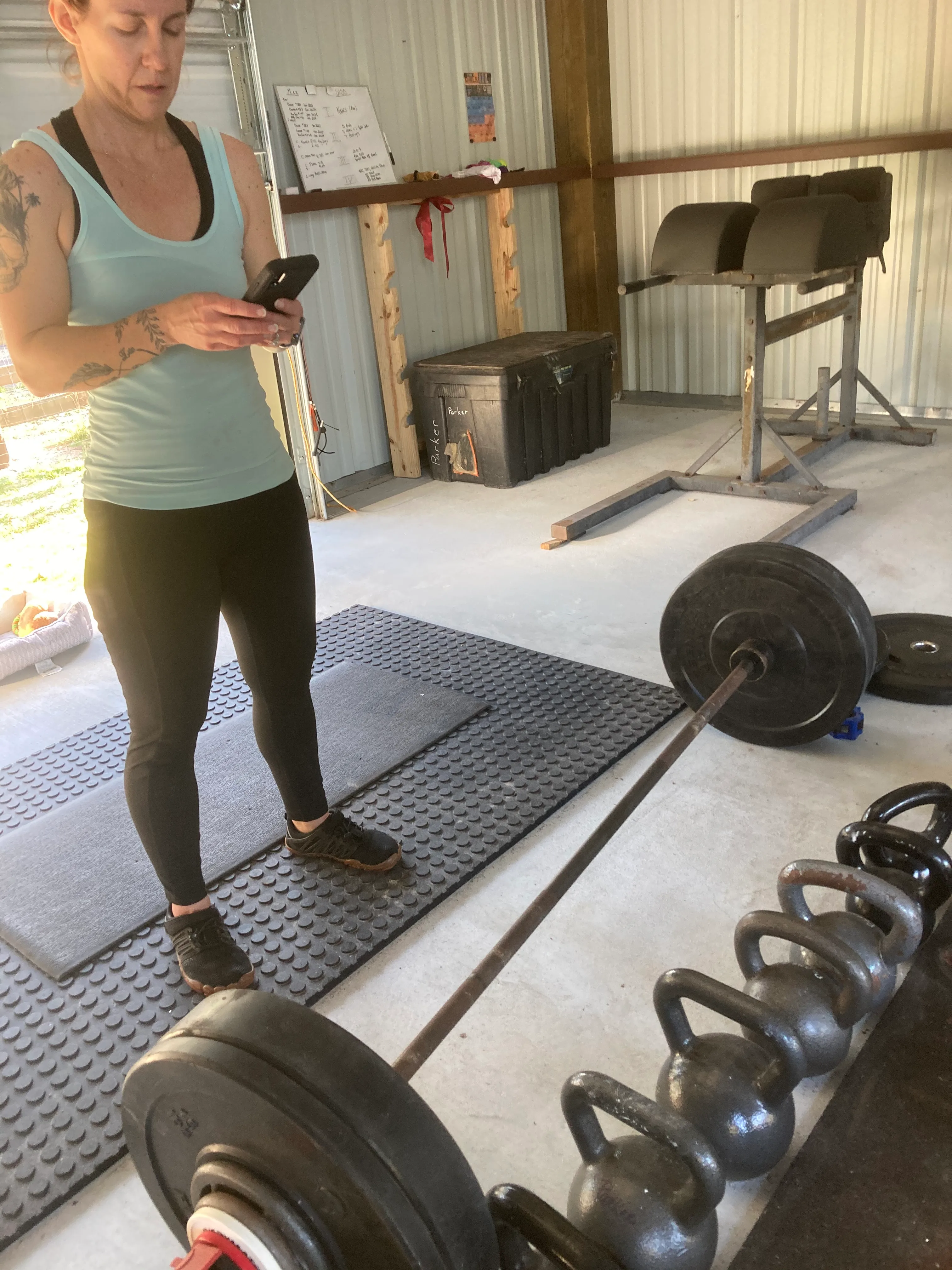
We’d been slowly collecting equipment for years before we had a place to put it. That’s how a lot of home gym stories start — a barbell in a closet, a few plates stacked against a wall, equipment accumulating faster than the space to use it. You keep your eye out, you pick things up when the price is right, and you wait.
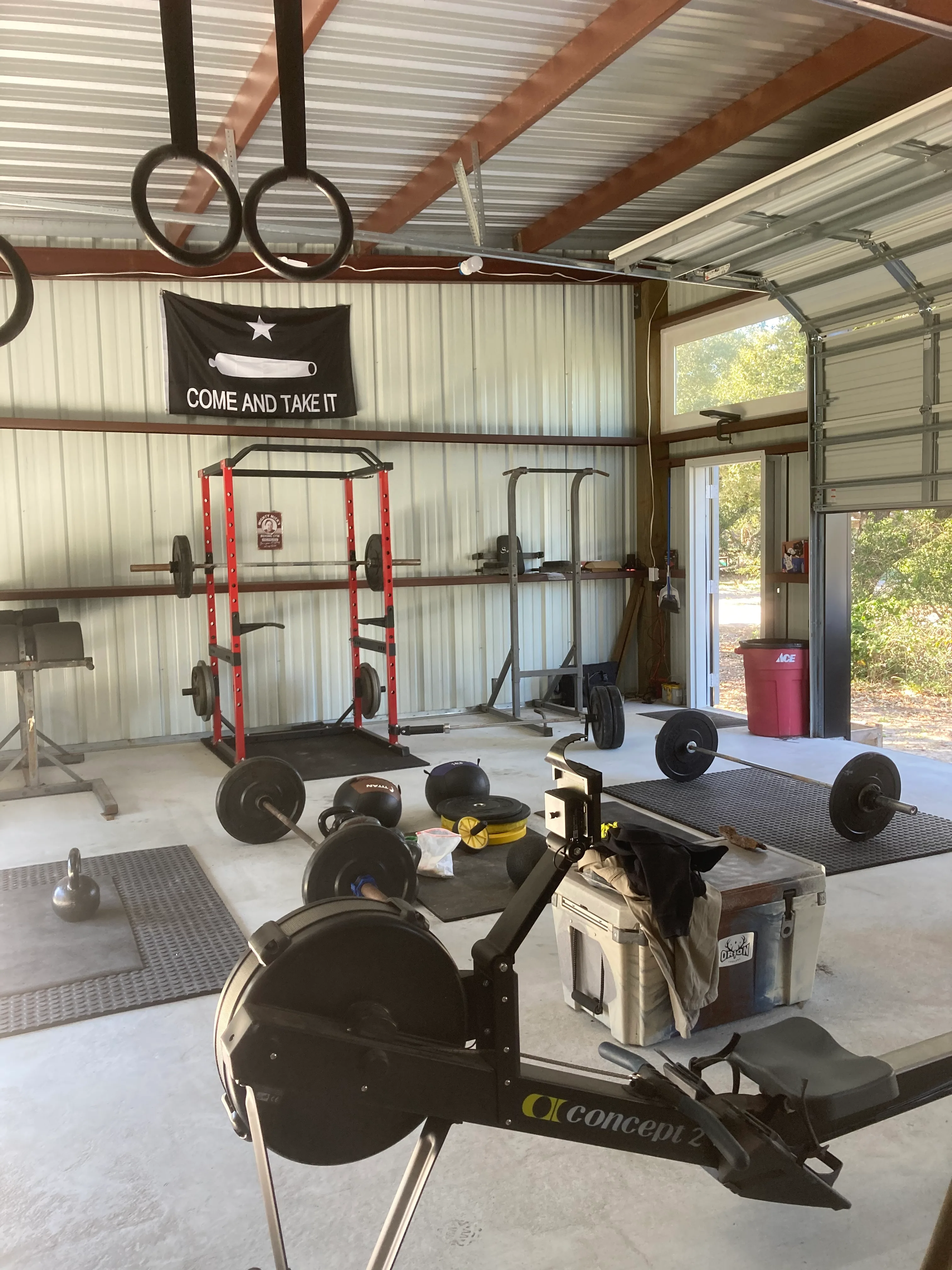
When we built our shop — a 24-by-40 pole barn on a concrete slab, $33,000 all in — half of it became gym. That wasn’t a plan we debated for long. It was obvious from the first day that half of that building had one job.
The shop side has a purpose. The gym side has the only purpose that matters to us every afternoon.
The Floor
Before anything else, put down rubber.
We use 4-by-6 stall mats as our lifting surface — horse stall mats from the farm supply store, not branded “gym flooring.” They’re thick, they grip, and they’re indestructible in a way that nicer-looking products tend not to be. You can drop a barbell on a stall mat and not give it a second thought.
We run rubber bumper plates specifically because we can drop them. That’s the feature — when the lift calls for it, you drop it. You don’t calculate whether the floor can handle it. You just lift.
What’s Actually In Here
Olympic bar and rubber bumper plates. Kettlebells in multiple sizes. A squat rack that doubles as the pull-up bar. Gymnastic rings for pull-ups and muscle-ups. His-and-hers wall balls and slam balls — yes, we each have our own, because sharing equipment mid-WOD is a good way to argue about weights.
Then there’s the Concept 2 rower.
I spent years coveting those machines. Watching Marketplace. Refreshing the listing, calculating whether a particular used one was worth the price and the drive. A Concept 2 is the kind of rowing machine that holds its resale value like it knows it’s good — the used market price doesn’t move much because people who own them don’t give them up easily.
During COVID, something unusual happened: the manufacturer’s price dropped below the used market. We reached out to Concept 2 directly and ordered one new. It arrived and it has been magnificent. I love rowing. That machine was a long time coming and worth every year of waiting.
Then there’s the airbike.
We have one. We hate it. We lovingly refer to it as the bike from hell — there’s a less polished version of that name we use in private, but this is a family blog. The airbike works because it is genuinely terrible in exactly the right way: the resistance scales with your effort, meaning the harder you push, the harder it pushes back. There is no coasting. There is no easy setting. There is just you and the bike and the suffering you’re choosing to create.
We use it every week. We hate it every time.
The $30 Find
This is still the part of the story that gets us.
A GHD — a Glute Ham Developer, the padded machine in CrossFit gyms that looks like something out of medieval history and makes grown athletes question their decisions — typically runs anywhere from $600 to $2,000 new. The quality ones go for more.
We were driving past a gym that was closing. Just happened to be going by. Saw the sign.
We stopped.
The GHD was sitting in the lot. Under thirty dollars. The pads were ruined — years of heavy use had done what years of heavy use does — but the frame was solid. We got it home. Sourced replacement pads. Did some creative problem-solving on the upholstery. Now we have a GHD that works as well as anything you’d buy at retail for a fraction of the price.
That’s the equipment philosophy in one story. Know what things are worth. Keep your eyes open. Move fast when the opportunity shows up.
The CrossFit Part
We’ve been doing CrossFit since 2008. Self-taught, almost entirely. We went through one affiliate gym — the one we lost to COVID, the one we miss — and worked out at one other once. That’s it. Everything else we’ve figured out ourselves.
CrossFit, if you’re not familiar: it’s a blend of Olympic lifting, plyometrics (bodyweight work — push-ups, sit-ups, pull-ups, that kind of thing), and conditioning. Sprints. Tire pulls. Lactic acid workouts designed to push your system to the edge and teach it how to recover. The combination changes what your body can do in a way that single-discipline training doesn’t.
We started with the daily WOD from crossfit.com — the free daily workout they post, which is an excellent starting point and a legitimate way to learn the movements. As the years went on and our experience grew, we started developing our own workouts. That’s where we are now. We know what our bodies need, we know what the movements are, and we build the session for that day.
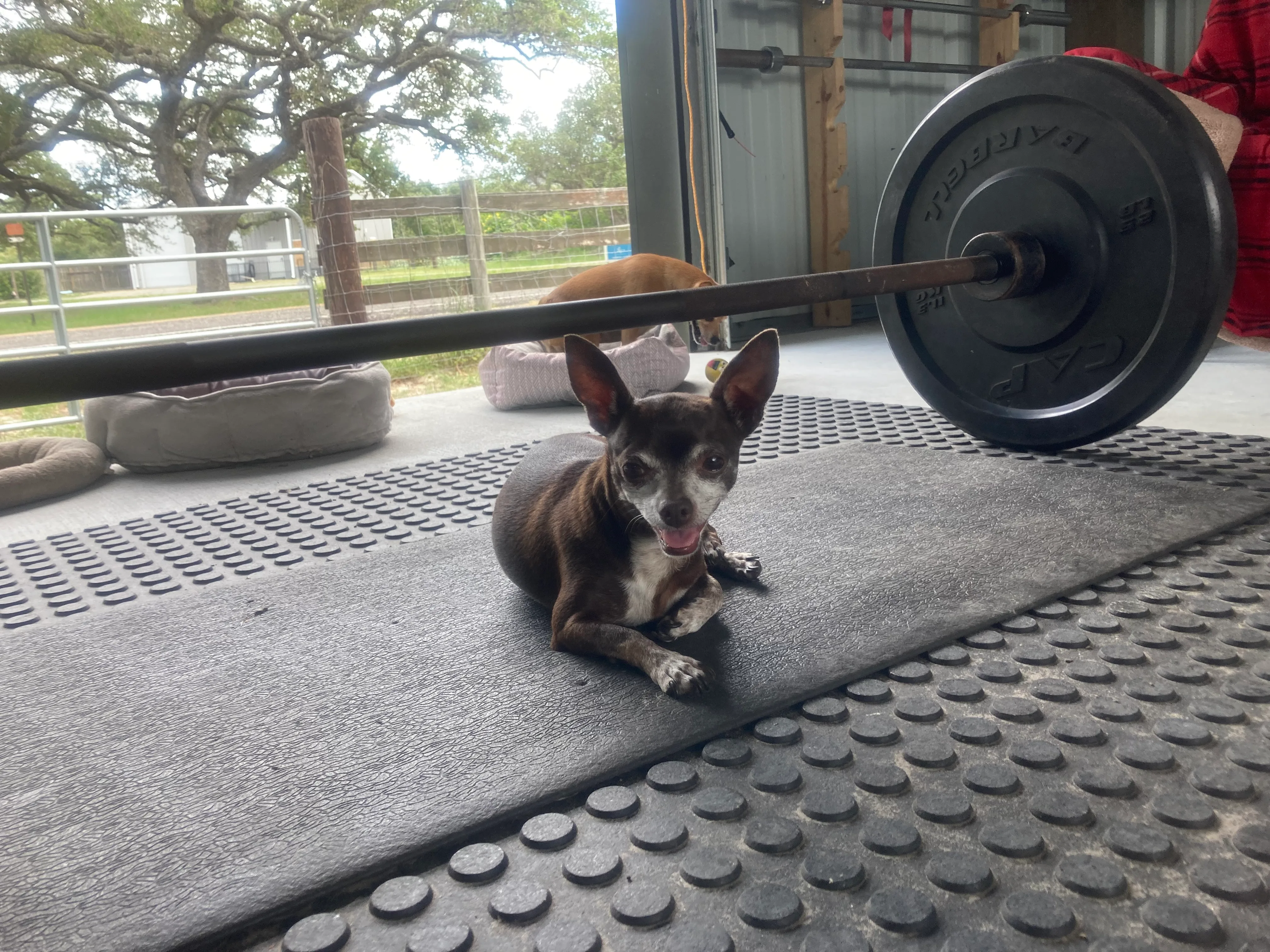
People ask about working out with us. We don’t say yes often, and here’s the honest reason: the movements in a CrossFit-style training program — Olympic lifts especially — require core strength and body awareness that isn’t built in a day. It’s built in hundreds of sessions, slowly, over time. The strength you need to do these movements safely is exactly the kind of strength that doesn’t show up until you’ve been putting in the daily reps.
When someone tries to jump in, they get hurt. Not because we’re doing anything extreme — it’s because they haven’t been building the base. We’ve put in eighteen years of daily work. That gap is real, and we’re not willing to be responsible for the injury that happens when someone skips it.
We’re also just a really good workout team with each other, and there’s a flow to how we train together that adding a third person disrupts.
The People
A gym without people is just a room with equipment in it.
We do this together, which changes the math entirely. There’s an accountability built into having a training partner who lives in the same house — you can’t quietly skip a WOD while the other person is already walking out to the shop. The friendly competition. Coaching each other through a movement. The moment when someone finally hits the lift they’ve been chasing.
That was what we lost when COVID closed our gym. We’ve rebuilt a version of it here — smaller, more personal, ours.
We organize the sessions so we’re not in each other’s way. While one of us is on the GHD machine, the other is running 200-meter sprints around the property. Different stations, different movements, same clock. No waiting around for the other person to finish a set so you can swap weights. The WOD flows.
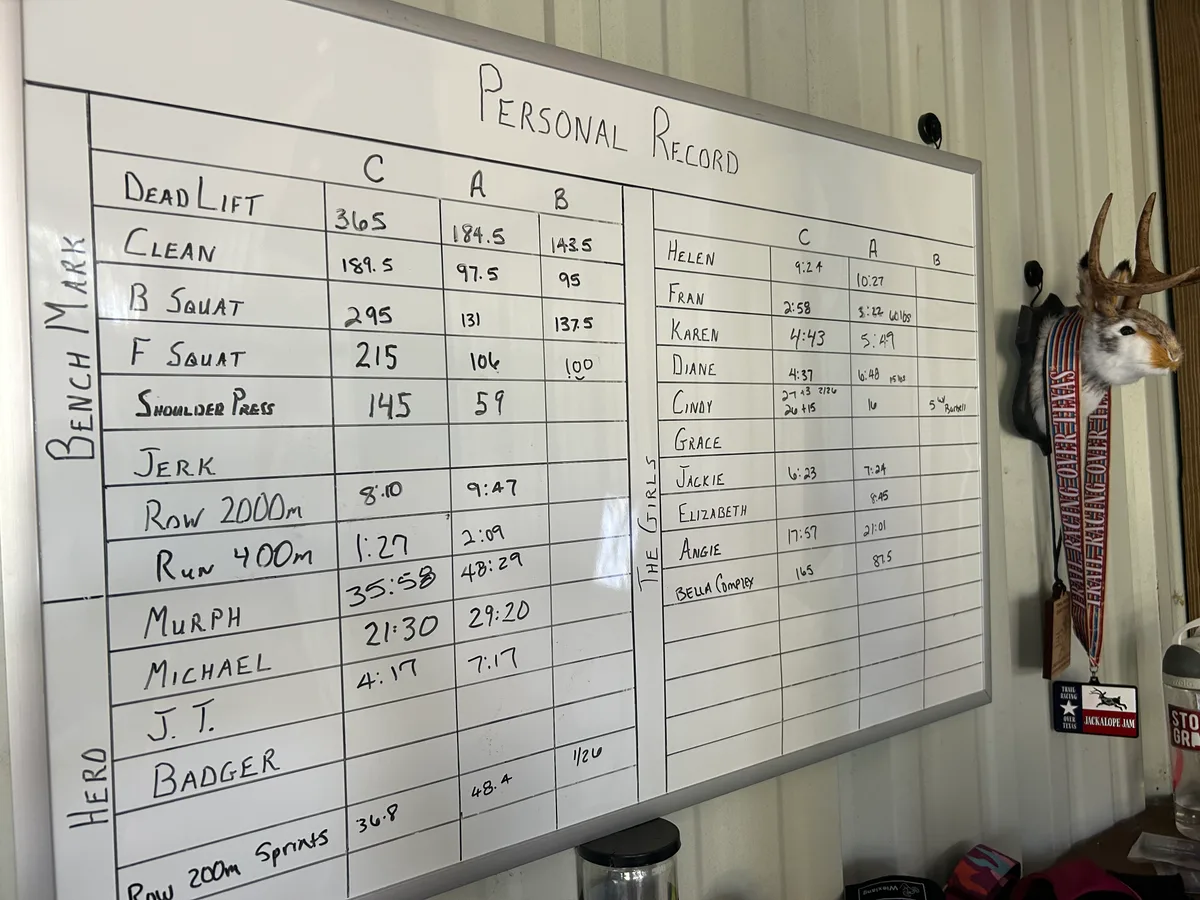
The PR board is the most important thing in the gym. Not the rower we waited years for. Not the GHD we found for thirty dollars. The board.
Every personal record goes up on it. Every best score, every milestone — on the wall. That’s the record of what this gym has built. That’s what eighteen years of showing up looks like.
You can buy equipment. You can’t buy that board. You have to earn it one session at a time.
The Climate Problem
The primary winds where we live run north-south. The bay doors are oriented along that axis on purpose. Open both of them and you get a through-draft that makes a Texas summer afternoon workout survivable. Not comfortable — survivable. There’s a difference, and we’ve learned to be okay with it.
When it’s cold, we close the doors and run a propane heater. Polly does not do cold voluntarily. This is a documented and uncontested fact about our operation.
The Daily Anchor
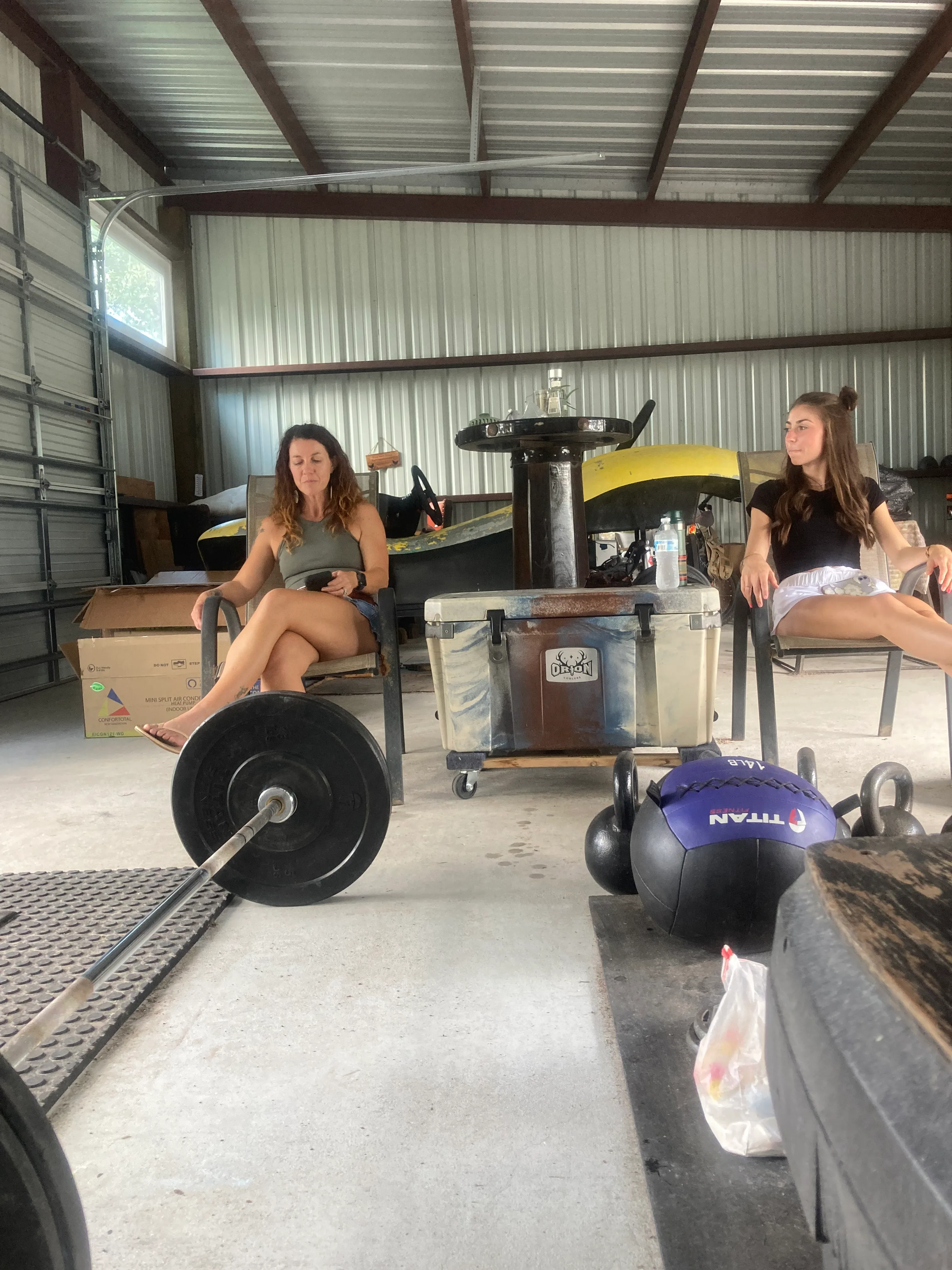
The gym anchors the afternoon. We wrap up whatever we’re working on, walk out to the shop around 4pm, and do a WOD. An hour. Quick, focused, done.
It’s not about the hour. It’s about what the hour does to the rest of the day — and to everything after it. The clarity that follows hard effort. The way a sunset walk at 8pm lands differently when you’ve already moved twice. The compounding effect of showing up every day to something that asks something of you.
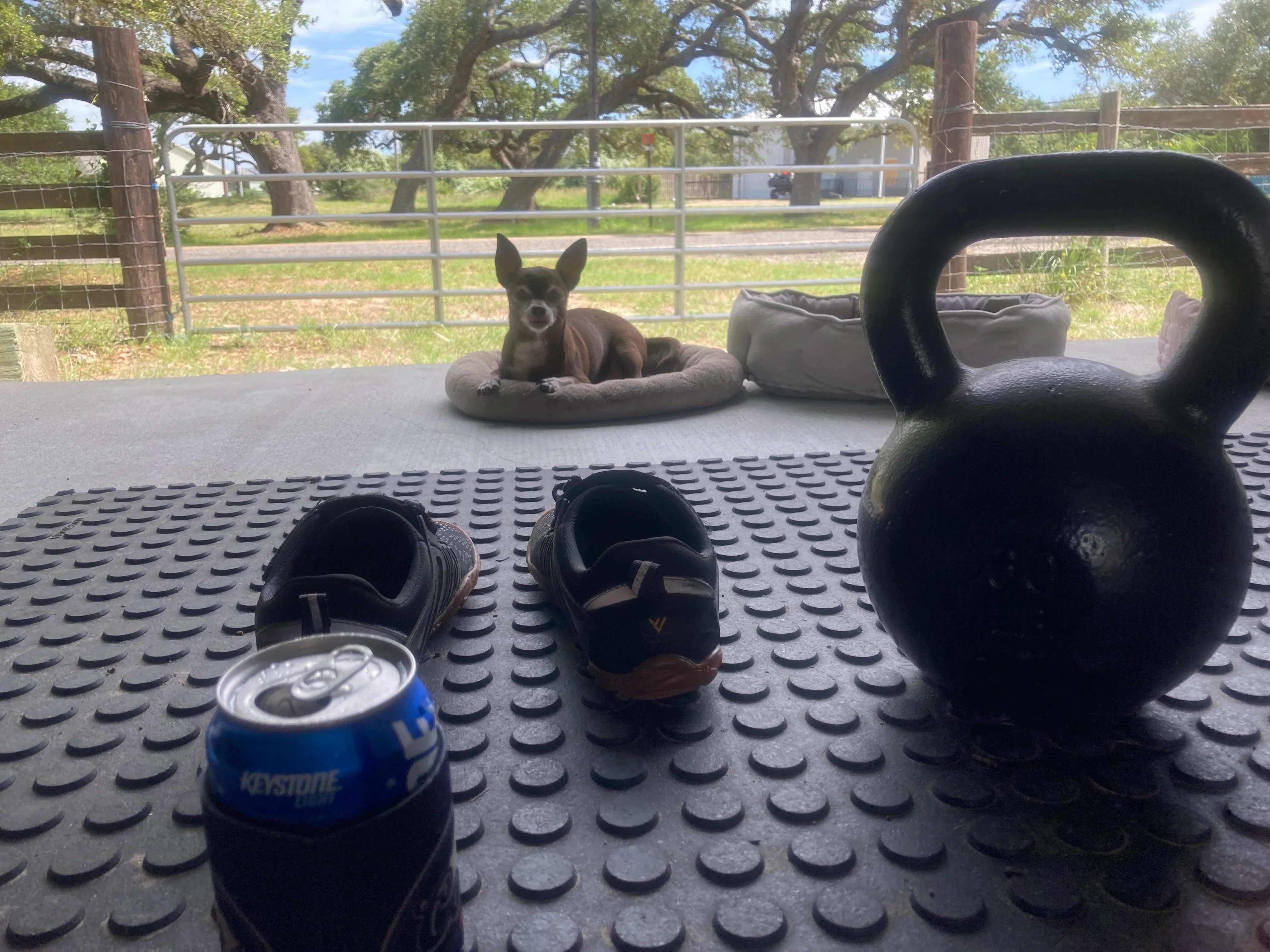
The workout changes every day. The commitment doesn’t. That’s the whole thing.
What We Actually Learned
COVID pushed us out of something we loved. We ended up somewhere better.
Not because a home gym is objectively better than a good box — it isn’t. The coaching, the community, a room full of people all suffering through the same thing at the same time: you can’t fully replicate that. We had it, and we know exactly what we lost.
But we built something with intention. On our schedule, in our yard, in a space that exists because we decided it needed to. We can open the bay doors to a cross-breeze. We can drop a barbell without worrying about it. We can be there at 4pm or 6pm or 6am or whatever the day calls for.
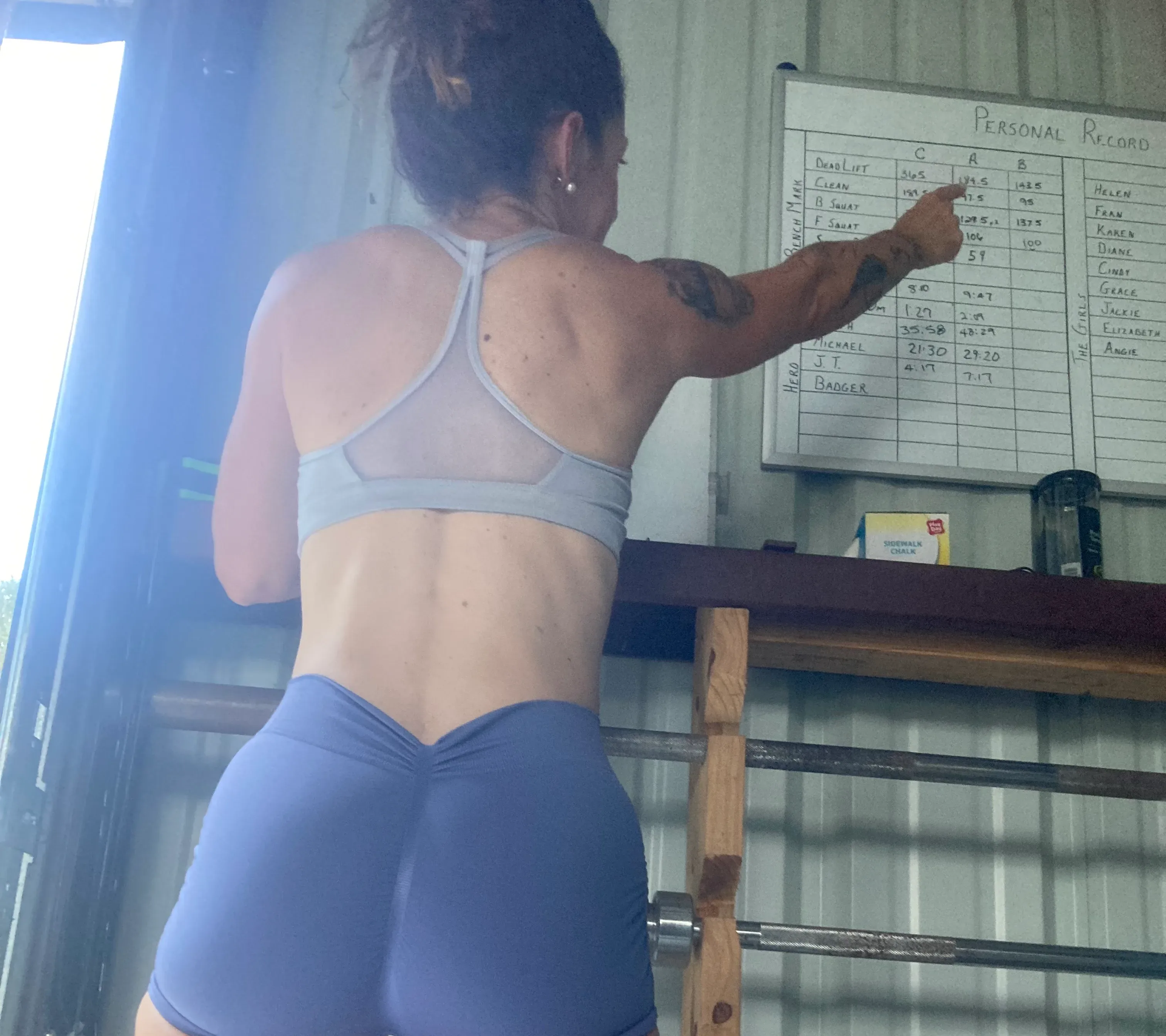
The shop cost $33,000. The gym half of that is worth every early afternoon we’ve put in out there since.
The Starting Gear
If you’re building your own, here’s what we’d tell you to look at first:
- Concept2 RowErg Indoor Rowing Machine — $990 · 4.9★, 13k ratings — the machine worth waiting for
- REP Fitness GHD — Commercial Grade — $479.99 · we got ours for $30 at a closing gym; keep your eyes open
- Marcy Air-Resistance Fan Bike — $255.99 · the bike from hell. You’ll hate it. Get it anyway.
- CAP Olympic Barbell — 7ft Classic — $79.99 · Amazon’s Choice, 4.7★
- CAP 2-Inch Olympic Bumper Plate Set — $194.99 · rubber, drop-safe
- Clout Fitness Quick-Release Barbell Collars — $15.95 · 27k reviews, they work
- Amazon Basics Cast Iron Kettlebell — from $17.99 · #1 Best Seller
- Titan Fitness Wall Ball — 10 lb — $54.99 · soft leather, built for wall ball throws
- Slam Ball / Medicine Ball — 10 lb — $25.99 · dead-bounce, for WODs
These are affiliate links — we earn a small commission at no extra cost to you. We link to gear we actually use.
The gym is one anchor in the daily routine — morning walks, the WOD, the sunset walk. It’s all part of how we stay ready for whatever the trail asks of us next.